Labels

Showing posts with label L P Doo. Show all posts

Tuesday, 6 June 2023

Luang Pu once told a story,

Luang Pu once told a story,


“There was a monk who practiced meditation until his heart became peaceful. When his citta converged into samadhi, there was a nimitta (vision) that arose where he saw a hundred Buddhas walking to meet him. 

This monk was very delighted and overjoyed to have this experience. After his meditation was over, he wanted to tell everyone about it. 

So early in the morning, he went to talk to his fellow meditators and tell them about the results of his practice. 

But after that, even with his persistent effort in meditation for about a month, he was unable to attain the peaceful samadhi that his citta had converged into like before.”

Luang Pu then advised that, “It is important to keep in mind…most people who know how to do something, usually they would not speak about it. 

Whereas many people who talk a lot [about their experiences], they are still unable to do it.”


Luang Pu Doo Prompanyo

Wat Sakae, Ayutthaya Province


Cr. “Following the Dhamma, in the footsteps of the Teacher”


9 June 2023


Monday, 26 September 2022

Benefits of placing monk photos around

Benefits of placing monk photos around


Traditionally in the past at Wat Sakae, Luang Pu taught that one must calm one’s mind first (samatha) before practising Vipassana (insight) meditation. Holding the amulet in one’s hand, we sit in a proper meditation posture and recite Buddham Saranam Gacchami until the mind becomes one-pointed. 

However, Luang Pu knew that for many people, it is not that easy to enter samadhi and make one’s mind one-pointed. On some days, we might feel that the breath or katha recitation doesn’t work. 

Instead of giving up, Tahn taught that if one is feeling very restless, distracted or just out of sorts, you can use certain techniques to calm the mind such as looking at the Buddha’s photo or imagine a monk in front of you, reciting Buddham Saranam Gacchami together with you. 

These are just skillful means to encourage faith and help one’s mind calm down.

But Luang Ta adopted this technique and used it as the focus of his meditation. As a layman, he had great faith in Luang Pu. He carried a photo of Luang Pu in his pocket everywhere he went. Even in his house, he put Luang Pu’s photo on his walls everywhere. 

Even when he was alone in Muang Na cave, he used the amulet that Luang Pu gave him (I heard from a disciple that it was a big palm sized one) as an object of meditation. 

Eventually, he was able to connect to Luang Pu’s stream of energy, which was useful for Luang Ta to spread merit and energy to spirits around him and help them to cross-over. 

Luang Ta taught that as long as one’s mind is with Luang Pu, you are already gaining merit. 

It is better than thinking about unskillful things all day long.

And for those who have more developed senses, Luang Ta taught that they can perceive that the Bodhisattas’ and Arahants’ photos emit light and positive energy. Put photos of the Phra around a dying Buddhist and they can follow the light after they pass on. 

Except that the aura is a bit different. Photos and amulets of Arahants have a clear, calm, crystal-like energy, whereas the auras of Bodhisattas are more lively and energetic because they are still around in Samsara, and are ever ready to help us. 

Luang Ta mentioned that the photos of Luang Pu are "alive”. This is the same reason why if you ever go to Luang Phor Kuay’s temple in Chainat, you will see a long queue (even on weekdays) where devotees from all over Thailand come to Wat Kositaram to invite a photo of LP Kuay home. 

And to be very honest, LP Kuay’s followers are even more devoted to LP Kuay’s photos than LP Doo’s devotees. You won’t see hordes of people rushing to invite LP Doo’s photos at Wat Sakae, even though they are readily available at the amulet counter 😅


Tuesday, 19 April 2022

Teaching of Luang Pu Doo

Teaching of Luang Pu Doo


Once there was a luksit of Luang Pu Doo who was just sitting by his kuti and chatting with him. 

The devotee told Luang Pu that he would like to share a story, and Luang Pu was all ears. The story went like this. 

It is commonly known that the great forest monk, Luang Ta Maha Bua was a strict monk who expected no less of his disciples. There was a time when Luang Ta noticed one of his disciples slacking off instead of putting full effort into the practice. Luang Ta questioned him as to why he was being so lazy and heedless. 

The disciple replied, "I am waiting for the dispensation of Phra Sri Ariya Metteya (Maitreya Buddha) so that I can be enlightened then."

Luang Ta replied back in a loud voice, "If you are good-for-nothing in this life, in a future life you won't achieve anything either! Even if you are born in the dispensation of a future Buddha, useless people have no chance of attaining the true Dhamma!"

Luang Pu Doo listened to this story and laughed in agreement. He said that it is indeed true. 

People who made a vow and received a prophecy from a Buddha to be enlightened during a future Buddha's dispensation must continue to work hard and accumulate their parami. It is not a matter of sitting around and waiting for the next Buddha to appear some time in the distant future. 

And for those who are practising to escape samsara immediately, Luang Pu often encouraged his disciples to practice hard so that they may attain, at the bare minimum, the fruit of stream entry (Sotapatti Fruition), because only then will the roads to the four unfortunate realms be shut off permanently. 

For the rest who made a wish or vow to follow Phra Sri Ariya Metteya, please continue to work hard and perfect your spiritual parami! Always keep Phra Jakkapat, Luang Pu Thuad or Luang Pu Doo in mind. 

1. Dāna pāramī: generosity, giving of oneself

2. Sīla pāramī: virtue, morality, proper conduct

3. Nekkhamma pāramī: renunciation

4. Paññā pāramī: wisdom, discernment

5. Viriya pāramī: energy, diligence, vigour, effort

6. Khanti pāramī: patience, tolerance, forbearance, endurance

7. Sacca pāramī: truthfulness, honesty

8. Adhiṭṭhāna pāramī : determination, resolution

9. Mettā pāramī: goodwill, friendliness, loving-kindness

10. Upekkhā pāramī: equanimity, serenity


Wednesday, 13 April 2022

Songkran Festival

Songkran Festival


I would like to wish all brothers and sisters in the Dhamma a happy Songkran 2022. May all of us receive the baramee of the Bodhisattas and flourish both in the Dhamma and in our worldly life, so that we are able to support the Buddha Sasana. 

This photo is of Luang Pu’s looksits preparing to bathe him. In the earlier days, Luang Pu had metta and allowed his disciples to bathe his whole body instead of just the hands, as we customarily do for our elders today. 

Regarding the bathing of Luang Pu, when Luang Pu got up from his seat to bathe in the water, people would bring their hands to touch the water that remained on the wooden floor and then sprinkle on their head. Everyone had a lot of faith in Luang Pu. 

But all these are merely customs. To show real respect to Luang Pu, it is important for us to pawana and suat mon. 

Photo cr. Sith Poror

Songkran Festival

https://en.wikipedia.org/wiki/Songkran_(Thailand)


Sunday, 3 April 2022

Luang Pu Fpo

In Thailand, inseparable couples who love each other very much often go and make merit together. Customarily, the power of merit performed can usually help one to fulfil one’s wishes. 

That is why we adithan after we have completed a meritorious act of dana or pawana. 

So these couples would often pray to tie their fates with one another, regardless of whatever world they will be born into or whichever future life they would be reborn to live. But this is not an aspiration or determination (Adhiṭṭhāna) based on right view of impermanence that all things rise and fall in accordance with cause and effect. 

Luang Pu Doo forbade his disciples from adhitthaning in this way. Luang Pu advised that as time passes, each individual may develop differently. One may become more mature and spiritually developed than the other. Therefore a married couple shouldn’t be seen as equals in terms of the Dhamma. 

When a married couple finished making merit with Luang Pu and were preparing to adithan, Luang Pu spoke up, “Husband and wife don’t have to pray to be together. Because such a determination will pull both of you together. If one can go and the other can’t, then both of you will be stuck together.”

Luang Pu is saying that as practitioners aiming towards enlightenment either in this life or perhaps many lifetimes later, we should not be making determinations that may manifest as obstacles to our Dhamma practice in the future, increasing our attachments and burdens in Samsara.


Thursday, 31 March 2022

Meditation method

Meditation method.


All meditation methods have their own advantages and disadvantages, and they suit different people of varying dispositions and inclinations. But perhaps let me explain more about why I switched to using Luang Ta’s method. 

Earlier I mentioned that I originally practiced with Phra Maha Winyoo, who focuses on the breath. This explains his new centre’s name, Anapanasati Bhavana Centre. Now focusing on the breath is excellent, because it can be used to enter samadhi, jhana or following through with the 16 steps, can be used to practice the 4 Satipatthanas leading to the development of Vipassana insights. 

So why did I switch to using Luang Ta’s method? 

Having been through the Singaporean education system, I find that many of us, including myself, we tend to think a lot. This is because we are taught to examine everything critically and analytically, whether at school or at work. Or perhaps we face all kinds of different stresses and worries, because there are just too many things on our plate at one time. 

I’m sure many brothers and sisters who are still studying or working can understand. Now if our mind is troubled and plagued with anxieties, or too many worries, it is very difficult to work with the breath. 

The breath is more subtle in nature. After a day’s work, even if we are not thinking of too many things, we may be just physically and mentally exhausted and fall asleep easily if we focus on the breath.

But Luang Ta’s method is different. I may not have expressed myself clearly via past posts, but the secret to this method is not the Maha Jakkapat katha. Rather, the secret is to look at Luang Pu’s (or any other Bodhisatta’s) photo. When you gaze at his image for a while, Luang Pu’s picture will naturally imprint on your mind, even if you close your eyes. You can try it. It is similar to using his photo as a Kasina meditation object. 

So whether you open or close your eyes, you can see Luang Pu in your mind’s eye. Don’t concentrate too intensely, just gaze gently as though you are looking at your beloved grandfather’s photo. Relax both the body and mind. Take it easy and sit comfortably. You may chant any katha or mantra you prefer. 

Now why do we chant the Jakkapat katha? Luang Ta once asked Luang Pu, you taught everyone to recite the Three Refuges, but what if I want something more powerful? 

Luang Pu told him that if you need energy, you can chant the Jakkapat katha instead. So Luang Ta switched from the Three Refuges to the Jakkapat Katha, which enabled him to accomplish his Bodhisatta mission of crossing over lost souls and amassing baramee. This explains why he is so successful today, even though he started off from a remote cave along the border next to a very poor village. 

Because Luang Ta is a Bodhisatta and has to help many beings, so he needed as much energy as possible to do so. Hence he used the Jakkapat katha. If any brother or sister has great dreams to help people or to do good for the world, then you are advised to chant the Jakkapat. 

Otherwise, any other katha will do. 

My experience is that when we practice in this manner, it is less likely for us to fall asleep or to get carried away by our thinking. Because our mind is always with Luang Pu throughout the day. Even if we are busy, we can still look at Luang Pu’s photo and remember his face. When you are mindful of a Bodhisatta, the Bodhisatta will be mindful of you. That is why many people who recite Guan Yin’s name get miraculous responses. 

We give and dedicate our lives to Luang Pu, to the Bodhisattas, for the sake of helping the Buddha Sasana and sentient beings. We don’t do it for selfish reasons to become rich or famous, but we do it to cultivate affinities, to give others who are suffering some inspiration, some motivation, some comfort, some assistance. 

If we face suffering in this life and we have no way out, then we must dedicate ourselves to Luang Pu, and constantly recollect him. Many people with all kinds of problems have come to him, and Luang Ta says the answer is to always recollect Luang Pu and to constantly pray. If our own boon-baramee is weak, then we need to rely on Luang Pu's. There will be a solution to every problem. 

And most importantly, we give our mind a break. Instead of always getting lost in thought or ruminating on our problems, we only have Luang Pu on our mind.


Sunday, 27 March 2022

Luang Pu Doo

Luang Pu Doo


Luang Pu Doo understood the differing natures of people who came to visit him, and had metta towards everyone. While he encouraged his disciples to practice, one devotee replied, “How can I practice and keep the precepts when I still like to drink alcohol?”

Luang Pu replied, “Well, if you want to continue drinking then you just go ahead. I don’t mind. However, I do just ask you to meditate for 5 minutes a day. That is enough.” 

The alcoholic couldn’t argue with Luang Pu because he felt that meditating for 5 minutes a day wasn’t too difficult. So he gave Luang Pu his word and departed. 

This man was a person who was true to his word and true to himself, so he did practice consistently without missing a single day. On occasion, he even refrained from drinking with his friends because he realised it was time for him to meditate. Soon, his mind became accustomed to the peace and tranquillity that arose during meditation, and eventually he gave up drinking without realising it. 

Later he had a chance to meet Luang Pu again, and Luang Pu told him, “I asked you to practice, know that this is for your own welfare and not mine.” 

With the faith and perseverance to practice, years later this man ordained to practice the Dhamma fully. 

There was another devotee who went to pay his respects to Luang Pu before he went on his way. Luang Pu told him to take the 5 precepts, but the devotee said, “I don’t dare to take the 5 precepts because I am going to go fishing and catch some shrimp in just a moment. It’s my job you know.” 

Luang Pu replied with kindness, “Do you know when you will die? It is not certain. For instance after you walk out of my kuti, you might be bitten by a snake in the middle of your journey before you reach the fishing ponds to catch fish and shrimp. You would not have committed any unwholesome kamma then, but you would still have your precepts. 

So even if you can’t keep the precepts fully, it is better than having totally no precepts at all.”

Luang Pu also showed no signs of jealousy or forbidding his disciple in any way when they want to practice the Dhamma. Once two of his disciples, students of Thammasat University said goodbye to Luang Pu, informing him that they would travel overnight to practice the Dhamma with Luang Ta Maha Bua Yannasampanno of Wat Pa Ban Tat.

Luang Pu raised his hands and said, “I anumodana with you. For me, I don’t have this opportunity.” 

But other times he would also encourage other students to rely on themselves as well, by telling them, “Good teachers although there are many, but it is important that you have to practice and learn by yourself more. That’s true goodness.”

Luang Pu was not a highly educated monk who was very good at giving Dhamma sermons, but he spoke simply and straight to the point. He would often remind his disciples that cultivating good deeds is important but one must also maintain one’s goodness. Just like planting a Dhamma tree, one must be careful not to let worms and insects such as greed, anger and delusion destroy the growing sapling.


Photo cr. Sith Poror


Wednesday, 9 March 2022

Luang Po Doo Prompanyo

Luang Po Doo Prompanyo


Luang Pu taught that we often see many compassionate initiatives in the name of Buddhism, such as efforts to propagate the Dhamma, but sometimes we neglect the importance of stillness and equanimity. 

For example, many enthusiastic Buddhists or new Buddhists may have just come to experience the Dhamma and are very excited about going to temples and practising meditation, as they see the value of Buddhism. 

So sometimes they will keep talking and talking about the Dhamma and suttas and whatnot, pushing their friends to go to the temples to join meditation retreats of 3, 5 or 7 days and longer. But Luang Pu cautioned that this is not the way of skilful means. 

When we invite people to experience the Dhamma or Buddhism, we must see whether they are interested in it in the first place and what stage of maturity their mind is. For example, some people may only be in the stage to do dana and tamboon but not yet ready to keep the 5 precepts. While others have been keeping the precepts but are still not interested in mental cultivation. 

Luang Pu told a story as an example. It is as though a man fell into a hole. A passer-by, full of metta wants to save him out of loving-kindness and ends up following into the hole together with him. The next passer-by is a man of karuna. Out of compassion, he tries to rescue the both of them and also falls in. 

Along came a man of mudita, who with sympathetic joy hoped to see all 3 of them rescued successfully so that he can delight in all of their well-being, so he too tries to pull them up but fell into the hole with all of them instead. 

Lastly came a man of upekkha, who with his equanimous mind saw that he was unable to rescue the 4 people in the pit, and had to go along his journey, and hopefully he could find more people and the necessary tools to perform the rescue. So he did not fall into the hole and was unscathed. 


Luang Pu Doo Prompanyo

Wat Sakae, Ayutthaya Province


Monday, 14 February 2022

L P Doo

 LP Doo Admin: I am curious as to the future of the world. Will there be more disasters and unfortunate events?

Ajaan Chai: I am unable to answer this question now. I need to meditate [and ask Phra Pikanet].


(A day later…)

After an initial examination, with regards to the Covid-19 virus, around the middle of this year (2022), effective drugs and vaccines being developed will be able to control the pandemic. 

This means things will start to get better. And then the virus will be regarded as any other normal virus and become endemic. 

What will be alarming after the virus is subdued, is an issue of disasters. So what may affect this place, could be famines and shortages. During this intermittent period, people with boon baramee (merit and parami) will be able to get over this difficulty. We must keep the sila (precepts) and tamboon often. 

This will enable us to pass through all obstacles and survive the crisis. Finally, humanity will enter into a period of prosperity and civilization. These people are the ones who are committed to doing good. They know what is skilful and unskilful action. 

The above is what Tahn [Phra Pikanet] communicated to me. 


Ajaan Phittinat Trakulsawangmo

Oracle of Phra Pikanet [Lord Ganesha]


L P Doo


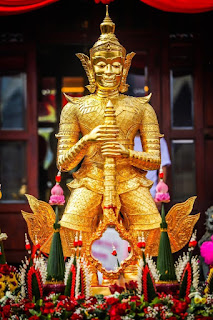
Many Buddhists who need assistance in invoking wealth or repelling pesky spirits often pray to Thao Wessuwan, the Guardian Deity of the North. Not to mention ordinary people like us, even powerful monks like Chao Khun Keng have to ask Thao Wessuwan for help when he is in trouble. 

Thao Wessuwan is a benevolent deity and guardian Dhamma protector who will assist Buddhists in times of need. As the King of Yakkhas, he is also able to grant wealth and deal with evil forces. Currently in Thailand, one of the most famous temples that one can go to pray to Thao Wessuwan is Wat Chulamanee in Samut Songkhram Province, which isn’t far from Bangkok. 

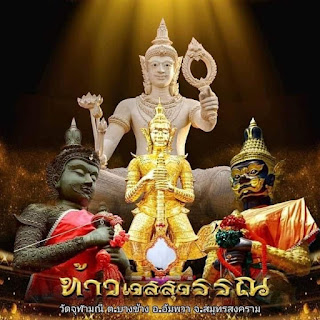
Wat Chulamanee is also close to tourist attractions like the floating market, umbrella market, mae klong market etc. There are many statues of Thao Wessuwan in Wat Chualamanee. The first type of image is Pang Phromma Suthep, a white figure who blesses devotees in terms of Chok Larp, smooth career, and financial matters. 

The origin of this image was when the abbot Phra Ajaan It, met a deva in his dream. The deva took Phra Ajaan It for a walk in a strange place, until he met many devotees who used to offer food to him. Phra Ajaan It was surprised and asked the deva who exactly he was, and the deva revealed his true form as a Yakkha holding a club. 

Phra Ajaan It realised that he was talking to Thao Wessuwan and asked for permission to build Thao Wessuwan statues in the temple to maintain Buddhism. Thao Wessuwan said that it was a good idea, and that after building his statue, Wat Chulamanee will no longer be a quiet place (i.e. there will be many devotees). However, his one condition is that Ajaan It has to find a potter from Phetchaburi province to make the statue, who later turned out to be Ajaan Thong Ruang Em Ot, a famous sculptor. 

The second version of Thao Wessuwan is Pang Chatumaharaj or the image of a Yakkha holding on to his club at the centre. The main purpose is to help devotees who pray to him expel evil spirits and black magic, and protect them from all danger. If this is a bad year for you, e.g. clash with tai sui or you are down on your luck, then you should go and pray to this version of Tao Wessuwan. 

And in front of this is Pang Theppabut (Devaputta) Soot Thep or more popularly known as Naa Thep, of a golden color. He can help bless devotees in terms of love, relationships, metta mahaniyom. 

Finally, the last version of Thao Wessuwan is “Pang Manut”, meaning Thao Wessuwan in a human form. 

He can help grant you a smooth-sailing life, and whatever you do will be successful without obstacles. 

Thao Wessuwan is a Buddhist deva who guards the temples and Buddha Sasana. He will help all sincere and good Buddhists in times of need. If you have problems in your life, you should pray to him. People with affinity with Thao Wessuwan as their guardian deva often find their lives intricately linked to temples, just like Moderator Siri Ying, whether she likes it or not.


Saturday, 8 January 2022

Sharing by LP Doo

Today Admin would like to explain the practice of Nirodha Kammathan – entering a meditative state in which one does not eat, sleep, urinate or defecate, which was first established by Kruba Srivichai and now practiced by many of the modern Krubas in Northern Thailand. Do note that one should not confuse Nirodha Kamma with Nirodha Samapatti, the latter which only very highly attained beings with complete mastery of the jhanas can enter. 

Nirodha Kamma is traced to a piece of mulberry bark paper, supposedly written by Kruba Srivichai who initiated this practice to test one’s own discipline and meditation. 

Monks who practice it are usually northern Krubas, such as Kruba Noi, Kruba Ariyachart, Kruba Norkaewfa, Kruba Chaiya etc. I think their names should be familiar to many Singaporeans and Malaysians, as well as people from Taiwan, Hong Kong and China as they have many overseas Chinese devotees, and their amulets are widely marketed targeting the Chinese. 

When Kruba Noi practices Nirodha Kammathan, which he said he will do every year until he reaches the age of 70 (this year, so not sure if he is going to continue) – he only drinks water from one big silver alms bowl. 

The water must be collected from different saksit holy sites, consecrated and filtered through 7 layers of phayants. 

During the 3 days, Kruba Noi will only practice walking and sitting meditation and do nothing else. Kruba Noi first started practising this in 1994, when his master Kruba Phad was seriously ill and about to die. 

Kruba Noi decided to practice the Nirodha Kammathana in order to save Kruba Phad’s life, and miraculously, Kruba Phad recovered in a couple of days. 

Another master who is famous for practising Nirodha Kammathana, is Kruba Ariyachart. 

Kruba Ariyachart does not do this as often as Kruba Noi, so when he does this, the temple kammakan will go into overdrive and start advertising this miraculous event. There will be a bamboo hut built for Kruba Ariyachart with a big hole at the bottom. Kruba Ariyachart will sit in this hole. He will only drink water from an alms bowl, like Kruba Noi. 

But his practice goes further, as he will not even stand up or practice walking meditation. 

And just like Kruba Noi, Kruba Ariyachart will not eat, urinate or defecate at all. The first time he practiced this, he was only a novice monk. 

He conducted his first Nirodha Kammathana practice in a cave in Nan province. Generally, Kruba Ariyachart will enter Nirodha Kammathana for a longer period of time as well, sometimes lasting a week. 

Standing opposed to the thousands of devotees, are some critics who argue that these are publicity stunts to promote the parami of the Krubas and attract more believers and devotees. 

Because these are highly publicised events and usually held in line with large donation drives, ceremonies and amulets. Hence, critics argue they are marketed as a way of identifying who are the “real” Krubas in Thailand. 

Many devotees rush to make offerings to Krubas who come out of Nirodha Kammathana because they believe that at that moment, if they make any offerings, the merit will be multiplied many times and be able to be reborn in heaven and reach Nibbana. 

Whatever the case, I (admin) hope to be able to travel to Thailand again at the end of this year to be able to meet good ajaans. I am sure that there are many well-practiced geiji ajaans around but who are living their own low-profile lives, perhaps in remote temples or caves. 

When I do find a master worthy of veneration who is willing to act as the spiritual advisor of this page and group, I will certainly let all devotees and followers know. 

May all Dhamma friends stay safe during these troubled time.

*******


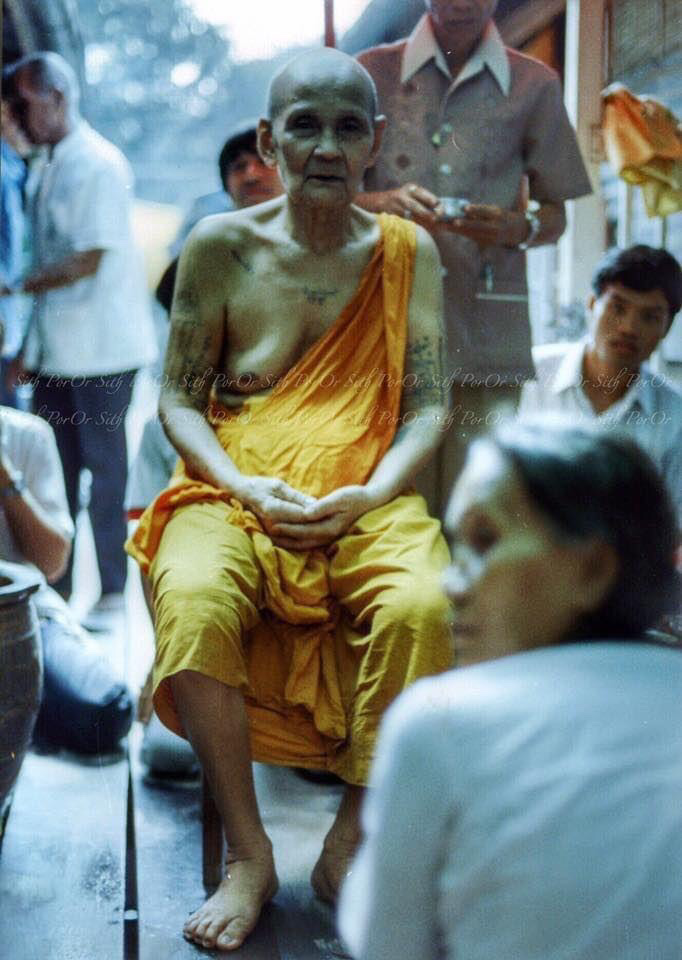
Having covered Nirodha Kammathan, now I shall talk about Nirodha Samapatti. This is a state of suspended animation which only high level meditators, such as Anagamis and Arahants who have attained mastery over the 8 jhanas, can enter into. In this state, breathing and heart beat stops, in addition to mental activity. So from a normal person's point of view, the meditator may appear to be dead. 

However, one should not disturb his or her body as the meditator will regain consciousness upon leaving this state. 

Masters who are known to enter into Nirodha Samapatti include Luang Pu Chah, who despite being paralysed and unable to speak in his later years, will stop breathing for long periods of time, yet his blood remains oxygenated and he remains alive. 

Another great Ajaan who is able to enter into Nirodha Samapatti is Khun Mae Boon Ruean. 

On the 20th of September 2496, Khun Mae Boon Ruean entered into Nirodha Samapatti at Baan Samakkhi Wisutti, Wisut Kasat Road, Bang Khun Phrom, Bangkok. Many people and disciples were there to witness this event. 

When Khun Mae entered into samadhi, she did not move a slightest bit at all, whether to eat or to go to the toilet. Khun Mae also told the people there that she would make an adithana. 

There was a mango tree nearby. By the power of entering into Nirodha Samapatti, Khun Mae made the mango tree produce and grow out a cluster of mango flowers over a single night. 

This was recorded and documented by the people and neighbours present. Everyone there could testify and they were amazed.



Tuesday, 28 September 2021

Meditations

Meditations

Once there was a meditator who commented to Luang Pu Doo, "Brightness in samadhi isn't good, because it is a kilesa and may encourage desire." 

[To give some background, when some people's minds settle down in samadhi, a bright nimitta may appear. 

I once communicated with a Westerner, follower of Thich Nhat Hanh/Plum Village lineage. He loved to meditate, and he had no idea why this bright blue light would appear in his meditation after his mind became peaceful.

It was actually a good sign, which demonstrated he had really great potential and ability. But some meditators would argue that this is samatha and not vipassana]

Luang Pu Doo replied, "It is not wrong to say that it may involve desire. But first, we have to rely on desire [e.g. desire to meditate or enjoy peace and happiness in meditation]. Just do not become obsessed with the brightness or get lost in the nimitta. But instead we should use it to our advantage [to reach a deeper state of samadhi and cultivate wisdom]. 

To use an analogy, it is like walking in the dark. We need fire to light our torch. Or to cross a broad ocean, we need a boat or vessel to sail with. But when you finally reach the shore, you can't use the boat anymore, because you have finally reached land. 

Brightness of mind as a result of samadhi, can be useful to someone with intelligence. 

To cultivate the brightness of paññā on the inside, of which there is no comparison."

As it is mentioned in the Suttas, 

"Monks, there are these four kinds of brightness. What four? The brightness of the moon, sun, fire, and wisdom. These are the four kinds of brightness. The best of these four kinds of brightness is the brightness of wisdom.” 

[Ābhāsutta, An4.14]


Wednesday, 19 May 2021

Question regarding Kasinas LP Doo

Question regarding Kasinas
LP Doo


Since there is some interest and questions on my previous post regarding kasinas, let me try to explain more. This is important because before you practice meditation, you must have a firm understanding of what you are doing. If not, there is a possibility that you may go astray (走火入魔). Even advanced meditators can mistake signs and nimittas as the absolute truth and become mentally unbalanced. If you want to hear such stories, you can ask Chao Khun Keng personally. 

1. Before the Buddha was enlightened, there were already practitioners practising meditation to calm their minds. The Buddha himself practised this kind of meditation before he was enlightened. Buddhists call this Samatha meditation. Samatha meditation refers to single-pointedness concentration on your chosen meditation object, which may lead into deeper states of samadhi or jhana. 

2. However, Samatha meditation on its own, does not lead to liberation (Nibbana). You have to follow up with Vipassana after the mind is sufficiently calmed. This is because the mind is peaceful when it rests in Samadhi, but when it emerges, the mind gets moved whenever it encounters sense objects (pleasant or unpleasant sights, sounds, smell, tastes, touches, ideas). Therefore this meditation alone is unable to lead one to liberation and release. At most, it can only lead to rebirth in the Brahma realms. 

3. The Buddha, having studied Samatha meditation under Ālāra Kālāma and Uddaka Rāmaputta, found that such meditation practices does not directly address the roots of suffering. At most, it is like putting a rock on grass, if the rock is removed, the grass continues to grow. Therefore he left and went to practice on his own. When he deeply analysed the elements of body and mind, he found them to be impermanent (anicca), unsatisfactory (dukkha) and non-self (anatta), and his mind became full liberated. This deep introspective meditation is what Buddhists call Vipassana meditation - insight into the true nature of reality. 

4. According to contemporary masters, especially those of the Thai Forest Tradition, beginners must keep mindfulness within the the internal frames of one's body, and not send it outwards. 

This is a key characteristic of the Thai Forest Tradition - Kayagatasati, or mindfulness immersed in the body. For instance, when practising the 4 Foundations of Mindfulness, we are taught to be mindful of the Body, Feelings, Mind and Dhammas. In comparison, amulet enthusiasts and followers of popular monks are more interested in katha aakhom or wichaa aakhom meditation, the practice of magic, as well as kasina meditation. 

5. When you practice kasina meditation to develop psychic powers, you are essentially sending your mind outside. This means you are focusing on an external meditation object and not your body or breath. When you send your mind outside, nimittas and visions are more likely to appear (nonetheless, they can still appear when you enter jhana via breath meditation, for instance). You have to be careful because some visions can turn out to be true, but some are deceptions. For instance, for those who like to visualise a Buddha, you know that it is not uncommon for a particular Buddha image to appear, it can be still or it may float around in front of you.  

6. It is my personal opinion that beginners should not contemplate Asubha Meditation. Asubha meditation reflects on the foulness or unattractiveness of the body. It is used by Kammathana monks as a method to get rid of sensual desire, which is a very strong defilement that causes many monks to disrobe. Luang Phor Thate once cautioned that some people experienced nimittas when they practise this form of meditation, such as seeing their body decomposing, as a skeleton, pile of ashes etc. which made them so repelled by the body that they commit suicide. But for others, they don't experience such problems.  

7. Kasina meditation is a type of samatha meditation. There are 11 kasina objects traditionally used, namely:

a) Earth kasiṇa(paṭhavī kasiṇa);

b) Water kasiṇa(āpo-kasiṇa);

c) Fire kasiṇa(tejo-kasiṇa)*;

d) Air kasiṇa(vāyo-kasiṇa);

e) Blue kasiṇa(nīla-kasiṇa);

f) Yellow kasiṇa(pīta-kasiṇa);

g) Red kasiṇa(lohita-kasiṇa);

h) White kasiṇa(odāta-kasiṇa);

i) Space kasiṇa(ākāsa-kasiṇa);

j) Consciousness kasiṇa(viññāṇa-kasiṇa);

k) Light kasiṇa (āloka-kasiṇa)*

Proceed at your own risk. Be careful when focusing on the fire or light kasina, use wisdom and don't damage your own retinas. 

8. When you choose your preferred kasina object to gaze upon, you must be seated comfortably. You can sit on a chair. Make sure it is not too near and not too far so that your eyes won't be strained. Don't use extra effort to "stare" at the object, it will be too tiring. Don't open your eyes too wide and don't squint too much either. This is so the after-image can form well. This is your object of focus, which remains there even when you close your eyes later.

9. It takes a lot of time to master kasina meditation and perceive an image floating in front of the kasina object. Some of us who have practiced this in our past lives can achieve quick results, others take months or years. If it is not for you, don't force it. There are 40 objects of meditation, you may just choose another one more suited to your temperament. 

10. Proceed at your own discretion. If in doubt, consult an expert Ajaan on kasina meditation. 


Not all Ajaans are expert on kasinas though. The masters of kasina pawana are able to bend space, generate fire, achieve divine sight, control water and the weather elements. But they cannot escape death, which only Vipassana can achieve. Neither are they able to cross-over spirits like LP Doo meditation can.


Friday, 7 May 2021

The Teaching of L P Doo

The Teaching of L P Doo


Always dedicate merit to your guardian deva

May they have loving kindness and strength

Leading us away from harm and danger

Guardian devas are real and can help us.


Divine beings exist throughout the cosmos.

They are scattered across the various heavens

In accordance with their accumulated merit 

During their human lives


What about our guardian devas - who are they?


They are our parents from a past life.

Who still love us and care for our well-being

They watch over us in all stages of our lives.


Or they could be a loved one or friend

Perhaps even our Phor Mae Kruba Ajaan

Who is bounded to us by ties of affinity.


Have you ever experienced a crisis in which 

You thought you could not survive

And yet there was someone protecting you 

Or warning you of danger in advance?


Always make merit whenever you get the opportunity.

Big or small merit, it doesn't matter.


Specify your name.

Dedicate it to your parents of all your lives

And to your guardian devas.


There are miraculous events that cannot be explained in this world.


Sometimes when we face insurmountable obstacles 

We feel like throwing in the towel and giving up.


But when we recollect our Phor Mae Kruba Ajaans 

And guardian devas

Dedicating merit to them and praying for their assistance

They show kindness to us and save us 


This is an ancient practice which our ancestors handed down.

But in the present day, we often forget such traditions. 

You can try it, there is never any harm 

In dedicating merit and recollecting our elders. 


Translated from a Thai post


****************


To all mothers, 

I honor your sacrifices and your unconditional love and dedication toward your children. 

Happy Mother's Day!!!

9th May, 2021