Labels

Showing posts with label Ajahn Dtun. Show all posts

Tuesday, 27 June 2023

:: Ajahn Dtun | Dhamma Talk on 11 Jan 2020 ::

:: Ajahn Dtun | Dhamma Talk on 11 Jan 2020 :: 


Listen to this Dhamma Talk in Thai and interpretation in English at Palelai Buddhist Temple: 

https://www.youtube.com/watch?v=VAZJz_aBX30&list=PLQ1AG6NNvCxEAQOtC7kCRQXgN-Q8BjvAz


Transcribed from the Video:


“I would like to greet you all here,

all of you here today

coming in the faith of the Lord Buddha

And when you are free from your work, duties and responsibilities

then you will naturally think of

wanting to come and offer dana or practise generosity


When you have the wisdom

to see that the practice of dana,

the practice of generosity

this is a source of happiness for oneself

then you will probably also have the wisdom to see that 

performing any immoral deeds, this is a source of suffering

therefore when you have this aspiration to seek out true happiness

You should then take up the teaching of the Lord Buddha

and follow it so as to develop your mind

One goes about doing this

by practising goodness, practising generosity,

to the utmost of one’s ability

and further develop your mind

so as to gradually cleanse it and purify it

unless you do it through the practice of sīla, samādhi and pañña 

or namely, moral virtues, concentration and wisdom

for somebody to keep the five precepts,

they need to have wisdom

to see the benefits of keeping these five precepts

Because otherwise if delusion is dominating within the mind

then we will act in accordance to the mental defilements

and therefore we will act and speak in unwholesome or unskilful ways

But if we have the mindfulness and the wisdom

to see the harm of performing any immoral deeds

by way of body or speech

then you will see the benefits of keeping the moral precepts

And for anybody who regularly practises generosity

and keeps these five precepts

then their mind will achieve a degree of coolness and peacefulness

Because there will be no harm or remorse coming to them

through performing any immoral deeds. 


And if one has the mindfulness or the intelligence

to see that within the mind, there is suffering

If one wishes to rid the suffering from within the mind

then one must further go about developing the mind

through the practice of concentration

for if we do not go about learning

how to train the mind and make it peaceful 

then the mind will always be a slave to its emotions

or a servant to mental defilements

there will also be greed and aversion and sensual desires

dominating within the mind

Sometimes the mind will be proliferating

about all kinds of bad or unwholesome things


Then when we see that the mind is suffering

suffering has arisen within the mind

we should therefore go about

the practice of cultivating the mind 

though the practice of concentration 


We do this by keeping our mindfulness

focussed upon a meditation object,

sustaining it at there,

if one can do this

then the mind will gradually

become concentrated and peaceful


One needs to have the wisdom

to see the suffering that arises within one’s mind 

and therefore have this wish to rid it from the mind

When we train the mind to become peaceful

then as a consequence

all the rest of the activities of the mind will cease

and the suffering that arises within the mind

will also cease accordingly


Once the mind has been concentrated and made strong and peaceful

then this will give rise to the energy of mindfulness and wisdom

And it’s this mindfulness and wisdom

that we use to take control over the mind

Always learning to use these two faculties

Always keep constant guard over the mind

Not allowing any suffering or unhappiness to arise within the mind

For if these unwholesome states of mind arise

then we should have the mindfulness to comprehend them

to know that it has arisen. 

And have the mindfulness and wisdom

to know the cause of the suffering that has arisen

and have the mindfulness and wisdom to seek out skilful means

to remove the suffering from the mind


for all manner of suffering

it doesn’t arise at one’s home or even here at this monastery, 

it arises within one’s own heart, within one’s own mind 

therefore one should take an interest

in learning how to free the mind from the suffering 

we practise the keeping of moral precepts

so as to take control over our body and speech

we practise concentration so as to take control over the mind

so as to make it peaceful 

and once the mind is peaceful

then this gives rise to mindfulness and wisdom 

And we use mindfulness and wisdom to screen out or to filter out

whenever greed arises within the mind

And we use these two faculties to screen out and filter out

whenever anger or hatred arises in the mind

and we use them to also remove the suffering that arises within the mind

for anybody who regularly takes good care over their mind

and keeps guard over it

then they will go beyond the control or the snares of Mara. 


~ Ajahn Dtun


:: Profile of Ajahn Dtun ::

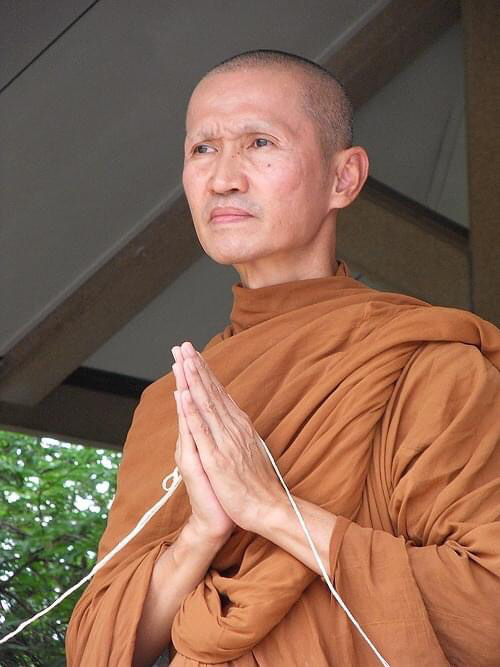
Tan Ajahn Dtun is considered to be one of the greatest living meditation masters in Thailand. Renowned for his gentle demeanour and deep wisdom, Tan Ajahn Dtun has always had an impeccable reputation as a well-practised monk in the Ajahn Chah Tradition. Even as a junior monk, there was a buzz among the monks regarding Tan Ajahn Dtun due to his dedication to practise and an aura of calm and clarity around him.

Born in 1955 in Ayutthaya, Thailand, Tan Ajahn Dtun was raised in Bangkok. After completing his Bachelor’s Degree in Economics, he decided to become a monk at Wat Nong Pah Pong with VenerableAjahn Chah as his preceptor. Presently, Tan Ajahn Dtun is the Abbot of Wat Boonyawad in Chonburi, Thailand. Wat Boonyawad has grown from being a hermitage of a few monks to a large monastery with close to fifty monks training under the guidance of  Tan Ajahn Dtun.


#AjahnDtun #LuangPorDtun #Watboonyawad

#DhammaTalk #Dhamma 

#PalelaiBuddhistTemple

www.fb.me/BuddhaDhammaFoundation


22 July 2023


Friday, 5 May 2023

Ajahn Dtun Biography: The Sacred Equation

Ajahn Dtun Biography: 
The Sacred Equation


Ajahn Dtun paying respect to Luang pu Boonsong in Wat Ratchabophit where both Luang pu Boonsong and Ajahn Dtun were one of the senior monks being invited.

Ajahn Dtun (Thiracitto) was born in the province of Ayutthaya, Thailand, in 1955. When he was six his family moved to Bangkok and he continued to live there until June 1978. From a young age he was a boy whose heart naturally inclined toward having a foundation in moral discipline. 

By the time he was a teenager and during his university years, many small incidents that would fashion his life gradually steered him away from the ways of the world and towards wishing to live the Holy Life. After graduating in March 1978 with a BA in Economics, he was accepted to study for a Masters degree in Town Planning at the University of Colorado, USA. However, while he was preparing to travel abroad, many small insights came together in force, and changed his way of thinking from planning to take his studies as far as he could and then lead a family life, to deciding that after graduation he would remain single and work to assist his father financially until the time was right for him to be ordained as a monk. 

One evening he picked up a Dhamma book belonging to his father: which opened by chance at the last words of the Buddha: “Now monks, I declare to you: decline and disappearance are the nature of all conditions. Strive on with diligence!” 

As he read this over a second and then a third time, the words resonated deeply within his heart, causing him to feel that the time had now come to be ordained, knowing this was the only thing that would bring him any true benefit. He resolved that within two months he would be ordained as a monk, and that his ordination would be for life.

In June 1978 he travelled to the north-eastern province of Ubon Ratchathani to be ordained by the Ajahn Chah at Wat Nong Pah Pong. Resolute by nature and determined in his practice, he was to meet with steady progress regardless of whether he was living with Ajahn Chah or at any of Wat Nong Pah Pong’s branch monasteries. In 1981, he returned to central Thailand to spend the Rains Retreat at Wat Fah Krahm (near Bangkok), together with Ajahn Piak and Ajahn Anan. The three remained at Wat Fah Krahm until late 1984, when Ajahn Anan and Ajahn Dtun were invited to take up residence on a small piece of forest land in the province of Rayong in Eastern Thailand. 

Seeing that this land was unsuitable for long-term residence, Ajahn Dtun chose another piece of land which was made available to them, a forested mountain that would later become the present day Wat Marp Jan. He spent five years assisting Ajahn Anan to establish Wat Marp Jan, and then decided it was time to seek solitude so as to intensify his practice, knowing this to be necessary if he was to finally bring the practice of Dhamma to its completion. He was invited to practise on 80-acres of dense forest in the province of Chonburi, where he remained in comparative isolation for two years. In 1992 he accepted an offer of land for the establishment of a monastery, which he named Wat Boonyawad. At present the monastery covers 160 acres, all kindly given by the faith and generosity of Mr and Mrs. Boon and Seeam Jenjirawatana and their family.

Since 1993 Ajahn Dtun’s reputation as a prominent teacher within the Thai Forest Tradition has grown, and has attracted between 50 to 60 monks to come and live and practise under his 

guidance at Wat Boonyawad.


Cr on Ajahn Dtun Biography: 


The Sacred Equation


28 May 2023


Thursday, 5 January 2023

Ajahn Dtun & Attractiveness of Girls

Ajahn Dtun & Attractiveness of Girls


“One day at university I was sitting talking with some friends when I noticed a university bus pull in to let its passengers off. As some girls got off the bus and walked passed where I was sitting, one girl caught my attention because I thought she was attractive. I thought to myself, ‘If she remains beautiful for more than three months I will try to get to know her.’ But upon seeing her again on another day she didn’t look the same as before, on this day she no longer looked beautiful because she had changed her hair style, and so I never did get to know her. 

On another occasion I saw a different girl whom I felt attracted to because she was also good looking, and again I thought if she is still beautiful after three months I will try to get to know her, but on a later day upon seeing her again she no longer looked attractive because she dressed differently. 

As it turned out there wasn’t one girl in the entire university who could remain attractive for more than three months, and so I never did get to know any of them. I thought to myself that I will associate with females only platonically and wait until I’ve finished my studies and have a job before considering starting a relationship. Every girl that I thought was beautiful would, on seeing them only a few times, quickly appear not to be so. As a result I no longer felt interested in females. It wasn’t until I ordained that I understood that my feelings and way of viewing things whilst being a student was based on insight (vipassana) that is, seeing the mutable nature of human beings or physical phenomena. 

Not long after this I saw a friend of mine arguing with his girlfriend. Whilst arguing the girl’s face didn’t look at all attractive. I asked myself, ‘Where exactly should I find attraction in a woman?’…


Book: Autobiography of Ajahn Dtun

https://www.abhayagiri.org/media/4158_E-BOOK%20-%20T.A.Dtun.pdf?fbclid=IwAR100hzR-6cCeMvMwnqqU-7I52FPTZdBJXV5SaNHPtqcAHbg4iWcOfuXDCE


30 January 2023


Saturday, 20 August 2022

Luang Phor Akaradej Thiracitto

Suppose we have a lifespan of 80 years

It is like a bright candle

Divided into 8 parts

How many parts have we used?

How many segments are left?

In the past we’ve made merit

Observed the precepts

As well as practiced pawana

And refrained from evil deeds

How much internal wealth

Have you already reaped?

Don’t be complacent

Thinking that the bright light

Of the candle will burn to the end

A strong gust of wind blowing

Can extinguish the candle’s flame

It doesn’t mean that everyone

Will reach their 80th birthday

Don’t be lost in life’s pleasures

And let day and night pass in vain

We must hurry to convert

External property into internal wealth

To build up our supplies and provisions

For our next journey

The path leading to the end of suffering

Is still very lengthy and distant

Revolving around birth and death

For not sure how long more

We must make haste in gathering merit

Don’t think that you are still young

And you’ll do it when you’re older

Sickness can cut off your life first

Or an accident can cause death to arrive

Therefore do not be careless

And let the days and nights pass in vain


Luang Phor Akaradej Thiracitto

Wat Boonyawat, Chonburi Province


Cr. to the original owner of this photo


Monday, 25 July 2022

The Way to The True Happiness.

 Tan Ajahn Dtun


The Way to The True Happiness.

Our homes are not very nice place to live in  if they're dirty & untidy. 

Our minds are, actually, no different to our homes. 

If our mind is full of greed, anger & delusion, or in other words dukkha (suffering & discontentment), then they are also not a nice places to be in because within them there'll be only feelings of discontent & restlessness to be found. 

To make an untidy home nice & cosy requires that it be strengthened up & made clean & tidy.

Our minds too must also be cleaned, because when we do, so we are relieving from greed, anger & delusion.

As a consequence, coolness & peacefulness of mind will arise.


Monday, 18 July 2022

This is the Path by Ajahn Dtun (Q and A)

This is the Path by Ajahn Dtun (Q and A)


Q: I told my mother that I would be with her, to help her when she is about to pass away. Can you please advise me as to how I can help her in her dying moments?

A: At this moment, while she is still alive, you should be taking the best possible care of her. In doing so you would be repaying some of your debt of gratitude to her, for she has taken great care of you right from when you were in her womb and throughout your life up until adulthood. 

This debt of gratitude that we have to our parents is immense. Sometimes we may try to repay it for our whole life and still be unable to fully do so.

Before I ordained, I sometimes thought that I would work and then try to financially assist my father; however, I came and ordained and so I would sometimes think, ‘How will I ever repay my debt of gratitude to my father?’ I felt that even if I was to find money, wealth and possessions to give him, I would still be unable to fully repay my debt to him. 

So I found a shortcut: I encouraged him to come and ordain, so that I would be able to take good care of him, meet his needs as he got older and also give advice on the Dhamma. I felt that if I could give him good advice about his Dhamma practice, this would be fully repaying my debt of gratitude to him.

My father was a person who had wholesome views and a strong faith in the Buddha’s teaching, so he ordained and lived with me for sixteen years. He died about two years ago and I was able to talk to him until the very last moments. I do feel that I was able to truly repay my debt to him.

If we look for material things and wealth to repay our debt to our parents, we cannot completely repay it. 

The way to do so is to give the Dhamma to our parents and to set them on the right course in Dhamma practice. This is the way to repay our debt of gratitude towards them.

If you feel a sense of gratitude towards your mother, this is very good. You should take the greatest care of her. Right now, you should teach her to practice meditation. If she shows strong attachment towards her body, teach her ways to gradually let go of this attachment. 

Teach her to contemplate the truth that these bodies of ours are not within our command, and that it is the elements of the body going out of balance that causes aging, sickness and death to occur. She should contemplate like this to make her mind quiet, practicing as time avails. 

When the moment of death comes, you should instruct her to use her mindfulness and wisdom to contemplate the body so as not to attach to it, but rather just let it go on its natural course. 

Having made the mind be at peace, she should then focus upon her meditation object. 

All of us here in this room should be practicing this contemplation of death, not leaving it until the moment of death comes. 

Just look at boxers: they have to train before going up into the ring for the real fight, they do not just go up there unpracticed. Athletes also must train before competing. 

The same goes for us: we have to practice and get an understanding of death before death actually comes to us. Consequently, we have to practice contemplating the body and death every day.


~•~•~•~

From This is the Path by Ajahn Dtun

https://www.abhayagiri.org/media/books/dtun_this_is_the_path.pdf


Tuesday, 28 June 2022

This is the Path by Ajahn Dtun

This is the Path by Ajahn Dtun


Q: I told my mother that I would be with her, to help her when she is about to pass away. Can you please advise me as to how I can help her in her dying moments?

A: At this moment, while she is still alive, you should be taking the best possible care of her. In doing so you would be repaying some of your debt of gratitude to her, for she has taken great care of you right from when you were in her womb and throughout your life up until adulthood. This debt of gratitude that we have to our parents is immense. Sometimes we may try to repay it for our whole life and still be unable to fully do so.

Before I ordained, I sometimes thought that I would work and then try to financially assist my father; however, I came and ordained and so I would sometimes think, ‘How will I ever repay my debt of gratitude to my father?’ I felt that even if I was to find money, wealth and possessions to give him, I would still be unable to fully repay my debt to him. 

So I found a shortcut: I encouraged him to come and ordain, so that I would be able to take good care of him, meet his needs as he got older and also give advice on the Dhamma. I felt that if I could give him good advice about his Dhamma practice, this would be fully repaying my debt of gratitude to him.

My father was a person who had wholesome views and a strong faith in the Buddha’s teaching, so he ordained and lived with me for sixteen years. 

He died about two years ago and I was able to talk to him until the very last moments. I do feel that I was able to truly repay my debt to him.

If we look for material things and wealth to repay our debt to our parents, we cannot completely repay it. The way to do so is to give the Dhamma to our parents and to set them on the right course in Dhamma practice. 

This is the way to repay our debt of gratitude towards them.

If you feel a sense of gratitude towards your mother, this is very good. You should take the greatest care of her. Right now, you should teach her to practice meditation. If she shows strong attachment towards her body, teach her ways to gradually let go of this attachment. 

Teach her to contemplate the truth that these bodies of ours are not within our command, and that it is the elements of the body going out of balance that causes aging, sickness and death to occur. She should contemplate like this to make her mind quiet, practicing as time avails. 

When the moment of death comes, you should instruct her to use her mindfulness and wisdom to contemplate the body so as not to attach to it, but rather just let it go on its natural course. 

Having made the mind be at peace, she should then focus upon her meditation object. 

All of us here in this room should be practicing this contemplation of death, not leaving it until the moment of death comes. 

Just look at boxers: they have to train before going up into the ring for the real fight, they do not just go up there unpracticed. Athletes also must train before competing. 

The same goes for us: we have to practice and get an understanding of death before death actually comes to us. Consequently, we have to practice contemplating the body and death every day.

~•~•~•~

From This is the Path by Ajahn Dtun

https://www.abhayagiri.org/media/books/dtun_this_is_the_path.pdf


Sunday, 12 June 2022

I COULD DIE ANY TIME SOON ~ Ajahn Dtun

I COULD DIE ANY TIME SOON
~ Ajahn Dtun


“You have to reflect on death because it arouses the mind, warning it to not be heedless. Death is something we must frequently recollect, for if we don’t we will just go about occupying ourselves happily throughout our days and nights, letting time drift by as days turn into weeks, weeks into months and months into years, allowing our thoughts to proliferate about ‘at the end of the year…’ or ‘at the start of next year…’ without ever giving any consideration at all to death.

Contemplating death brings our awareness back to the present moment. We will realize that the future is uncertain, so there is no need to be too worried or concerned about it. If we need to make plans of any kind, that’s fine. But once any plans for the future have been made, we return to establishing our mindfulness in the present, because it is right here in the present moment that the causes which determine our future originate. Hence we have to live skilfully in the present moment.

We mostly like to think about the future and forget to reflect that our lives are uncertain. This being so, we become careless and unconcerned, allowing our days to pass by in vain. And it is this laxness that causes us not to put effort into the practice of sitting meditation.

Each of us should try asking ourselves: ‘Have I developed wholesome, virtuous qualities to the utmost of my ability throughout my entire life or not?’ or ‘If I were to die right now, would my heart be prepared for this?’ or ‘Does my heart possess sufficient merit to be born into a heavenly realm or not?’ or ‘Have I developed the spiritual perfections (pāramī) sufficiently or not?’ If we realize this isn’t yet so, we should take up the practice of contemplating on death so as not to be heedless.

We should frequently think to ourselves: ‘I could die any time soon’.”


This reflection by Ajahn Dtun is from the book, Sacred Equation, (pdf) pp.1-2.

E-book: https://forestsangha.org/teachings/books/the-sacred-equation?language=English


Source:

https://www.abhayagiri.org/reflections/594-i-could-die-any-time-soon?fbclid=IwAR2-08LEjw2nmd7EYGS6ZJdwKfIa4tA7W6tXjtwu0lHXJFks3y4mFdznlHY


📸 Credit: WatBoonyawad


Thursday, 9 June 2022

Ajahn Dtun is considered to be one of the greatest living meditation masters in Thailand.

Ajahn Dtun is considered to be one of the greatest living meditation masters in Thailand. 


Renowned for his gentle demeanour and deep wisdom, Ajahn Dtun has always had an impeccable reputation as a well-practised monk in the Ajahn Chah Tradition. Even as a junior monk, there was a buzz among the monks regarding Ajahn Dtun due to his dedication to practise and an aura of calm and clarity around him.

Born in 1955 in Ayutthaya, Thailand, Ajahn Dtun was raised in Bangkok. After completing his Bachelor’s Degree in Economics, he decided to become a monk at Wat Nong Pah Pong with Ajahn Chah as his preceptor.

Presently, Ajahn Dtun is the Abbot of Wat Boonyawad in Chonburi, Thailand. Wat Boonyawad has grown from being a hermitage of a few monks to a large monastery with close to fifty monks training under the guidance of Ajahn Dtun.


*********

:: The Autobiography and Dhamma Teachings of Ajahn Dtun ::

If we have mindfulness and wisdom, and the intention to wipe out or abandon the defilements from the heart, then we will see that any defilement that has arisen in the heart is merely a cause for more suffering.

And so we will look for a way to find the source of this suffering.

We already know that aversion is suffering, so we must cultivate kindness and forgiveness towards one another, not allowing aversion to arise in the mind.


~ Luang Por Dtun


:: Download "The Autobiography and Dhamma Teachings of Ajahn Dtun" in PDF ::

https://www.abhayagiri.org/media/4158_E-BOOK%20-%20T.A.Dtun.pdf


#AjahnDtun #LuangPorDtun #WatBoonYaWad


Tuesday, 6 July 2021

QnA with Ajahn Dtun: Body Contemplation and what Ajahn Chah Actually Taught

QnA with Ajahn Dtun: Body Contemplation and what Ajahn Chah Actually Taught


Q: How essential is body contemplation? Didn’t the Venerable Ajahn Chah teach ‘letting go’? 


Ajahn Dtun: 

It is essential to investigate the body to see the mind clearly. Sometimes people take Luang Por Chah’s teachings from the end of the path and forget about the instructions for the beginning. 

If one has not passed beyond all attachment to the body, it is impossible to clearly investigate the mind. 

The investigation of citta and dhamma satipatthānas (the four foundations of mindfulness: the body, feelings, mind and dhammas) is the path of practice for anāgāmis. Before that, they can be investigated, but only superficially. 

Sometimes you hear people say, ‘Kilesas are in the mind, not in the body, so it is the mind that should be contemplated.’ But it is only by passing beyond attachment to the body that the other khandhas (the five physical and mental components of personality: body, feeling, memory, thinking and consciousness) become clear. 

Without investigating the body as elements, as asubha, as thirty two parts, one will not be able to realize sotāpanna. Even those with great pāramī, such as Luang Por Tate and Luang Ta Mahā Boowa, had to go through the body to realize the path. 

It is important to note that in the higher ordination ceremony to become a Buddhist monk, the preceptor must instruct the candidate for ordination on the five principal objects of meditation: hair, body hair, nails, teeth and skin. To not give this instruction invalidates the whole ordination. 

And why? Because the Lord Buddha knew that by not instructing a candidate on such an essential topic would be the cause for those persons Holy-Life to be unfruitful, or more precisely, they will not realize the noble paths to awakening, their fruitions, nor Nibbāna.


~   ~   ~


Q: How deep can one go with the practice of being mindful in daily life? 


Ajahn Dtun: 

Being continuously aware of mental objects throughout the day is an essential support for one’s meditation practice, but it is samādhi that gives sati (mindfulness) the strength to be firmly established. If we are mindful throughout the day, letting go of mental objects as they arise, then when we sit in meditation, the mind becomes deeply peaceful more easily. 

However, this kind of awareness and letting go is like trimming the branches of a tree: no matter how much you trim them, they keep growing again. To uproot the tree altogether, you have to uproot the attachment and identification with the body as ‘me’ or ‘mine’. 

I experimented with simply watching mental objects for a while: one day attraction to sense objects would arise and I would focus my awareness upon it, causing the delight to cease. But the next day, there would be delight with other objects. There is no end to it. 

However, with body contemplation, it comes to an end.


*     *     *     *     *     *     * 


From This is the Path by Ajahn Dtun pp12-13

https://www.dhammatalks.net/Books13/Ajahn-Dtun_This-is-the-Path.pdf


Wednesday, 9 June 2021

The Guardian Spirit of the Oceans

The Guardian Spirit of the Oceans 


On the seventh of December, 1973, I went on holiday for my third time to Phuket with my younger brother and his friend. Many of our friends were the sons of fishermen and led us in their usual pastime of catching crabs coming up onto the shoreline of Sai Kaew Beach. The crabs were put into a pot, intending that they would be our supper that evening. After quite some time I returned to where our vehicle was parked and sat chatting with some friends, while several others went about lighting a campfire close by. By 9 p.m. everyone had returned and we sat around the fire talking. 

An incident occurred at about that time which made me see the light of some simple truths and encouraged me to further develop goodness in my life. A being from a different realm came to this human realm – it called itself ‘The Guardian Spirit of the Oceans’.

It said to me, ‘Beneath the ocean are things of great beauty and things that are most fearsome. Many people who come to play in the ocean are lacking in both caution and a sense of their own physical strength. Waves that sweep up onto the beach are then drawn back into the ocean. In some spots where this happens the ocean floor quickly falls away, becoming deep in an instant. Subsequently, many will lose their life. For some, when they swim out to deep water, they will get dragged out to even deeper water and do not have the necessary strength to resist the current. It’s all because of heedlessness that many people lose their life in the ocean.’

It then asked me, ‘Do you love your father?’ ‘Yes’ I replied. ‘Would you like it if someone were to harm him?’ ‘No’ I answered. It then went on to ask, ‘Do you love your younger brother?’ ‘Yes’ I replied again. ‘Would you like it if someone were to harm him?’ ‘No’ I answered. Finally, it asked ‘And you, do you love yourself?’ Again I answered, ‘Yes.’ ‘Would you like it if someone were to come and harm you?’ ‘No.’ 

It said, ‘All animals have fathers, mothers, and siblings. It’s just that they don’t speak your language. You already have a comfortable life, why do you think to harm or take the life of other creatures?’ Having said just that much I instantly knew I had unwittingly done wrong and behaved improperly.

Deep in my heart I knew straight away that henceforth I would never intentionally harm or take the life of another creature. It taught me many things which not only led to my refraining from taking life, but also caused some of my other friends who were present that night to also do the same. Afterwards I told my friends to take the pot of crabs and release them at the shoreline. 

Even though seven years had already passed before writing about this in my journal, I could still remember the incident so clearly, and I frequently recollect the compassion and kindness of this being, for it enabled me to see the light and endeavour to do only good. It made me clearly aware that there are numerous realms of existence outside of this human one.

My conversation with this being lasted for three to four hours. Some time after the incident I further recollected on the theme of dhammas that come in pairs and realized that there is good and there is evil. Since then I’ve always tried to do what is good and refrain from what is not. One time, not long after that day the thought arose, ‘Whatever is reckoned as good in this world, that is what I wish to possess.’ 

Even to this day I still recollect this being’s great act of kindness. 


Luang Por Akaradej Thiracitto Bhikkhu

(Ajahn Dtun)

Wat Boonyawad, Bo Thong, Chonburi


Thursday, 11 February 2021

The Guardian Spirit of the Oceans

The Guardian Spirit of the Oceans


On the seventh of December, 1973, I went on holiday for my third time to Phuket with my younger brother and his friend. Many of our friends were the sons of fishermen and led us in their usual pastime of catching crabs coming up onto the shoreline of Sai Kaew Beach. The crabs were put into a pot, intending that they would be our supper that evening. After quite some time I returned to where our vehicle was parked and sat chatting with some friends, while several others went about lighting a campfire close by. By 9 p.m. everyone had returned and we sat around the fire talking. 

An incident occurred at about that time which made me see the light of some simple truths and encouraged me to further develop goodness in my life. A being from a different realm came to this human realm – it called itself ‘The Guardian Spirit of the Oceans’.

It said to me, ‘Beneath the ocean are things of great beauty and things that are most fearsome. 

Many people who come to play in the ocean are lacking in both caution and a sense of their own physical strength. Waves that sweep up onto the beach are then drawn back into the ocean. In some spots where this happens the ocean floor quickly falls away, becoming deep in an instant. Subsequently, many will lose their life. For some, when they swim out to deep water, they will get dragged out to even deeper water and do not have the necessary strength to resist the current. It’s all because of heedlessness that many people lose their life in the ocean.’

It then asked me, ‘Do you love your father?’ ‘Yes’ I replied. ‘Would you like it if someone were to harm him?’ ‘No’ I answered. It then went on to ask, ‘Do you love your younger brother?’ ‘Yes’ I replied again. ‘Would you like it if someone were to harm him?’ ‘No’ I answered. Finally, it asked ‘And you, do you love yourself?’ Again I answered, ‘Yes.’ ‘Would you like it if someone were to come and harm you?’ ‘No.’ 

It said, ‘All animals have fathers, mothers, and siblings. It’s just that they don’t speak your language. You already have a comfortable life, why do you think to harm or take the life of other creatures?’ Having said just that much I instantly knew I had unwittingly done wrong and behaved improperly.

Deep in my heart I knew straight away that henceforth I would never intentionally harm or take the life of another creature. It taught me many things which not only led to my refraining from taking life, but also caused some of my other friends who were present that night to also do the same. Afterwards I told my friends to take the pot of crabs and release them at the shoreline. 

Even though seven years had already passed before writing about this in my journal, I could still remember the incident so clearly, and I frequently recollect the compassion and kindness of this being, for it enabled me to see the light and endeavour to do only good. It made me clearly aware that there are numerous realms of existence outside of this human one.

My conversation with this being lasted for three to four hours. Some time after the incident I further recollected on the theme of dhammas that come in pairs and realized that there is good and there is evil. Since then I’ve always tried to do what is good and refrain from what is not. 

One time, not long after that day the thought arose, ‘Whatever is reckoned as good in this world, that is what I wish to possess.’ Even to this day I still recollect this being’s great act of kindness. 


Luang Por Akaradej Thiracitto Bhikkhu

~ Ajahn Dtun

Wat Boonyawad, Bo Thong, Chonburi


Sunday, 10 January 2021

Sacred Equation ~ Ajahn Dtun

Sacred Equation 
~ Ajahn Dtun


You eat three or four meals a day to nourish your body, and yet you rarely think to nourish your heart, your mind. Rather than sit in meditation just once, you make all kinds of excuses as to why you don’t have time. Ajahn Chah would ask people who liked to make such excuses: ‘Do you have the time to breathe?’ He also said: ‘If you have time to breathe, you have time to meditate’, meaning that in truth we always have the time to focus our mindfulness on the breath. 


The wise know that the practice can be done at all times.


Ajahn Dtun. 

You eat three or four meals a day to nourish your body, and yet you rarely think to nourish your heart, your mind. Rather than sit in meditation just once, you make all kinds of excuses as to why you don’t have time. Ajahn Chah would ask people who liked to make such excuses: ‘Do you have the time to breathe?’ He also said: ‘If you have time to breathe, you have time to meditate’, meaning that in truth we always have the time to focus our mindfulness on the breath. 


The wise know that the practice can be done at all times.


Ajahn Dtun. 

The Sacred Equation.


Sunday, 27 December 2020

I COULD DIE ANY TIME SOON ~ Ajahn Dtun

 I COULD DIE ANY TIME SOON
~ Ajahn Dtun


“You have to reflect on death because it arouses the mind, warning it to not be heedless.

Death is something we must frequently recollect, for if we don’t we will just go about occupying ourselves happily throughout our days and nights, letting time drift by as days turn into weeks, weeks into months and months into years, allowing our thoughts to proliferate about ‘at the end of the year…’ or ‘at the start of next year…’ without ever giving any consideration at all to death.

Contemplating death brings our awareness back to the present moment. We will realize that the future is uncertain, so there is no need to be too worried or concerned about it. If we need to make plans of any kind, that’s fine. But once any plans for the future have been made, we return to establishing our mindfulness in the present, because it is right here in the present moment that the causes which determine our future originate.

Hence we have to live skilfully in the present moment.

We mostly like to think about the future and forget to reflect that our lives are uncertain.

This being so, we become careless and unconcerned, allowing our days to pass by in vain. And it is this laxness that causes us not to put effort into the practice of sitting meditation.

Each of us should try asking ourselves: ‘Have I developed wholesome, virtuous qualities to the utmost of my ability throughout my entire life or not?’ or ‘If I were to die right now, would my heart be prepared for this?’ or ‘Does my heart possess sufficient merit to be born into a heavenly realm or not?’ or ‘Have I developed the spiritual perfections (pāramī) sufficiently or not?’ If we realize this isn’t yet so, we should take up the practice of contemplating on death so as not to be heedless.

We should frequently think to ourselves: ‘I could die any time soon’.”

This reflection by Ajahn Dtun is from the book, Sacred Equation, (pdf) pp.1-2.


E-book: https://forestsangha.org/teachings/books/the-sacred-equation?language=English

Source:
https://www.abhayagiri.org/reflections/594-i-could-die-any-time-soon?fbclid=IwAR2-08LEjw2nmd7EYGS6ZJdwKfIa4tA7W6tXjtwu0lHXJFks3y4mFdznlHY

📸 Credit: WatBoonyawad


Wednesday, 14 October 2020

The Sacred Equation by Ajahn Dtun Thiracitto

The Teaching of Ajahn DtunThe Sacred Equation by Ajahn Dtun Thiracitto


Layperson: Will we be able to attain to the Dhamma by only watching the arising and ceasing of all mental objects within the mind? I have many Dhamma-friends who say that sitting meditation isn’t necessary, and that the practice of watching the mind is a more direct and effective approach. I was told that Dhamma practice for modern people should be more mind-oriented, because we are required to think a lot and have also received a better education than previous generations?_

Ajahn Dtun: It is true that in this modern age people have received a very good education and possess much knowledge. However, regardless of whether someone has graduated with a BA a Masters or a Ph.D, even if they are an academic, their knowledge is only the worldly kind of intelligence, it is not wisdom. Wisdom is what enables us to free our hearts from the defilements of greed, anger and delusion. I’m sure you’ve seen cases of highly intelligent people, or people with a high rank and position, who when they are given the chance are quite capable of behaving corruptly because their minds are being influenced by greed. If anger dominates their mind, they might think to use their power and intelligence to take the life of somebody else. This is the intelligence of the mental defilements at work.

The strength of ordinary mindfulness combined with our intelligence is not strong or incisive enough to see the mental defilements and bring about their cessation by completely letting them go from the mind. If a high level of education and much acquired knowledge were sufficient, all people in the world with those advantages would by now have attained the various stages of enlightenment and Nibbāna.

The Dhamma Army, the fighting force that battles with the kilesas, must comprise the forces of sīla, samādhi and paññā. All three forces must unite to resist the Kilesa Army, which is collectively formed by the forces of greed, anger, sexual lust and delusion. If it was possible to attain to the transcendent path, its fruitions and Nibbāna by merely using our mindfulness to watch the mind and our wisdom faculty to contemplate the arising and ceasing of all mental objects, the Buddha wouldn’t have taught us to cultivate moral virtue so as to create a foundation for the development of concentration. He taught that concentration ultimately gives rise to sati-paññā, mindfulness and wisdom.

In the higher ordination ceremony to become a Buddhist monk, the preceptor instructs the candidate on five essential meditation objects: hair, body hair, nails, teeth, and skin. Monks must reflect frequently on these five objects in their meditation practice. The purpose is to aid the meditator to see the true nature of the body: that it is impermanent and totally devoid of any ‘self’ entity. This insight enables the meditator to attain the Noble Path to Liberation, its fruitions and Nibbāna. If a preceptor fails to instruct a candidate on these five principal objects, that is, if he fails to make the candidate aware of their importance, that person’s holy life will not be fruitful; he will be unable to attain to the Dhamma.

The view that people in this modern age need only use their mindfulness to see the arising and ceasing of all mental objects to attain to the Noble Path and ultimately realize Nibbāna is a product of the kilesas. These mental defilements are actually much smarter than we are, as they can convince us that it’s not necessary to develop concentration because this is difficult to do. This deception will prevent any uninformed believer from ever attaining to the Noble Path. ‘Why undergo the difficulty of developing concentration?’ our kilesas tell us. The defilements are so clever, they make people believe this. Actually, they want all beings to remain in saṃsāra. They don’t want us to attain to the Noble Path, its fruitions and Nibbāna. If we fail to develop concentration, we will not possess sufficient mindfulness and wisdom to let go of the kilesas from the mind.

Simply using one’s mindfulness to watch the mind, without ever developing concentration and contemplating the body, will not take one to the transcendent path that leads to the stages of enlightenment and Nibbāna. An untrained mind, one that has not developed concentration, while sometimes aware of some of its emotions, will not perceive them with any real clarity. The untrained mind will therefore attach to the emotions in the belief that they are the self or the mind. In doing so, the mind blends together with its thoughts and emotions until they are inseparable; they become one and the same. The mind is then left incapable of separating itself from the stream of thoughts and emotions.

For a cell phone to be in good working order, it must be charged frequently. If we use the phone but never recharge the battery, its charge will run down until it can’t be used.

Mindfulness is no different from a cell phone. If we never strengthen our mind through the practice of concentration, it will gradually weaken until it is incapable of letting go the emotions from the mind. If mindfulness is used only to watch the mind and we never develop the strength of concentration to support it, our mindfulness will be unable to keep up with all our thoughts and emotions, or to know them according to the truth. Any attempts to contemplate the body will also be unsuccessful, because our mindfulness and wisdom will lack the strength and clarity needed to see body’s impermanence and the absence of self.

The teaching of the Buddha is never outdated or unsuited to any age, because it is a timeless teaching. He taught a path of practice that leads beings to gain insight into the Four Noble Truths and takes them out of suffering. His path of practice consists of three factors: moral virtue, concentration and wisdom.

Any being in any age or era who cultivates all three factors of the Path with the aim of achieving insight into the Four Noble Truths, that is, of fully comprehending suffering, its cause, its cessation and the path leading to its cessation, will be capable of attaining the Noble Path, its successive stages of enlightenment and, ultimately, Nibbāna. All of us must therefore remain firm in the way of practice of the Lord Buddha and his arahant disciples. We have to look at how they practised to attain to the Dhamma and realize Nibbāna. All of them had to cultivate the path of sīla, samādhi and paññā, and also reflect on the body to realize the Dhamma–the Truth.

*******
The Sacred Equation by Ajahn Dtun Thiracitto
https://forestsangha.org/teachings/books/authors/ajahn-dtun?language=English