Labels

Showing posts with label Ajahn Jayasaro. Show all posts

Thursday, 7 September 2023

❖ Holding On to Your Principles in a Skilful Way ❖ ~ By Ajahn Jayasāro ~

❖ Holding On to Your Principles in a Skilful Way ❖
~ By Ajahn Jayasāro ~


Holding on to your principles in a skilful way is not easy. Some people make compromises too easily. 

Others can be too harsh and judgemental. Here is a story about my teacher Ajahn Chah, told by one of his disciples.

“One day a layman from Ubon brought a car to offer to Ajahn Cha. He said, ‘I absolutely refuse to take it back; you must accept this gift from me.’ He drove the car in and parked it behind Ajahn Cha’s kuti, at the foot of a big old tree, and placed the keys in Ajahn Cha’s shoulder bag. He was so proud of himself that he was laughing.

Not even once did Ajahn Cha go out to look at the car. When he left his kuti he always took a different path. If he had to go out of the monastery on business he would rely on someone elses car. He never showed the slightest interest in the car, even so much as to go and see what make of car it was or what colour. After seven days Ajahn Cha asked a lay supporter to go and tell the donor of the car to come and pick it up. Ajahn Cha had accepted it, the man had made is merit, and now Ajahn Cha would like to return it. A car was not a proper possession for a monk.”

- - ❖ - -

"Food for the Heart", a series of Dhamma teachings handwritten weekly is posted on the Buddhadāsa Indapañño Archives page with Ajahn's kind permission.

https://forestsangha.org/teachings/books/food-for-the-heart?language=English

- - ❖ - -


Copied 

Photo credit. The owner who posted it.


10 September 2023


Saturday, 19 August 2023

A Positive Ideal to Cultivate Ajahn Jayasaro

A Positive Ideal to Cultivate
Ajahn Jayasaro

In Dhamma practice, wisdom acts as the direct antidote to ignorance by examining the reality of life and the world with a stable, stilled and unbiased mind sustained in the present.

The direct antidote to craving is the systematic and integrated development of wholesome mental states. In the case of love, the most prominent of these virtues are lovingkindness and the effort to be a good friend. Training ourselves to practice restraint, to keep track of our emotions, to let go: these are at the heart of the negating side of the practice.

But at the same time we need a positive ideal to cultivate. That positive ideal is provided by the pure love called metta.

The distinguishing characteristics of a pure love are:

It is unconditional.

It is boundless, a wish for all living beings to be well.

It is not a cause of suffering.

It is governed by wisdom and 
equanimity (upekkha). 


It is a miracle that such a love exists and that every single human being has the ability to develop it.

This reflection by Ajahn Jayasaro is from the book, On Love.


18 August 2023


Wednesday, 26 July 2023

Ajahn Jayasāro

:: Ajahn Jayasāro ::


In the Thai Forest Tradition, teachers tend to avoid using technical terms and try to teach the Dhamma in simple down-to-earth language. 

They sometimes adopt an everyday word or phrase to encapsulate a key teaching in a fresh way. They use it continually for a certain period, and when it becomes stale they find a new one.

In the last years of his teaching career, Ajahn Cha was very fond of the word ‘my nae’ (ไม่แน่). The literal meaning of this word is ‘not sure’. 

Applied to future events it might be rendered as ‘maybe/maybe not.’ 

Applied to present experience it points to the inherent instability of conditioned phenomena.

By emphasizing the unpredictability of all things, inner and outer, Ajahn Cha introduced a new perspective on the contemplation of impermanence, one that included reference to the other two universal characteristics. All things that arise pass away, and exactly how and when they do so is inherently unpredictable. It is ‘my nae’. There is no guiding deity in control of existence, only a vast, unimaginably complex web of causes and conditions. No constituent of that web can provide a sure refuge. The simple phrase ‘my nae’ includes wishing itself aniccā, dukkha and anattā.


~ Ajahn Jayasāro


1 August 2023


#AjahnJayasaro #YellowPagesTeaching 


:: Follow Us ::

www.fb.me/BuddhaDhammaFoundation

instagram.com/buddhadhammafoundation 

www.youtube.com/@BuddhaDhammaFoundation/

Telegram: https://tinyurl.com/BuddhaDhammaFoundation


Tuesday, 27 June 2023

❖ How long does it take to get enlightened? ❖

❖ How long does it take to get enlightened? ❖


This question may be answered with an old story:

A monk is walking through the countryside. He asks an old lady sitting by the side of the road how long it will take him to get to the mountain. She ignores him. He asks her again and she ignores him again. 

And so for a third time. The monk assumes that the woman must be deaf. As he walks on he hears her shout out: “Seven days!” The monk returns to the woman: “Grandmother, I asked you this question three times and you ignored me each time. Why did you wait until I had walked on by before shouting out the answer?” The old lady said, “Before I could answer I had to look at how fast you were walking and how determined you looked.”

Buddhists who are convinced that there is such a thing as enlightenment and that they have the potential to realize it, and who are following the path to that realization, give little time to speculating on how long it will take. 

Seven days, seven months, seven years, seven lifetimes—however long it takes, there is no alternative route.


~ by Ajahn Jayasaro ~


- - ❖ - -

To read the ebook, please visit ‘Without and Within', by Ajahn Jayasaro:

http://www.withoutandwithin.net/ebook/

- - ❖ - -

For other teachings by Ajahn Jayasaro, please visit the Panyaprateep Foundation website:

https://www.jayasaro.panyaprateep.org/

- - ❖ - -

To request the print book, please register: https://www.bia.or.th/wowi/

- - ❖ - -

Photo: ‘Without and Within’


25 July 2023


Tuesday, 21 March 2023

❖ How useful is it to attend a meditation retreat? ❖ ~ by Ajahn Jayasaro ~

❖ How useful is it to attend a meditation retreat? ❖
~ by Ajahn Jayasaro ~


A meditation retreat provides meditators with the opportunity to apply themselves to meditation practices for many hours a day under the guidance of a qualified teacher, and to benefit from the support of a group of like-minded people. Having withdrawn from their usual surroundings, responsibilities and problems, for a retreat of seven or ten days meditators can build up a momentum of practice that may allow for experiences of calm and insight normally unattainable in their daily lives.

Retreats have a rejuvenating effect on long-time meditators and give self-confidence to new ones. Novice meditators can prove to themselves that meditation is not just a matter of struggling with sore knees and a restless mind, but that it does have results, and that they are capable of experiencing those results.

It is difficult for most people to establish a regular meditation practice at home. Attending a meditation retreat gives meditators a foundation on which to build, and the faith in the value of meditation that will help to sustain them through periods of doubt and discouragement.

- - ❖ - -

To read the ebook, please visit ‘Without and Within', by Ajahn Jayasaro:

http://www.withoutandwithin.net/ebook/

- - ❖ - -

For other teachings by Ajahn Jayasaro, please visit the Panyaprateep Foundation website:

https://www.jayasaro.panyaprateep.org/

- - ❖ - -

To request the print book, please register: https://www.bia.or.th/wowi/

- - ❖ - -

Photo: ‘Without and Within’

22 March 2023


Sunday, 19 February 2023

❖ How important is it to have a teacher? ❖ ~ by Ajahn Jayasaro ~

❖ How important is it to have a teacher? ❖
~ by Ajahn Jayasaro ~


The ideal conditions for spiritual progress are experienced by those living in a community led by an enlightened teacher, but few people, including monastics, are given such an opportunity. Receiving instructions from a qualified teacher, taking them away to put them into practice, and then meeting with the teacher every now and again to relate progress and to receive advice and encouragement, is both a workable and beneficial approach. The ability of the teacher to point out weak areas, blind spots and the student’s tendency to get sidetracked means that regular contact with him or her is truly valuable. 

Occasional periods of retreat with the teacher tend to be especially fruitful.

Another approach is to take advantage of the multitude of teachings on meditation now available through the various media. Reliable information may be found in books and dvds and on the internet. In Thailand many Dhamma programs are broadcast on radio and television. This can be a great opportunity, but at the same time can encourage superficiality: some people end up sampling a number of different techniques without making the necessary commitment to any one in particular. Progress in meditation requires taking one method as a vehicle and applying it consistently over a long period of time.


- - ❖ - -


To read the ebook, please visit ‘Without and Within', by Ajahn Jayasaro:

http://www.withoutandwithin.net/ebook/

- - ❖ - -


15 March 2023


Tuesday, 31 January 2023

::Ajahn Jayasāro | Fear of Ghosts::

::Ajahn Jayasāro | Fear of Ghosts:: 


“I quite often speak with people afraid of ghosts. Usually, I ask them how many times they have been threatened or mistreated by ghosts. In almost every case, after some hesitation, these people (usually, but not always, children) reply ‘Never’. I then ask, “In your life so far, which has caused you more suffering: ghosts or fear of ghosts?’ 

The reply is - as you may guest - fear of ghosts. ‘So,’ I say, ‘let’s follow the Buddhas’ teachings and look at the two most important things: suffering and the end of suffering. Surely, your real problem is not malevolent spirits but the fear of them. Let’s look at how to free ourselves of fear.’

Fear is triggered by sensory impingements. It is sustained by a torrent of thoughts, memories and perceptions. We cannot usually counter that torrent purely on the mental level. To abandon fear we must turn our attention to its physical manifestations. Scanning the body in order to observe in fine detail exactly how fear feels, removes attention from the mental states that feed it. By considering fear as an object rather than identifying with it, fear subsides.”


~ Ajahn Jayasāro

13/12/22

#AjahnJayasaro #YellowPagesTeaching

#Dhamma 

www.fb.me/BuddhaDhammaFoundation


5 February 2023


Saturday, 14 January 2023

:: Ajahn Jayasāro | Fear of Ghosts::

 :: Ajahn Jayasāro | Fear of Ghosts:: 


“I quite often speak with people afraid of ghosts. Usually, I ask them how many times they have been threatened or mistreated by ghosts. In almost every case, after some hesitation, these people (usually, but not always, children) reply ‘Never’. I then ask, “In your life so far, which has caused you more suffering: ghosts or fear of ghosts?’ 

The reply is - as you may guest - fear of ghosts. ‘So,’ I say, ‘let’s follow the Buddhas’ teachings and look at the two most important things: suffering and the end of suffering. Surely, your real problem is not malevolent spirits but the fear of them. Let’s look at how to free ourselves of fear.’

Fear is triggered by sensory impingements. It is sustained by a torrent of thoughts, memories and perceptions. We cannot usually counter that torrent purely on the mental level. To abandon fear we must turn our attention to its physical manifestations. Scanning the body in order to observe in fine detail exactly how fear feels, removes attention from the mental states that feed it. By considering fear as an object rather than identifying with it, fear subsides.”


~ Ajahn Jayasāro

13/12/22

#AjahnJayasaro #YellowPagesTeaching

#Dhamma 

www.fb.me/BuddhaDhammaFoundation


5 February 2023

Wednesday, 4 January 2023

Ajahn Jayasaro

Ajahn Jayasaro


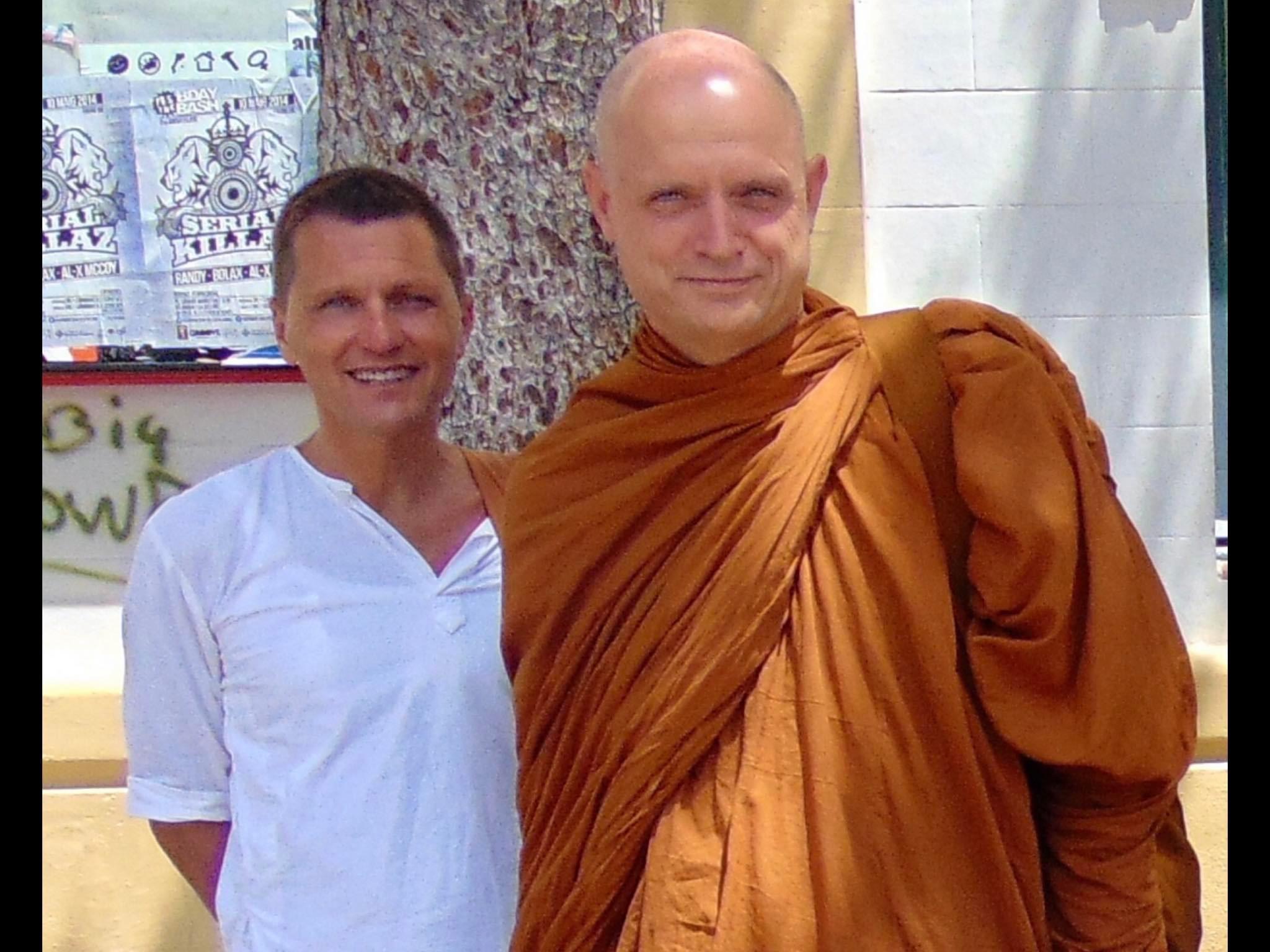
About ten years ago in Barcelona, I had the great honour of accompanying and translating for, the most venerable Ajahn Jayasaro for three days. During those three days I, alongside a few devout Thai friends, had the pleasure of being with Ajahn as he taught in English and I translated into Spanish. I rode with him and Ajahn Vajiro, as he visited the spectacular Parc Güell and graciously accepted an invite to visit my beautiful home town of Sitges. I slept on the floor of the dwellings rented for the two monks, to assist in any way necessary. 

Having read and learned from the wonderful teachings of Luangpor Chah for more than ten years, secretly hoping that one day I would be able to ordain into his lineage, while at the same time aware that as an Insulin dependent Diabetic, I might be rejected, to meet an Ajahn Chah monk was, for me, like meeting royalty or the worlds most famous person, and he did not disappoint! For the three days I observed Ajahn Jayasara closely, scrutinising his moves, his mannerisms, his speech, his way of addressing people and his wise, considered responses to questions or comments. In serving food into his alms bowl I was hugely impressed by his kindness, restraint and gratitude. He really did not put a foot wrong and was, for me, a living example of what a practicing Bhikkhu can, and ideally should be. 

I had read the story of the Arahant Maechee Kaew. Her description of the Great Ajahn Mun, as he appeared in her village from the surrounding forest, I fond truly inspiring. For me, the Great Ajahn Jayasaro, left that same profound impact, that same sense of awe that will never leave me. 

I write all of this to express my GREAT delight, my heart felt joy, for a young friend who had the opportunity to meet, pay respects to, learn from and sit with Ajan Jayasaro, the modern day master of Thai Buddhism and disciple of Ajahn Chah. Young Padair, an accomplished meditator, eager dhamma student, highly intelligent and polite, respectful, kind man, was blessed to attend Ajahn’s dhamma talk at Wat Buddhapadipa in Wimbledon last night. I had no doubt in my mind that this young Dhamma brother would be impressed by Ajahn Jayasaro and eagerly awaited his response yesterday evening. His message to me, “I am without words!” was exactly what I expected, and my heart has been soaring since! 😁😁😁🙏❤️ 

I believe that Ajahn Jayasaro, who has lived a very exclusive life in an unknown, carefully guarded secret location for many years, is teaching in the U.K for a few weeks. I hope beyond hope that I will be able to see him. If any of you have the opportunity to hear Ajahn speak, I would encourage you to give up everything to do so. I promise you that it will be life changing and something that you will cherish for always, as I too cherish my memories of this wise, compassionate, joyful and humble renunciate.

🙏🙏🙏😁❤️


May all beings be happy, free from suffering and attain Nibbāna 

😁❤️🙏


17 January 2023


Sunday, 25 December 2022

The Beauty of Sila Ajahn Jayasaro

The Beauty of Sila
Ajahn Jayasaro 


"The third principle underlying the life of a samana deals with integrity, restraint and chasteness in matters related to the sexual instincts of the body. That a group of young men — most of you young, Ajahn Vipassi and I are getting on a bit — are able to lead a completely celibate life, this is almost unbelievable to many people in the world. They assume that we have some kind of sexual release, that we must have homosexual relationships or else that we masturbate. They don’t think it’s possible to live this way. People these days can hardly credit the idea that a community of men can live in a completely chaste way, and not be utterly screwed-up, repressed or misogynist. Maybe we are! — if we were repressed we wouldn’t realize it would we? But I don’t think so. I think our community is living the ‘Holy Life’ in a resolute but intelligent way. And though it’s not difficult all the time, for almost everyone there are periods when it is definitely challenging. It’s a struggle, and it is fitting to feel a sense of wholesome pride in the fact that you can do it."


The Beauty of Sila

Ajahn Jayasaro 

http://www.watpahnanachat.org/beauty-of-sila

Inset: Ajahn Jayasaro, Ajahn Siripanyo and Prayudh Payutto (Somdet Phra Buddhakosajarn). Prayudh Payutto is a renowned Buddhist scholar in Thailand, he holds the rank somdet phra rachakhana. Ajahn Jayasaro was the abbot of Wat Pah Nanachat from 1997-2002. Ajahn Siripanyo is the only son of Ananda Krishnan, one of the wealthiest Malaysian.


7 January 2023


Friday, 28 October 2022

❖ Why do monks wear robes of different colors? ❖ ~ by Ajahn Jayasaro ~

❖ Why do monks wear robes of different colors? ❖ 
~ by Ajahn Jayasaro ~ 

The bright yellow or orange - colored robes are usually worn by monks living in monasteries situated in the villages, towns and cities. The darker colored robes are usually worn by monks from forest monasteries. 

Most monks nowadays wear robes made of synthetic material. These robes are produced commercially in a variety of colors, bought by lay Buddhists, and then offered to monks. 

In most monasteries a set color is prescribed, but in some monasteries monks are free to wear whatever colored robe is offered to them, provided it lies within acceptable boundaries. 

In many forest monasteries monks still sew their own robes and dye them with color extracted from the heartwood of the jackfruit tree. The color of these robes varies according to the color of the wood used (which varies from a golden color through to orange-red), and to the age of the robe (which is only ever washed in a diluted solution of the dye, a weak astringent, and gets darker as it ages). 

(From “Without and Within, Sangha” by Ajahn Jayasaro) 

- - ❖ - -

To read the ebook, please visit ‘Without and Within', by Ajahn Jayasaro:

https://cdn.amaravati.org/wp-content/uploads/2014/10/11/Without-and-Within-by-Ajahn-Jayasaro.pdf

- - ❖ - -

For other teachings by Ajahn Jayasaro, please visit the Panyaprateep Foundation website:

https://www.jayasaro.panyaprateep.org/

- - ❖ - -

Photo: ‘Without and Within’


14th November, 2022


Thursday, 27 October 2022

The teachings of Ajahn Jayasāro.

The teachings of Ajahn Jayasāro.


There is no way out of suffering for those who identify with it, or those who deny it.  There is no way out of suffering for those who consider it a random occurrence, or those who see it as a test or a punishment from a supreme being.  

There is a way out of suffering for those who gain faith in the Buddha's analysis of suffering as a conditioned state and who follow the Eightfold Path.  In the Upanisa Sutta, the Buddha revealed the causal process involved:

"With faith as proximate cause, well-being.

With well-being as proximate cause, zest.

With zest as proximate cause, tranquillity.

With tranquillity as proximate cause, happiness.

With happiness as proximate cause, samādhi.

With samādhi as proximate cause, the knowledge and vision of things as they really are.

With the knowledge and vision of things as they really are as proximate cause, disenchantment.

With disenchantment as proximate cause, dispassion.

With dispassion as proximate cause, liberation.

With liberation as proximate cause, the knowledge of ending."

"It's like when it rains heavily on a mountain top, and the water flows downhill to fill the hollows, crevices and creeks.  As they become full, they fill up the pools.  The pools fill up the lakes, the lakes fill up the streams, and the streams fill up the rivers.  And as the rivers become full, they fill up the ocean."


~ Ajahn Jayasāro


11th November, 2022


Wednesday, 6 July 2022

Ajahn Jayasaro

Ajahn Jayasaro


“During meditation, when the mind is firm, clear and alert in the presente moment, it as if the world and the person we believe yourself to be, disappears for a while. 

At that time we have no sense of name, gender or status. 

We do not experience ourself as a son or daughter, as a sibling, a spouse or a parente. 

We don´t look on ourself as good or bad, intelligente or stupid. 

We have entered another dimension of life, one characterised by a feeling of well-being that seems completely normal and natural. It is as if we have come home.

Opening our eyes and returning to the world of relationships and responsibilities, the memory of that other more profound dimension of life gives us a new perspective. 

We are conscious of a realm of peace within us, untouched by all the ups and downs of daily life. We fully participate in our world but don´t take it quite so seriously as before.”


AJAHN JAYASARO


Thursday, 26 May 2022

What is the best way to deal with stress?

❖ What is the best way to deal with stress? ❖
~ by Ajahn Jayasaro ~


Given our responsibilities and the pressures upon us, feeling a certain amount of stress is probably inevitable. It is not always a bad thing, and hard to imagine how making positive changes in our life, abandoning old unwise habits, could be possible without any stress at all. If we are unable to deal with stress or feel we should not have to deal with it, we may fail to realize important goals in our life.

Nevertheless, it is possible to radically reduce the amount of stress we experience. It helps to simplify our lives as much as we can and learn to slow down a little; trying to fit too much into a day is needlessly wearing. 

Bringing attention to the quality of our actions and speech reduces stressful interactions with others. A more judicial use of resources reduces stress over personal finances. Regular exercise, especially yoga and tai chi (because designed to affect the nervous system), alleviates much physical tension, and teaches us to breathe more naturally.

Regular meditation practice gives us the skill to recognize and let go of the toxic moods and thoughts that underlie chronic tension. 

Unrealistic expectations of ourselves and those around us, for instance, can be crippling. In daily life, taking regular short breaks to calm and center the mind prevents stress from gradually accumulating throughout the day. 

These breaks might take the form of a sixty-second breath meditation in front of a computer or simply taking a few deep grounding breaths before picking up a ringing phone. 

Developing the ability to come back to the present moment and re-establish a state of calm alertness on a regular basis throughout the day can make significant changes to the quality of our life.

- - ❖ - -

To read the ebook, please visit ‘Without and Within', by Ajahn Jayasaro:

https://cdn.amaravati.org/wp-content/uploads/2014/10/11/Without-and-Within-by-Ajahn-Jayasaro.pdf


Tuesday, 16 November 2021

❖ What does it mean to “let go”? ❖ ~ by Ajahn Jayasaro ~

❖ What does it mean to “let go”? ❖
~ by Ajahn Jayasaro ~


The Buddha taught us to observe how we constantly create suffering for ourselves by grasping onto the body and its senses, feelings, perceptions, thoughts, emotions as being “me” or “mine”. Learning how to abandon that habit is learning how to “let go”. It is not possible through an act of will. 

Letting go occurs naturally when the trained mind is keen enough to perceive that there is nothing to be found in our direct experience which corresponds to the concept of “me” and “mine”.

“Me” and “mine” are not, however, mere illusions; they are extremely useful social conventions, and the Buddha taught that they should be respected as such. Although the body, for example, is strictly speaking “not mine”, that does not mean that it should be neglected. Letting go of the body does not mean giving up on exercise, bathing and a healthy diet. It means not allowing one’s life to be defined in terms of the body. It means freeing oneself from all the anxiety, insecurity and vanity, and all the fear of aging, sickness and death that accompanies an unwise relationship to the body.

“Letting go” is also an idiom used for intelligent effort. Knowing that no effort we make exists in a vacuum, that it will always be affected to some degree by conditions over which we have no control, we let go of our demands and expectations for the future. We create the best possible conditions for reaching our goals, and then let go of the results.


- - ❖ - -


Thursday, 11 November 2021

❖What is the essence of Buddhism?❖ ~ by Ajahn Jayasaro ~

❖What is the essence of Buddhism?❖
~ by Ajahn Jayasaro ~


The Buddha answered this question with a powerful simile. He said that just as from whatever sea, whatever ocean, one were to take a sample of water, it would always have the same salty taste, so every one of the Buddha’s teachings reveals the single taste of liberation. Liberation, freedom from dukkha and its causes, is the essence of Buddhism.


❖ What is the ultimate goal of Dhamma practice? ❖
~ by Ajahn Jayasaro ~

The results of Dhamma practice can be expressed both in the negative and the positive sense. In the negative sense, the result is freedom from all suffering and from all the causes of suffering, namely the toxic mental states rooted in greed, hatred and delusion. In the positive sense, it is the perfection of wisdom, compassion and inner freedom.


���������

- - ❖ - -

To read the ebook, please visit ‘Without and Within', by Ajahn Jayasaro:

http://www.withoutandwithin.net/ebook/

- - ❖ - -

For other teachings by Ajahn Jayasaro, please visit the Panyaprateep Foundation website:

https://www.jayasaro.panyaprateep.org/

- - ❖ - -

To request the print book, please register: 

https://www.bia.or.th/wowi/


- - ❖ - -

Photo: ‘Without and Within’

Thursday, 20 May 2021

The Monastery as a Refuge ~ Ajahn Jayasaro

The Monastery as a Refuge
~ Ajahn Jayasaro


The monastery, he [Ajahn Chah] said, was a refuge from the stresses and strains of daily life. It was a place where people could take a step back from their lives, take an overview and learn life skills that would stand them in good stead in their daily life.

If they left it too long, it might be too late. He teased people who waited to go to the monastery until they could no longer sit on the floor and were too deaf to hear the Dhamma talks. Worse than that, they could die first…

“And the only way a corpse gets to go to the wat is when it’s carried there for cremation.”

Apart from the people who believed that they had too little suffering to need to practise Dhamma, there were those who felt that they had too many worries to make it worthwhile. 

Even if they went to the monastery, they believed, it would be a waste of time. 

They could never find any peace until their troubles were sorted out.

To Luang Por, this was like someone saying that they would not go to see the doctor until they were feeling better. At the monastery, everyone could learn ways to handle the stresses of their situation better.


This reflection by Ajahn Jayasaro is from the book, 

Stillness Flowing.

https://www.abhayagiri.org/books/617-stillness-flowing


Saturday, 6 March 2021

What is the purpose of walking meditation and how is it practiced? ~ by Ajahn Jayasaro ~

What is the purpose of walking meditation and how is it practiced?
~ by Ajahn Jayasaro ~


Walking meditation provides both a supplement and an alternative to sitting meditation. 

Some meditators prefer it to sitting and may make it their main practice. 

Walking meditation is a particularly useful option when illness, tiredness or a full stomach make sitting meditation too difficult. 

Whereas in sitting meditation mindfulness is developed in stillness, in walking meditation it is developed in movement. 

Practicing walking meditation in combination with sitting thus helps the meditator to develop a flexible all-round awareness that can be more easily integrated into daily life than that which is developed by sitting meditation alone. As an added bonus, walking meditation is good exercise. 

To practice walking meditation, a path of some 20-30 paces long is deter-mined, with a mark placed at the mid-point. 

Meditators begin by standing at one end of the path with hands clasped in front of them. Then they begin walking along the path to its other end, where they stop briefly, before turning around and walking back to where they started. After another brief halt, they repeat this, walking back and forth along the path in this way for the duration of the walking meditation session. Meditators use the beginning, the end and the mid-point of the path as check-points to ensure that they have not become distracted. The speed at which medi-tators walk varies according to the style of meditation being practiced and to individual preference. 

In the initial effort to transcend the five hindrances to meditation a variety of methods may be employed. 

One popular method, similar to that mentioned in the discussion of sitting meditation, is to use a two-syllable meditation word (mantra): right foot touching the ground mentally recit-ing the first syllable; left foot touching the ground, the second. Alterna-tively, awareness may be placed on the sensations in the soles of the feet as they touch the ground. As in sitting meditation, the intention is to use a meditation object as a means to foster enough mindfulness, alertness and effort to take the mind beyond the reach of the hindrances, in order to create the optimum conditions for the contemplation of the nature of body and mind. 


(From “Without and Within, Bhavana (Mental cultivation) by Ajahn Jayasaro) 


Tuesday, 23 February 2021

What is the basic method of meditation? ~ by Ajahn Jayasaro

What is the basic method of meditation?
~ by Ajahn Jayasaro ~ 🥀


Although certain fundamental principles inspire all forms of Buddhist meditation, there is great variety in the specific techniques employed to embody them. There is not one basic method of meditation but many. 

One particular approach is as follows. 

Firstly, the meditator gives attention to the external conditions. It is helpful to have a particular space put aside specifically for practicing meditation. The meditator wears loose clothing and ensures reasonable ventilation: stuffy rooms induce dullness. 

Sitting cross-legged is the best posture, as it produces feelings of stability and self-reliance which support the meditation practice. Most people find it helpful to use a small cushion as support for the lower back. 

The posture should be straight, but not rigid; the meditator looks for a balance between effort and relaxation (the free flow of the breath is a sign that this has been achieved). The meditator places the hands in the lap or on the knees and gently closes the eyes (they may be kept slightly open and unfocused if sleepiness threatens). If sitting cross-legged is not possible, the meditator sits on a seat, but if possible, without leaning against the backrest. 

Meditators begin by spending a few moments of reflection recalling their motivation, the technique to be employed and the pitfalls to avoid. They then systematically pass their attention from the head down to the feet, identifying and relaxing any tension in the body. On discovering a knot of tension, in the shoulders for example, the meditator consciously increases the tension for a second or two and then relaxes it. 

Physically prepared, meditators now focus on the particular meditation object which they have chosen. 

Here we will discuss breath meditation, the most popular form in the Buddhist tradition: the meditator trains to be present to the sensation of the breath at the point in the body in which it is felt most clearly. 

For most people this point will lie in the area around the tip of the nose. It is unwise to force the breath in any way. The meditator is merely aware of the present sensation as it appears. 

To help sustain attention on the breath, a two-syllable mantra may be recited mentally, first syllable on the in-breath, second on the out-breath. The most common word used by Thai Buddhists is Bud-dho, but reciting ‘in’ on the inbreath, and ‘out’ on the outbreath would also work. Counting the breaths may also be used to sustain the connection between the mind and the breath. The simplest form of counting the breath is to count in cycles of ten, taking one inbreath and outbreath as 1, and then continuing up to 10 and then back to 1. 

Whatever technique is adopted, the mind will wander. Just as in learning to play a musical instrument or learning a language, the meditator must be patient and committed, and have faith that in the long run meditation is worth the time and effort. Gradually the mind will settle down. 


(From “Without and Within, Bhavana (Mental cultivation)” by Ajahn Jayasaro) 


- - ❖ - -


To read the ebook, please visit ‘Without and Within', by Ajahn Jayasaro:

https://www.bia.or.th/ebook/content/web/index.php?bookid=130


- - ❖ - -


For other teachings by Ajahn Jayasaro, please visit the Panyaprateep Foundation website:

https://www.jayasaro.panyaprateep.org/


- - ❖ - -


Photo: ‘Without and Within’


Sunday, 24 January 2021

A SPECIAL ATTITUDE ~ Ajahn Jayasaro

A SPECIAL ATTITUDE
~ Ajahn Jayasaro


[Ajahn Chah] said that listening to Dhamma talks requires a special attitude:

“Keep listening, keep listening. Don’t just believe what you hear and don’t disbelieve. Make yourself neutral. Keep listening. It will bring good results, and there’s no danger in it.

The peril lies in believing too much in what you hear, or in disbelieving. Listen and contemplate. This is what practice is about: being a listener and being one who reflects on things. As you don’t know yet whether the things you like and dislike are true or not, the Buddha said that, for the time being, you should keep listening.

If you don’t, you’ll just follow your own opinions about things, and if you do that, then you will develop wrong view, and your practice won’t advance. The wise person is one who keeps looking, contemplating, continually reflecting.

The true Dhamma is not something that can be communicated with words. You can’t appropriate someone else’s knowledge. If you take someone else’s knowledge, then you have to meditate on it. Listening to someone else and understanding what they say doesn’t mean that your defilements will come to an end. 

You have to take that understanding and then chew on it and digest it until it’s a sure thing and really your own.”


This reflection by Ajahn Chah as recounted by Ajahn Jayasaro is from the book, Stillness Flowing, (pdf) pp. 198-199.


E-book: https://forestsangha.org/teachings/books/stillness-flowing?language=English


📷 Credit & Source: https://www.abhayagiri.org/reflections