Labels

Showing posts with label Question and Answer. Show all posts

Wednesday, 29 November 2017

Only those with calm minds will notice the suffering when it arises by Ajahn Suchart Abhijāto

"Only those with calm minds will notice the suffering when it arises…”


Question:  
“How is cultivating mindfulness related to being aware of dukkha—the first of the Four Noble Truths?”

Than Ajahn:  
“Cultivating mindfulness (sati) has to do with the fourth Noble Truth, or the path (magga). It is to be aware and mindful of the movement of and changes in your body. There are four foundations to the Establishing of Mindfulness: body (kāya), feelings (vedanā), mind (citta), and phenomena (dhamma).
In the beginning, you have to start from the body—to use it as your basis (to cultivate mindfulness) for it is the easiest object of contemplation. Feelings, mind, and phenomena are subtler and more profound, hence difficult for beginners to penetrate.

You have to be able to establish an awareness of your body first—to ground your mind and train it to be in the present in order to gain concentration (samādhi). You'll be able to see your suffering (dukkha)—the first of the Four Noble Truths—once your mind is concentrated. You won't be able to discern the first of the Four Noble Truths when your mind is restless, unfocussed, and distracted. When you're unhappy, you'd blame the things that you can physically see. You'd blame others, attributing your unhappiness to their actions. In reality, your discontent is due to your own craving—wanting them to be in a certain way.

In order for you to notice your unhappiness or discern dukkha— the first of the Four Noble Truths, you first need to calm and focus your mind. You ought to cultivate your mindfulness because it will lead to your mental calm and concentration. With a calm mind, you'll able to notice the difference immediately when suffering arises. It's because your mind will waver as opposed to being tranquil. The arising of suffering is like repercussions of throwing a stone into a pond.

Only those with calm minds will notice the suffering when it arises, whereas those with unruly minds won't because their minds are constantly in flux. So to discern the first Noble Truth, or dukkha, requires an establishing of mindfulness—getting the mind concentrated first. The Buddha thus emphasised cultivating the path, or magga. Magga includes: generosity (dāna), precepts (sıla), and mental cultivation (bhāvanā). Bhāvanā is basically to establish mindfulness (sati), concentration (samādhi), and wisdom (paññā).”


“Essential Teachings”

By Ajahn Suchart Abhijāto


Wednesday, 8 November 2017

The process of rebirth by Ajahn Suchart Abhijãto


“The process of rebirth.”

"How long you have to spend in heaven or hell depends on when you finished spending your good kamma or bad kamma. After you have expired your good kamma and bad kamma, your mind will take up a new body and be reborn as a human being again. This is what we called, ‘the process of rebirth’. After you die, you’ll go to heaven or hell, or be born as an animal. And after you have expired all your kamma, the good kamma and the bad kamma, then you’ll be reborn as a human being again, to do more good or bad kamma depending on whether you know about it or not. If you live with people who know about it, such as the Buddha, or you live when there is Buddhism, then you’ll be taught not to do bad kamma, but do only good kamma. Buddhism also teaches you the way not to be reborn again.

The Buddha has discovered the cause of our rebirth. Our rebirth is caused by our craving or desire – the desire to use the body as a mean to bring happiness. We have to have a body to see what we want to see and to hear what we want to hear. We use this body to take us to places, to do things to make us happy. As long as we rely on this body as a mean of producing happiness for us we’ll always have to come back and be reborn to have a new body after this body expires. This body only last for a certain length period of time. After 80 or 90 years, the body will have to die.

But the desire to use the body doesn’t die with the body, so it brings the mind to take a new body. This is called, ‘rebirth’.

Once you’re reborn, you then have to go through the process of suffering. You have to get old, get sick and die. You have to worry about your existence. You have to fight to stay alive.
According to the Lord Buddha, these are all suffering.  If you don’t want to suffer, then you should stop rebirth."


-------


Question:

Does it mean that the habitual practice is actually very important course of action?

Than Ajahn:

Yes. Everything that you do adds up until the end of your life.
Today you’re doing good kamma. Maybe tomorrow you are doing a bad kamma. Then, these go to different accounts: good kamma account and bad kamma account. When you die, both of these accounts will combined and you’ll see which one is stronger. If the good kamma is stronger, then it will send you to heaven. If the bad kamma is stronger, it will take you to hell.

And when both the good and the bad kammas become equal, then you’ll be born as a human being.
Because the good kamma cannot send you to heaven; The bad kamma cannot send you to hell. So, the only place you can go is to become a human again.”


Dhamma for the Asking,

Laypeople from Malaysia and Singapore, Oct 26, 2017
Laypeople from Malaysia, Feb 6, 2017.

By Ajahn Suchart Abhijāto


Saturday, 4 November 2017

May they take what is taught to heart and put it into practice by Ajahn Suchart Abhijãto

"May they take what is taught to heart and put it into practice.”

Question:
Out of compassion for your students, may Than Ajahn live a long time.

Than Ajahn:
I will have compassion as long as this body allows. When the body breaks down I won’t be able to do anything about it. I can’t control it. May the students also have compassion for the teacher. May they take what is taught to heart and put it into practice.

When the students don’t practice, the teacher feels weary.

Sometimes whatever is taught goes in one ear and right out the other. Even though they come back days or months later, they still haven’t changed at all. When this happens the teacher gets discouraged. The students are stuck in 1st grade and refuse to move on to 2nd or 3rd. They don’t want to graduate college at all.

Oh, be considerate of the person teaching as well! It’s not just for the teacher to have loving kindness. 

Really, the student should have loving kindness for the teacher as well. If the students complete their studies, then “Oh!” It will really encourage the teacher to live a long time because then he sees the results coming from his teaching.

There really is nothing like seeing people free themselves from suffering. Seeing people cry is so sad; wouldn’t it be better to see them laughing? Wouldn’t it be better to see them happy? Truly, once we attain to the Dhamma, we can laugh even when we are sick and dying because Dhamma teaches us to know that the body is not us or ours.

The body is but a house on fire, a mountain that weighs down the heart. Every day we feel burdened and heavy-hearted because of the issues related to the body, making a living, and maintaining our body so that it can live free from illness. All these things revolve around the body. If there were no body, we would be light-hearted. Or to get the same result while there is a body, we do not attach to it or believe it to be ourselves.

May you have compassion for your teacher and go practice. Then you can come back and tell me, “Now I’m so happy! I’m no longer bothered by my body at all. If something happens to it, even if it dies, I can accept it. It’s not a problem at all.”

If that happens, out of compassion I will live a long time.

“Mountain Dhamma”

By Ajahn Suchart Abhijāto

Look at the pain like the weather by Ajahn Suchart Abhijāto

The Teaching of Ajahn Suchart.

4 October 2024

"Look at the pain like the weather.”

Monk:
"We all want to let go of painful feeling but it can’t be just an act of will. How do we let go of painful body feeling?"

Than Ajahn:
"You have to use rationality. Look at the pain like the weather. Leave it alone. Can you tell the sun to disappear? Can you tell the rain to come right now? 

You cannot. You just take them as they come. If you have pain, just leave it alone. One way to leave it alone is to focus on something else, like on the mantra or on your breath, so you don’t go engaged with the pain. 

This is the first step to deal with the pain, by using mindfulness.

Once you can deal the pain with mindfulness, the next step is to use rationality, use wisdom. 

Look at the pain as if you look at the weather. 

It’s anattā. It doesn’t belong to you. You cannot control it. You cannot tell it what to do. You cannot tell it to come and go. It comes as it likes. It goes as it likes. The only thing you can do is just to watch it like you watch the weather.

Monk:
"Sometimes we bring umbrella when it rains.” 

“Sometimes when there is pain, we change our postures. Do you suggest that we shouldn’t change postures, and just watch the pain?"

Than Ajahn:
"Yes. If you change the posture one time, when you get sick, no matter how you change your postures, it won’t disappear, such as if you’ve got cancer and you’ve got pain in your body. 

Nowadays they try to use medicine and if medicine doesn’t work, then they use the bullet or injection because they could not withstand the pain. This is vibhava-taṇhā. And as long as you still have vibhava-taṇhā, you’ll still have to come back and be born again.

And then, you will face the same problem and solve the problem the same way again. So, you will be stuck within this vicious cycle."


Dhamma for the Asking,
Monks and laypeople from Australia.
Feb 6, 2017

By Ajahn Suchart Abhijāto

When you’re enlightened, it means you see the truth of the body by Ajahn Suchart Abhijāto

“When you’re enlightened, it means you see the truth of the body.”

Question (F):
"Is it possible for someone who is unenlightened to actually see and accept the breakdown of the body?"*

Than Ajahn:
"That’s the purpose of the practice. You practice to become enlightened. When you’re enlightened, it means you see the truth of the body. When you do not see the truth yet, you just have to keep teaching it to see the truth.

The problem is the mind doesn’t want to look at the truth. That’s why you have to force it to keep contemplating on ageing, sickness, and death all the time.

If you keep contemplating, you will eventually see it. The reason why you are not seeing it is because you don’t want to think about it. When you don’t think about it, you forget. So, what you have to do is to keep reminding yourself that the body will get sick, get old, and die and there is nothing you can do about it."

Question (F): 
"Sometimes I become afraid. I’m scared."

Than Ajahn: 
"That’s because your mind is not calm enough to handle the truth.

That’s why you have to meditate to calm your mind first. You need to have samādhi before you can go on to develop insight, go on to contemplate the truth. And you need to develop the mindfulness first. If you have strong mindfulness, then you can calm your mind. When your mind is calm, you can see the truth and you wouldn’t feel any fear. You will not be scared of the truth.

That’s why the Buddha taught samādhi before you go to paññā or wisdom. And in order to get samādhi, you need to have mindfulness. That’s where the Four Foundations of Mindfulness comes into play. The first instruction is to go sit under a tree and meditate. Focus your attention on your breath until your mind becomes calm. Once your mind becomes calm, then you can look at the truth of the body: you can investigate the nature of the body; you can investigate the nature of feelings; you can investigate the nature of your mind.

If you are not calm, you will not be able to do it because your mind will be distracted. Your mind will be pushed by the defilement to think of other things. The defilement likes you to think about things that are nice and beautiful, long-lasting, and permanent, even though they never exist. But the defilement tells the mind to go look for them instead of looking for the truth.

That’s why there is a story about ‘going after the eternal youth’.

There is no such thing, yet the defilement can deceive the mind to think that there is something like that."

Dhamma in English,
Monks and laypeople from Australia.
Feb 6, 2017

By Ajahn Suchart Abhijāto

Monday, 23 October 2017

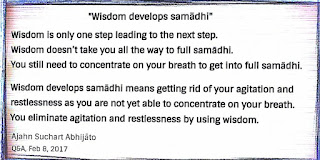
Wisdom develops samādhi.- Ajahn Suchart Abhijāto


"Wisdom develops samādhi.”


QuestionLuangta Maha Boowa mentioned that there are two general ways in meditation to achieve stillness. One being ‘samādhi develops wisdom’, and the other is ‘wisdom develops samādhi’. Will Venerable Ajahn share the key points of 'wisdom develops samādhi' – using wisdom as a means to develop concentration?

Than Ajahn: When you sit to meditate and your mind keeps thinking about work or about the problems you have and when you cannot use a mantra or use your breath to calm it down, then, you need to attack the problem that keeps your mind away from being calm.

If you’re worried about your work, then you have to look at your work whether it’s permanent or not. No matter how well you do with your work, one day you’re gonna run out of work. Why should you worry? Don’t worry. One day you are going to lose it anyway. And you cannot tell when you’re going to lose your job today or tomorrow.

If you can accept the truth that your work is impermanent and there is nothing you can do about it to make it permanent, then you just forget about it and accept it. Once you accept that one day, sooner or later, you’re going to lose the job, you have no worry about your job. Your mind can then settle down and you can concentrate on your breath.

Wisdom is only one step leading to the next step. Wisdom doesn’t take you all the way to full samādhi. You still need to concentrate on your breath to get into full samādhi. Wisdom develops samādhi means getting rid of your agitation and restlessness as you are not yet able to concentrate on your breath. So you eliminate agitation and restlessness by using wisdom. Wisdom is to see things as aniccaṁ, dukkhaṁ, anattā (impermanent, subjected to suffering, and everything doesn’t belong to you). Sooner or later, one day, you’re going to lose them.

If you can see the truth, you will not worry about anything or anybody. Right now, you think that people and things are belonged to you and you want them to stay with you. When they show signs of not staying with you, you become worried and agitated. If you can see the truth and say, ‘They’re gonna leave you one day, sooner or later, and there’s nothing you can do to stop them from leaving you. It’s either they leave you or you leave them.’, then you’ll just stop worrying. Your mind can settle down. You can sit and concentrate on your breath.


By Ajahn Suchart Abhijāto


Friday, 20 October 2017

Life is an addiction by Ajahn Suchart Abhijāto

The Teaching of Ajahn Suchart.

Life is an addiction


Than Ajahn: Do you want to become enlightened?

Sāmaṇera: There is something I believe about Buddhism but there are other things that I don’t think I agree, like being alone.

Than Ajahn: Do you think to be alone is not good? Do you think that it’s better to be with someone?

Sāmaṇera: Yes. I think that even Buddhism said that life is full of pain and sorrow, but now at this moment, I want to live my life fully, do whatever I want to do.

Than Ajahn: How long do you think you can do this for? Until you get old, right? Until you get sick. Then, what happens?

Sāmaṇera: Then, die.

Than Ajahn: Then, die. So, what happens to all the things that you have done?

Sāmaṇera: They vanish.

Than Ajahn: So, why do you do them in the first place if they vanish?

Sāmaṇera: I don’t know.

Than Ajahn: Because you cannot stop yourself from not doing it. If you can stop yourself from doing it, you’ll be happier. I’ll give you an example, which one is better, someone who is addicted to drugs and someone who is not addicted to drugs?

Sāmaṇera: The one who is not addicted to drugs.

Than Ajahn: It’s the same way with being addicted to do things. You are addicted to do things and this is like addicted to drugs. When you have nothing to do you feel bad, and when you’ve got something to do, you feel good. But for how long can you continue doing it? One day you’ll end up not being to do what you want to do. Then, what happens? You’ll feel bad. You might want to kill yourself.

When people cannot do things they want to do by themselves, they’re not happy. They feel terrible. So, what do they do? They decide to kill themselves. But if you don’t have to do anything, you don’t have to kill yourself. If you can become a monk and you don’t have to do anything, then you will always be happy, like someone who is not addicted to drugs.

Monks and laypeople are like two persons. 

One person is addicted to drugs and the other person is not addicted to drugs. Monks are the ones who are not addicted to doing things to make them happy, while laypeople are those who are addicted to doing things to make them happy. But the happiness that laypeople get is like smoke. It comes and disappears very quickly. As soon as they get what they want, their happiness disappear. 

Sāmaṇera: Do you mean happiness from material things?

Than Ajahn: Yes, materials or actions, like going to see a movie, listening to music, sleeping with someone. These are temporary happiness. They’ll vanish. Then you’re left all alone again. You have to keep having them all the time until the time when you cannot have them then you’ll kill yourself. 

But if you can stop this addiction, you can be happy all the time without having to have anything to make you happy.

Life is an addiction. We are addicted to life, addicted to do things to make us happy, to feel alive. We don’t want to be dead. When you’re dead, you cannot do anything. But you can stop your mind from being addicted to life. 

You can live happily with life or with no life, it’s like having drugs or no drugs. 

Sāmaṇera: And you are happier when you meditate, right?

Than Ajahn: When you meditate, it can stop you from doing other things. Once you know how to meditate, you don’t need to do other things. 

Focus on one object to stop your mind from thinking. When you think, your mind will not be calm, will not be concentrated, will not be happy. If you can stop your mind from thinking, your mind will become calm and happy. Once you’re happy, then you don’t need anything. You can get rid of your drug addiction and can get rid of all your addictions. 


By Ajahn Suchart Abhijāto

Thursday, 19 October 2017

What is the feeling of being enlightened? By Ajahn Suchart Abhijāto

“What is the feeling of being enlightened?”

Sāmaṇera I don’t understand why monks cannot touch women?

Than Ajahn: To prevent the sexual desire to arise. When you touch a woman, the desire can arise and then you might not be able to stop it.  And if you do something with a woman, you have to be considered to be disrobed.  You cannot remain as a monk or a novice.  
A monk and a woman are like electricity, positive and negative charge.  When they come together, they’re attracted to each other.  So, you have to stay away from women.  No touch.  Not even looking.  If you happened to look, you should look away. When you see a woman, try not to look at her.  Try to ignore her.  Don’t see her.  

Sāmaṇera Are there other monks who have reached enlightenment after the Buddha?

Than Ajahn:  Yes.  

SāmaṇeraAre there a lot of them or just a few?

Than Ajahn:  There is no statistics which counts how many are there. But there are very few monks who are enlightened, and they are very hard to find. Do you believe that there are still monks who can be enlightened?  

Sāmaṇera I don’t know. It’s strange.

Than Ajahn:  Why?

Sāmaṇera I would like to hear what they say.

Than Ajahn:  What do you want to hear from them?  

SāmaṇeraWhat is the feeling of being enlightened?

Than Ajahn:  You can hear about it from the Buddha.  He said, ‘If you’re enlightened, you’ll be happy’. You will have no sorrow, no sadness. You will always be happy 24 hours a day. ‘Nibbānaṁ paramaṁ sukhaṁ.’  Nibbāna is the state of enlightenment.  When the mind becomes enlightened, it becomes pure, it has no defilements: no greed, hatred, delusion.  When the mind is without greed, hatred, and delusion, the mind will be very happy and will have no sadness. 


By Ajahn Suchart Abhijāto

Is chanting a kind of prayer? And what is the value of chanting?


Is chanting a kind of prayer? And what is the value of chanting?

As prayer is generally taken to involve a relationship with a deity, it would not accurately describe the Buddhist practice of chanting. The Theravāda Buddhist understanding of action and its results (kamma-vipaka) allows no place for prayers of supplication or thanks. However, there is some similarity between chants praising the qualities of the Buddha, Dhamma and Sangha, and the hymns of praise found in theistic traditions. Many people believe that a protecting power and auspiciousness arise in the heart through the chanting of such verses.

Most of the more popular chants found in the Thai Buddhist tradition consist of passages selected from the Tipitaka. They include verses listing the qualities of the Buddha, Dhamma and Sangha, discourses expounding key teachings, passages of wise reflection, and verses for radiating thoughts of kindness, and for sharing merits with all sentient beings.

For many Thai lay Buddhists chanting is their main spiritual practice. It particularly suits those of a more active disposition who find sitting meditation practices difficult. Some people choose to chant verses in the original Pāli language, without understanding the meaning, as an act of devotion and for the calming meditative effect it produces. But these days it is popular to chant in the modern style, whereby each line of Pāli is followed by its Thai translation. Here the benefit shifts more to the recollection of the meaning of the texts chanted.

In monasteries, the chanting of important discourses is a practice that goes back to the time of the Buddha. Before the teachings were written down they were preserved by communities of monks regularly chanting them together. Chanting also performs a social function in monasteries, where the morning and evening chanting session helps to create a sense of community and harmony.

From Without and Within 
- by Ajahn Jayasaro

Theravada Buddhist Chantings:


Saturday, 14 October 2017

Is a monk allowed to touch his mother, daughter or sister? and Answer

Q: Is a monk allowed to touch his mother, daughter or sister)?


A: No. 

As we read in the Vinaya Piṭaka, Mahāvibhaṅga, it is prohibited in the second saṅghādisesa rule 
(Vin. iii. 126), Monks’ Suspension 

2: Physical contact under an offense of wrong-doing (dukkata).

At the Buddha's time, this happened to a certain monk:
{Now at that time a certain monk stroked his mother for the sake of a mother’s affection. He was remorseful, and said: “What now if I have fallen into an offence entailing a formal meeting of the Order (saṅghādisesa) ?” He told this matter to the lord. The Buddha said: “Monk, this is not an offence entailing a formal meeting of the Order, it is an offence of wrong-doing.”}

(The same offense is then repeated for a monk's daughter and sister...and a monk who makes a physical contact with a wooden doll or a female animal. But if a monk makes a physical contact with a sleeping woman, he commits an offense entailing suspension.)

Caption: 

Recently a TV singer celebrity was ordained temporarily for about one month at one of the Thai temples. His actress wife who is a non-Buddhist, but a Christian asked the abbot if a monk could hold his own daughter. The answer was "yes". After the photos were shared, some people criticized that it was not appropriate for a monk to do so according to Vinaya Pitaka (rules for monks prescribed by the Buddha). People started to argue. Finally, a Thai well known senior monk came out to respond in the social media that it was no problem for a monk to hold his daughter with a heart full of love. He said that even though it was an offense, it was the very minor one. Some monk recommended that he could confess afterwards. Hmm!


Some of the common social issue with monasticism
https://goo.gl/uv6qfY


__________________________________________


_______________________________________________________________