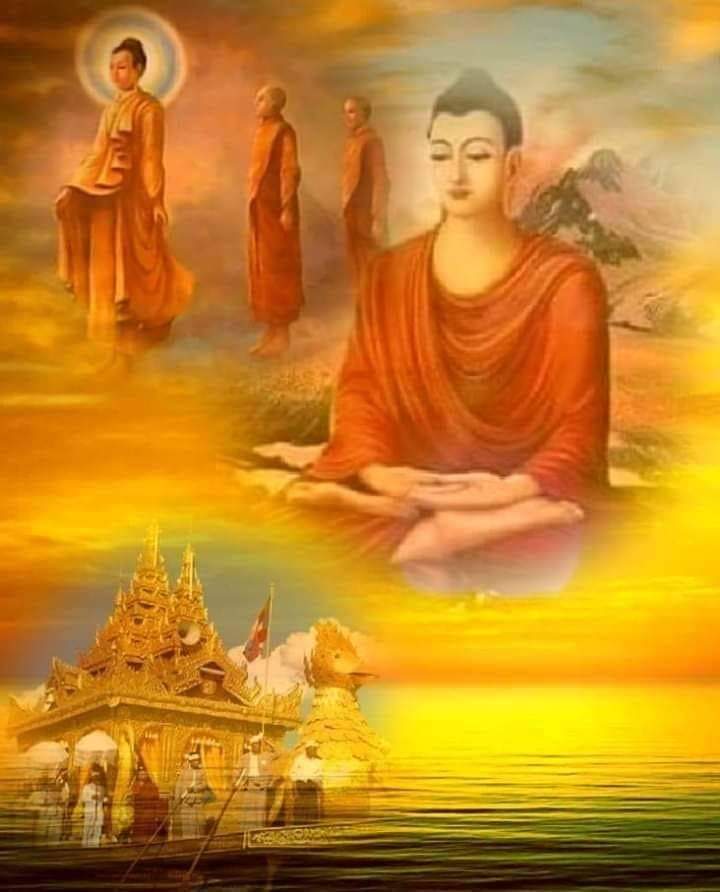
Is it necessary to consecrate a Buddha Image?
The above is the topic expounded by Bhante K Ratanasara of DKBS at its premises this Sun 8 May 2022 afternoon. Days before DKBS announced that it was offering to devotees for free a ''Beautiful, Serene Buddha Statute to set your Spiritual Sanctuary'' as a Vesak Day Gift and that Vesak Day ''is an Auspicious Day to make renewed aspirations and determination to strengthen our Spiritual Practice.'' Thus this afternoon's exposition serves well to enable us to appreciate the true significance of a Buddha Image as practitioners and going forward. At the same time, Bhante made it clear that a Buddha Image is not meant to do magic contrary to mistaken beliefs and misconceptions held by less informed devotees.
Consecration of images is not unique to Buddhism and every religion has ritual ceremonies of some kind.
Socially these ceremonies bring both monastic and lay followers together in spiritual unity. A common belief is that it is necessary to undertake an ''Eye Opening Ceremony.'' When an image is crafted by an artisan or drawn by an artist, invariably they would fill in the ''pupils'' to the eyes to complete and in a way can be described as ''giving breath or life.'' The truth is that The Buddha is a Fully Self-Awakened One and who can be qualified to conduct ''Eye Opening'' for a Fully Self-Awakened One? Even awakened ones like the Arahants prostrate in homage to the Buddha.
Every artist or artisan behind a Buddha Image will endeavour to fulfill the description of the Buddha as described in the Lakkhana Sutta (The Marks of a Great Man), DN 20 as best as he can.
The question is if a Buddha Image is not consecrated is it of any less efficacy? From the Dhamma point of view, it does not make any difference.
The true purpose of a Buddha Image is for practitioners in seeing the serene image to feel a sense of calmness and be inspired by and to recall the sublime qualities of the Buddha as embodied in the Image.
We must remember that while the Buddha is Fully Self-Awakened, all of us are still in deep slumber of ignorance. Hence to the Buddha we endeavour to be inspired to be like Him who sees the Four Noble Truths directly and by Himself. He had no teacher or any outside agency to tell him what to do.
Why is it special that the Buddha Image is given as Gift on Vesak Day? To understand this, it can be traced to the Udana Vatthu, Verses 153 and 154 of the Dhammapada which were uttered by the Blessed One as expressions of intense and sublime joy. He felt at the very moment of His attainment of Enlightenment; as such, they are replete with a wealth of sublime meaning and deep feeling. In Verse 153, it is recorded as ''I who have tried to find the builder of the house.'' The house is the body, the builder is Craving (Tanha). The meaning of this verse is given in the Commentary as follows: ''I who have been seeking the builder of this house, knowing that he could be seen only with a certain wisdom, have been trying to attain such wisdom (Bodhi nana) ever since Dipankara Buddha prophesied that I would, one day, become a Buddha like him. But failing to attain Bodha nana, I have wandered through this course of hundreds of thousands of existences in the endless round of rebirths. To be reborn again and again is dukkha.
This is the reason for trying to find the builder of this house, the Carpenter Craving. Birth which comes together with aging, disease and death is dukkha; that is why I have been incessantly looking for the House-builder Craving.''
In his exposition, Bhante shared common questions that devotees are faced with and he cited:
1. Can you bless the Buddha Image?
The Buddha is already the Blessed One and who is qualified to ''bless'' Him; even awakened ones like Arahants prostrate in homage to Him.
2. There are some devotees who feel good if a simple ceremony of recitation and chanting is provided as they embark on their spiritual journey [something like those who must pump 98 octane petrol and pay more when 95 octane which is cheaper can also power the car!]
3. What is a ''right'' Buddha Image for oneself?
When one sees one and feels a sense of calmness and is inspired by it, then go for it.
The spiritual journey has just begun! Keep walking!
4. Where to place a Buddha Image?
There is no restriction so long as it helps in one's practice in providing some kind of seclusion, aid meditation practice and learning and studying and aiding mind transformation to be better and wiser Buddhists.
5. Which direction should a Buddha Image be placed? It is an irrelevant question to say the least.
6..Should one offer fruits, waters, flowers every day to a Buddha Image?
It is optional for the purpose of such is to demonastrate respect just like offering flowers to one's mother on Mother's Day [surely no mothers will mind if their children do not observe, isn't it? Suppose a mother a mother has 6 children and each brought home a huge bouquet of flowers, isn't it troublesome just where to place them and finally to dispose them?] Also these items serve only to remind us of the impermanent nature of all phenomena.
7. Will a Buddha Image protect the devotee? This is irrelevant. Simply put, the Buddha is not a security guard to protect the occupants, the devotees or the house itself. The golden rule is really to see in this teaching: He who lives by the Dhamma is protected by the Dhamma.
Another inspiring teaching is: He who sees the Dhamma sees the Buddha.
The key is learning and practising the Dhamma.
8. Will a Buddha Image bring one, good luck?
Such a question smacks of ignorance. The Buddha is not against wealth accummulation but it must be done honestly and without harming others like bees collect honey without hurting the flowers and with the wealth one earns, to use it wisely including to benefit others by way of dana.
Bhante related an interesting experience of a man who came up to him to ask for a Buddha Image for his house as he and his wife were always quarrelling. Bhante obliged him and taught him to practise the Metta (Loving Kindness) Sutta and urged him to also encourage his wife to do likewise. A week later, the man returned the Buddha Image and said that the Image was not effective!
[In listening to this afternoon's exposition by Bhante, I recall a talk some years ago in Singapore by Ajahn Brahm who related that once a journalist went up to him and asked what he would do if he took a Dhamma book and threw it into the WC. Ajahn said he would call in a plumber. The journalist repeated his question and again Ajahn repeated calling in the plumber. He was startled and Ajahn then explained to him that it was just a book and there is no way that he could flush away the Truth but if it was to destroy the Truth, then of course he would respond differently and vigorously.]
[Grateful for Bhante Ratanasara's exposition. All errors in narration are mine.]
2 May 2023
🙏🙏🙏