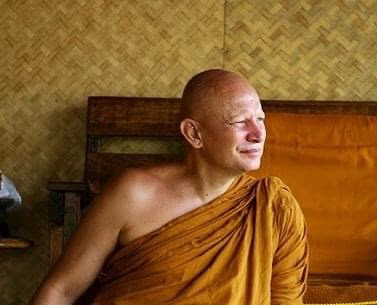
Ajahn Nyanadhammo Talks about what life with Ajahn Chah
Ajahn Nyanadhammo gives a Dhamma talk on what life was like living with Ajahn Chah. He tells many great stories of Ajahn Chah, and conveys how skillful a teacher he really was, always leading by example.
https://www.youtube.com/watch?v=oVUh0iG4O9U
Ajahn Chah sounds like a Zen monk here.
Also, his actions could be (mis)construed as abuse / physical violence.
“One day while out on alms round, Ajahn Ñānadhammo had a slight argument with another monk and became stirred up and upset. When he returned to the monastery [Wat Pah Pong], Ajahn Chah smiled at him and uncharacteristically in English said, “Good morning.” Of course Ajahn Ñānadhammo was really tickled with that, and this feeling of happiness arose that was uplifting for him.
In the late afternoon, he went over to Ajahn Chah’s dwelling place. Oftentimes monks would go over there in the afternoon when laypeople came by to pay respects and ask questions; it was a good opportunity to hear Ajahn Chah give advice. As evening approached, Ajahn Chah sent everybody off to pūjā, except for Ajahn Ñānadhammo, who alone was asked to stay. He sat beneath Luang Por Chah, massaging his feet. In the distance he could hear the chanting of evening pūjā, with the stillness of the forest almost palpable.
Ajahn Ñānadhammo described it as an ethereal, heavenly experience, and he felt quite blissful.
Suddenly, Ajahn Chah pulled his foot away and kicked Ajahn Ñānadhammo in the chest, sending him flat on his back. This was quite a shock, of course. Then Ajahn Chah said, “You’re not really paying attention to the practice or the training. You have an argument in the morning and get upset, carrying around a mood of ill will. Then all it takes is one person to say good morning to you, and you go off into a happy mood, spending the day proliferating about that. You come over here and even more happens that pleases you, so you get into an even happier mood. Next I put you flat on your back, and you’re confused.
That’s not the mind of a practitioner, that’s not the mind of somebody who is training in Dhamma. You have to be able to stop yourself from following your moods. You do your best not to be caught by them, believe in them, or buy into them. That’s what defines a practitioner.” As one might imagine, this was an exceedingly powerful and influential teaching for Ajahn Ñānadhammo.”
~ Luang Por Pasanno, “Putting Our Moods in Their Place” (2013)
Ajahn Ñānadhammo relates the story here (22:45).
https://www.youtube.com/watch?v=IIxF2Fw5YCA&feature=youtu.be&app=desktop
Profile.
Ven. Ajahn Nyanadhammo was born in Adelaide, Australia in 1955 and studied biology at university. His contact with the Dhamma via reading a Buddhist book eventually drove him to Thailand to receive his novice ordination in 1978 at Wat Bowon Niwet Wiharn in Bangkok.
Full ordination followed in 1979 at the age of 24, under Ven. Ajahn Chah at Wat Nong Pah Pong in Ubon Ratchathani province. In 2002, he became the abbot of Wat Pah Nanachat, a branch monastery of Wat Nong Pah Pong with an international community of English speaking monks. In 2007, he became abbot of Wat Ratanawan, where he is currently residing.