Labels

Friday, 3 August 2018

How to use pain in order to reach Samadhi by Ajahn Martin Piyadhammo

'How to use pain in order to reach Samadhi':


It’s very important that we start investigating pain, particularly because we don’t like it. If we get concentrated on pain, it can become very, very interesting, even if it disappears after a while. It can be much more interesting than any of the other meditation objects that we use, for the breath or the word buddho become boring after a while. Pain doesn’t become boring so it is the perfect meditation object. If we meditate all day long and then pain comes up, it’s really useful because we can concentrate on it; the mind doesn’t wander off, so it’s the perfect object for investigation and concentration. At these times, we investigate the pain, we find that it disappears, and we go back to our breath or the word buddho. So you should really be happy if you are meditating all day long and pain comes up because you can concentrate on it easily. In fact, the investigation of pain can lead to appanã samãdhi, the deep state of samãdhi. If we really investigate and really focus in, we can easily become one-pointed. Don’t despair that pain is coming up, but rather be happy, thank it for appearing and accept it. In fact, pain is a whetstone that sharpens our wisdom, and it can hone our concentration as well.

For the investigation of pain, we have to sit long enough so that pain arises. Then, we have to learn how to accept pain; we have to think, “Oh, there is pain. Thank you for coming.” We have to breathe in the pain just as we would breathe in the smell of delicious food, experiencing it completely, one-hundred percent. After we’ve done this, we go to the spot where it has arisen and ask the question, “What is pain?” because we have to understand what this painful feeling really is. Where is it? Is it a point, or an area, is it deep, or shallow? Is it moving? If we assume that it is fixed, this contradicts the Lord Buddha’s teaching on anicca, that everything is changing, and it means we have not accepted the pain wholeheartedly. So, we have to go back and accept the pain and start the investigation again. If we do this exercise properly, we will see that the pain is constantly changing. Just as our breath changes all the time, so pain is always changing; sometimes it is more painful and sometimes less. We will find that we can observe it, because it’s interesting. Because our interest helps us to concentrate, we will discover that we become more concentrated and able to stay with the changing pain. Next, we ask ourselves where the pain actually is. Is it in the skin, the tendons, the flesh, the bones, or the muscles? Although we’ve had all of these body parts since we were born, the pain has developed only while we have been sitting in meditation, so we can infer that something else is going on. At the beginning of our investigation, we really believe that the pain is in our skin, muscles or joints, but if we examine the pain that comes from sitting practice, we discover that we really cannot find it. After all, if it were really in the parts of the body, it would still be there when we get up, but it vanishes as soon as we stand up. Why does it appear only when we sit and try to meditate, and disappear as soon as we get up?

The next task is to try to find the spot that is the origin of the pain. If we really get concentrated on the pain, on that spot, we find that something ‘shifts’. This shows that our investigation is becoming keen and that we are getting close to finding the spot, for the pain will shift from one place to another, e.g. from one knee to the other. We then turn our attention to the place to which the pain has shifted and do the same kind of investigation until we are very close to the spot where we think the pain arises. Again, we find that the pain jumps to another place. Sometimes the pain will go to the back, but wherever it goes, we follow it until it shows us its true origin. People who have read a lot about Buddhism assume that the origin is the citta (heart), so they go to the heart. But that is not the exercise here. The exercise is to follow the pain from wherever it initially shows itself to the place to which it shifts or jumps. We do this until it leads us to the heart, to the origin of the pain. We can only understand pain if we follow it until it shows us where it comes from, and that is the heart. At the final step, the pain jumps to the heart and creates a pain that is unimaginable. But we can stay there and try to see the nature of pain and understand it; the heart is the last place where we can investigate pain. In the last stage of the investigation, the pain becomes so strong that we believe we are going to die. Then we go through the first stage of death, and after this the pain completely disappears. It disappears instantly the moment we accept that we are going to die, even though it was very strong.

~ Ajahn Martin Piyadhammo

From the Dhamma talk “Dealing with pain and emotions” given on 30th August 2015

Available at: http://www.forestdhammatalks.org/…/ajahn_martin/readings.php

Youtube channel: https://www.youtube.com/channel/UC9XqRMjIiJI1s4jm9_kz3bA


Wednesday, 1 August 2018

Committing to a rains retreat. - Ajahn Suchat Abhijāto

The Teaching Of Ajahn Suchart.

22 July 2024

"Committing to a rains retreat.” by Ajahn Suchart Abhijāto 


“We have now made a resolution to remain in this monastery throughout the next three months: not to stay overnight elsewhere except in cases of emergency. 

According to the disciplinary rules (vinaya), a monk is allowed to take leave to care for an ill parent or teacher for no more than seven days and seven nights. 

Exceeding this permissible leave period is considered breaking one’s observance of rains retreat (vassa).

Breaking vassa means not being able to benefit from the five merits of committing to a rains retreat. For instance, you will not be able to receive a kaṭhina (festival at the end of vassa) cloth—only those who maintain their observance can receive the cloth. 

However, breaking vassa will not affect your period of ordination—the number of years you have been in robes. Such is an example of an exception that allows monks to be away with consent for seven days and seven nights.

To commit to a rains retreat, you need to be aware of the monastery grounds you are to remain in. Most monasteries have surrounding walls to mark their boundaries. But Wat Yansangwararam—being a part of His Majesty the King’s Royal Project—is situated on a vast piece of land, so it is necessary to inform everyone of its boundaries.

Let’s begin from the entrance of the monastery: the gate just before the roundabout is the starting point. 

The road that runs along the Geriatric Centre and the Agricultural Centre and leads to the Land Development section marks the boundary on one side.

The monastery grounds also include the lodging area of Dhamma practitioners, His Majesty the King’s residence, the Mondop hill, Khao Chi-On, and the Non-Hunting Wildlife Reserve area. From the Reserve area, the road that runs behind the monks’ residence area and leads to the Sian Vihāra and loops back to the roundabout along the International Sālā marks the boundary on the other side. These are the monastery grounds you are to remain in during the rains retreat.”


“Essential Teachings.”

By Ajahn Suchart Abhijāto


“Committing to a rains retreat.” part 2

“You are not allowed to leave the monastery grounds before dawn. Leaving the monastery grounds before dawn is considered breaking vassa. For example, if you were to go on your alms round before dawn and return once it’s light, then it would be considered breaking vassa. However, if there’s a reason for you to leave the monastery during the night and you’re able to return before dawn, then it’s not considered breaking your observance.

There are two ways to determine whether it is light. One is to look at leaves. If you can clearly see each leaf on a tree, then it’s considered light. The other is to look at your palm lines. If you can clearly see your palm lines when your arm is fully extended, then it’s considered light.

You can leave the monastery grounds if you have a duty to perform, such as going on an alms round. So, when you go on your alms round in the morning, you shouldn’t have to bring your outer robe with you; otherwise, it would mean that it’s not light yet. You should wait until you’re able to leave behind your outer robe and then go on your alms round. If you were to leave before dawn and then return once it’s light, then it would be considered breaking vassa.

This is a disciplinary matter that the Buddha laid down so that each of you has time to remain in one place to study and practise the Dhamma continually. The purpose of ordination is to learn Dhamma theory and the Buddha’s teachings (pariyatti). This is so we know the right way to practise.

Once we know the theory or method, we can then put it into practice (paṭipatti). When we’ve practised properly, a result from having penetrated the truth (paṭivedha) will arise. Together they form a triad of theory, practice, and attainment.”

“Essential Teachings.”

By Ajahn Suchart Abhijāto


"Committing to a rains retreat.” Part 3

“An attainment is a result of practice. And what is the result of the Buddhist practice? It is the four paths (magga), four fruits (phala), and one enlightenment (nibbāna). They are the goal—the result of ordination, Dhamma study, and proper practice—which is to be liberated from thej cycles (vaṭṭa) of rebirth, ageing, illnesses, and death.

There are four levels of attainment. The first level is called sotāpatti phala, or the result of stream-entry. There will be at most only seven more times of rebirth before attaining nibbāna.

Stream-enterers (sotāpanna) will not be reborn into the lower realms (apāya-bhumi)—anything lower than those of human and heavenly beings. The second level is that of once-returner (sakadāgāmı). There will be at most only one more rebirth.

If once-returners were to be reborn, they would only be reborn one more time into the human realm. The third level is that of non-returner (anāgāmı). Non-returners will no longer be reborn as humans. They will instead be reborn into the heavenly realm of pure abode (brahmā) before attaining arahantship. If they practise to the level of arahant, they will no longer be in the perpetual cycles of rebirth and death, thus reaching enlightenment.

The Buddha referred to the practice towards these results as the four maggas, four phalas, and one nibbāna. Each level’s path involves a cultivation of moral virtue (sıla), meditative absorption (samādhi), and wisdom (paññā). Sotāpannas must cultivate their level of sıla, samādhi, and paññā. Sakadāgāmıs must cultivate their level of sıla, samādhi, and paññā; so is the same for anāgāmıs and arahants. Each of them uses sıla, samādhi, and paññā as means to achieve various levels of attainment.”

“Essential Teachings.”

By Ajahn Suchart Abhijāto


"Committing to a rains retreat.” Part 4

“If you want and manage to practise correctly just as you chant to recollect the Saṅgha’s qualities, ‘Supaṭipanno bhagavato sāvaka-saṅgho. Uju-paṭipanno bhagavato sāvaka-saṇgho. Ñāya-paṭipanno bhagavato sāvakasaṅgho. Sāmı-cipaṭipanno bhagavato sāvaka-saṅgho’, you will then attain the four paths and their results respectively.

You will reach the level of sotāpanna, and then move on to that of sakadāgāmı, of anāgāmı, and of arahant. This is your duty. The duty of a monk is to study, to practise, and to attain enlightenment.

It is not your duty to build permanent structures and objects or to raise funds to build such things. The Buddha left those affairs to lay devotees and their faith, for they are the ones with financial means to build shrine halls (uposatha), stupas (chedis), huts (kuṭis), halls (sālās), and so on. For monks like us, the ones without money, it is not our duty to build such things.

When the Buddha was still alive, he never built a temple, not even one. Each temple was established as a result of lay devotees’ faith in, and admiration for, the Buddha. They wished to provide the Buddha and monks with dwellings and places to study, to practise and to attain enlightenment. Such is the duty of lay devotees—to build permanent structures and so on.

The duty of a monk is to cultivate sıla, samādhi, and paññā. Samādhi and paññā, in particular, are the most important. While you duly maintain the 227 precepts, samādhi and paññā require mental cultivation (bhāvanā). Samatha bhāvanā, or the development of tranquility, is to cultivate samādhi. Vipassanā bhāvanā, or the development of insight, is to cultivate paññā.

“Essential Teachings.”

By Ajahn Suchart Abhijāto


"Committing to a rains retreat.” Part 5

*“Samādhi alone isn’t enough to eradicate mental craving and desire. Samādhi is only able to suppress them. It’s just like a rock on a patch of grass that prevents the grass from growing: the grass will continue to grow once the rock has been removed.”*

When the mind becomes concentrated and absorbed in calmness, your mental defilements (kilesas) and craving (taṇhā) will disappear. They will stop working for a while but not disappear permanently. Once you come out of samādhi, you will resume thinking about things, seeing things, and hearing things. Your craving and desire will reappear. If you want to eradicate your craving and desire for good, you will need to resort to paññā by practising vipassanā bhāvanā.

The development of insight is to be carried out once you’ve come out of samādhi. When the mind is in absorption, during which the mind is resting, it is not possible to cultivate wisdom. The mind recharges just like the body does. You cannot go out and work while you sleep, but once you have enough rest and get up, you can then resume working and doing things. The cultivation of wisdom is like the function of your body: it can only be carried out once you’ve come out of samādhi.

In leaving that calm absorption, you will need to contemplate your physical body. This is because you still misperceive your body and cling to it—you still suffer because of your body. You need to contemplate and see clearly: your body is impermanent— it is not who or what you are and it does not belong to you.

Thinking that your body is you and yours will make you want it to be permanent and last forever. Once you have cravings, discontentment (dukkha) will then arise. You need to contemplate in order to realise that your body is impermanent and not you or yours. Once you see it clearly, you won’t have the desire for your body to last forever and not to change. It ought to change with time: having been born, your body will age, get ill, and die eventually. No one can prevent it. It’s a matter of your physical body. Your physical body does not belong to you and is not who or what you are.”

“Essential Teachings.”

By Ajahn Suchart Abhijāto


“Committing to a rains retreat.” Part 6

“The Buddha taught us to identify and contemplate thirty-two parts of the body in order to see that the body is not who or what you are. The body consists of thirty-two parts, such as head hair, body hair, nails, teeth, skin, flesh, tendons, bones, bone marrow, spleen, heart, liver, membranes, kidneys, lungs, large intestines, small intestines, undigested food, faeces, and other bodily fluids.

The Buddha told us to contemplate each part on its own and consider whether we can truly identify ourselves with any of them. Is your head hair who or what you are? Is your body hair who or what you are? Are your nails, teeth, and skin who or what you are? You ought to identify each and every single part and contemplate whether any of them is who or what you are. Are you your head hair? Are you your body hair? By contemplating this way, you will see clearly that they are simply head hair, body hair, nails, and teeth and nothing more. It is, in fact, your delusion to think that head hair, body hair, nails, teeth, skin, flesh, tendons, and bones are who or what you are and that they belong to you.

You need to train yourself to contemplate these bodily parts on a regular basis. You will come to realise that they are not who or what you are. You will see that your true self is merely the one who is contemplating and investigating. You are, in fact, the perceiver and the thinker who are contemplating your body. Your body is merely an object of contemplation, not who or what you are. If you can see it clearly, you will become detached from your body. There won’t be any desire for your body not to age, get ill, and die. When there is no desire, there is no dukkha.

*Ageing, illnesses, and death are not the causes of your dukkha. The cause of your discontentment is your craving—craving not to age, craving not to get ill, and craving not to die.* You can see clearly that your body is inevitably subject to illnesses and death due to impermanence and selflessness. You cannot prevent illnesses and death from happening to your body and you cannot hold on to your body. If your physical body is truly yours, then it should be with you forever. If it doesn’t last forever, how can you assume that it is yours? Looking at it rationally will give you courage to detach yourselves from your body.”

“Essential Teachings.”

By Ajahn Suchart Abhijāto


“Committing to a rains retreat.” Part 7

*“You should seek and go to places that used to make you afraid of dying in order to see whether you are still attached to your body. If you don’t consider your body as who or what you are and as yours, you will not care. No matter what happens to your body, you will be happy and prepared. It is as if your body belongs to someone else, just as you aren’t normally bothered when something happens to other people’s body. This is a contemplation to eliminate any fear of illnesses and death.* Illnesses are just the same: they are unpleasant sensations (dukkha-vedanā). They belong to your physical body, not you— you only come into contact with and acknowledge them. If you only perceive and acknowledge them and do not have any desire for them to go away, then you won’t suffer.

Dukkha arises out of your desire for a physical pain to go away. You need to sit until it hurts to teach yourself that the pain belongs to your body, not you. You are simply the observer and the perceiver. You don’t need to want it to go away because if there’s craving, then there’s dukkha. Your inability to tolerate the pain has nothing to do with the pain itself but your desire to be without it. There will be no dukkha if you don’t wish for it to go away. You will then be able to live happily with the pain.

When you’re ill and have no medication, you won’t be bothered. If there are no painkillers, it is not a problem as most aches and pains have to do with your mind. If you have the wisdom to cure them by not desiring them to go away, most pain in your mind will disappear and only minor physical pain will remain. There is then no need to take painkillers. This is how to contemplate your physical body: to become detached from them so that you no longer suffer because of your body.

You are all heading towards old age, illnesses, and death. If you don’t prepare yourself to handle them, you will not be able to face them without suffering. This is the goal of the cultivation of wisdom, or vipassanā bhāvanā. It is to see the truth—to see things as they are and not according to your thoughts and feelings.

*Your thoughts and feelings arise from your delusion—from not knowing the truth. It makes us mistake things: to see things that are wrong or bad as right or good, to see things that are impermanent as permanent, to see things that are not who or what you are as you, and to see suffering as happiness (sukha).*

“Essential Teachings.”

By Ajahn Suchart Abhijāto


"Committing to a rains retreat.” Part 8

“The cultivation of wisdom is for you to see any existing things as they truly are. You are not changing anything. The only thing that you change is your mind. This is only to turn your ignorance into wisdom: to know what is what, to know that your physical body is not you or yours, to know that your body is impermanent, and to know that any physical pain belongs to your physical body and not to you. If you can see your body clearly, then you will not be troubled by the ageing, illnesses, and death of your physical body.

Another aspect that you need to contemplate is the unattractiveness of your physical body. If you consider your body as something beautiful and attractive, there will then be sensual passion (kāmarāga). Once sensual desires arise, there will be lust. Once there is lust, there will be sexual desires. It will be very tormenting to not be able to fulfil them. If it were to happen to a monk, then that monk would not be able to remain in robes and would eventually have to disrobe because he wants to sleep with those he considers beautiful and attractive.

Your sexual desires will diminish if you contemplate the foulness of your body, such as their ageing, illnesses, death, decomposition, and internal organs. This is why your ordinator taught you to recite during your ordinations the five key words, ‘kesā, lomā, nakhā, dantā, taco’, meaning head hair, body hair, nails, teeth, and skin, respectively.  Your ordinator taught you to contemplate the unattractiveness of your body—to consider various organs and conditions within your body and not just their external features and appearance. Seeing only the attractive parts of your body will conjure up sexual desires, which makes it difficult to remain celibate, thus leading to disrobing in the end.

This all concerns the cultivation of pañña. You alternate it with the cultivation of samādhi because after a period of contemplation, you will be exhausted. So you need to take a break to rest your mind. You need to stop contemplating and get into samādhi to recharge. This is just like your body that needs rest and sleep and food after a long day of work.

When you wake up, you can resume your work. When you contemplate to the point where your mind is no longer interested or distracted, you need to stop and get back into samādhi and calm your mind. You should alternate them accordingly until you can rid yourself completely of various desires and cravings that are in your mind. Once you have eradicated all these cravings, there will no longer be any dukkha in your mind.

 “Essential Teachings.”

By Ajahn Suchart Abhijāto


“Committing to a rains retreat.” Part 9

“The contemplation of your body and sensations are only the first two tests. The third test is the contemplation of the foulness of your body. The fourth test is the contemplation of your mind (citta). Your mind is also subject to the three characteristics of all existence and beings (tilakkhaṅa), namely impermanence (anicca), unsatisfactoriness (dukkha), and non-self (anattā).

The term, citta, refers to various moods and mental states that are in your mind. Your mind are in a constant flux—depending on the day it can range from being clear and happy to gloomy and sad. It is impermanent, unsatisfactory, and non-self. You need to contemplate in order to become detached from its conditions just in the same way. This is to not have any desire for your mind to be in a certain way. Whatever condition it is in, just be aware of that. So you won’t have any desire. When there’s no desire, then there’s no suffering. Without suffering, then there’s no problem.

That’s all the problem there is when it comes to dukkha. The cause of dukkha is craving. The means to eliminate the cause of craving is sıla, samādhi, and paññā, which are what you are here to learn and practise.

"I’d like to conclude the Dhamma talk here. May you be blessed with merit.”

“Essential Teachings.”

By Ajahn Suchart Abhijāto

Tuesday, 24 July 2018

Upcoming events for 2018 MONTH OF AUGUST

Upcoming events for 2018
MONTH OF AUGUST


2nd Aug, 2018 (Thur)

Fellowship & Dhamma sharing with Bro Dr Wong Yin Onn
Time 8 pm to 10 pm


4th Aug, 2018 (Sat)

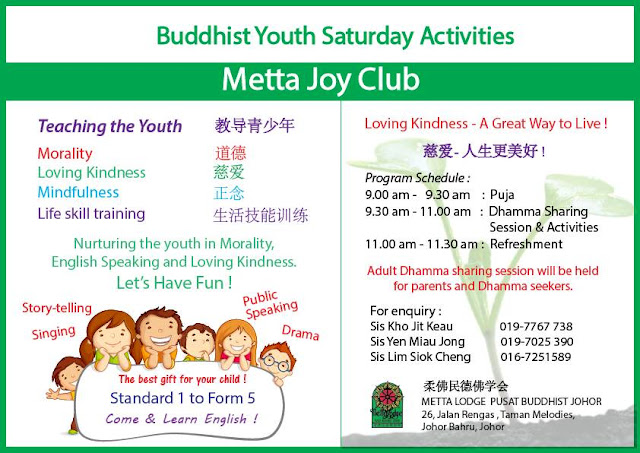
2018 Buddhist Youth Saturday Activities

Time: 9 am to 11.30 am


6th Aug, 2018 (Mon)

"Let's-Chant-Together"
with Bro Loh Piak Hong

Every 1st & 3rd Monday

Time: 8.00 to 9.30 pm


7th Aug,  2018 (Tues)

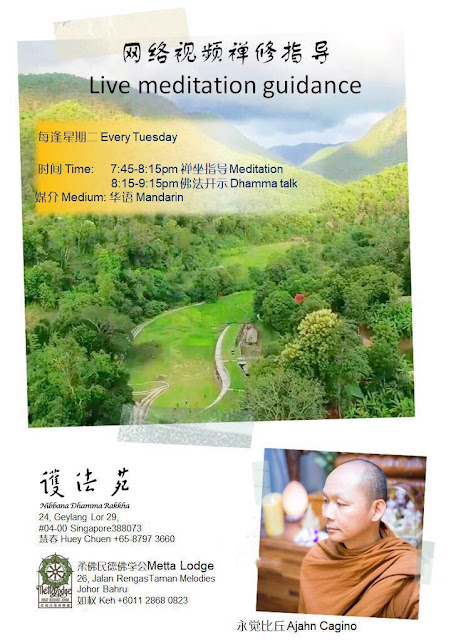
Live Streaming video Meditation Guidance

🕖 7:45 pm-9:15 pm

☸网络视频禅修指导
Ajahn Cagino 👤  永觉比丘
Mandarin 🗣华语

Enquiry 📱询问 :
如权  Bro Keh +601128680823


8th Aug, 2018 (Wed)

DIPLOMA IN DHAMMA & ABHIDHAMMA by
COLOMBO Y.M.B.A. Sri Lanka ....

Dhamma Classes are conducted every  :

1) 2nd Wed of each month
from 8 pm - 10 pm

2) 2nd. SUN of each month
from 12.50 pm - 5.00 pm

3) 3rd Wed of each month
From 8 pm - 10 pm

Facilitator : Bro T C Lim

For enquiry :
Sis Joanne Lai +60127239181 or

Sis Rose      +6012 9114125 
(Available: 2 pm - 6 pm Only )


9th Aug, 2018 (Thur)

Fellowship & Dhamma sharing 
with Bro Dr Wong Yin Onn

Time 8 pm to 10 pm


11th Aug, 2018 (Sat)

2018 Buddhist Youth Saturday Activities

Time: 9 am to 11.30 am


11th Aug, 2018 (Sat)

New Moon Paritta Chanting & Meditation

Time 8 pm - 10 pm

We will invite a Venerable to chant every Full Moon
Dhamma family members birthday for that month can bring pot luck to share.

*15 mins Meditation
*Blessing for all birthday boy & girl for that month.
*‎Blessing for all ML deceased members
*‎Transference of merits to all ML Dhamma family


12th Aug, 2018 (Sun)

DIPLOMA IN DHAMMA & ABHIDHAMMA by
COLOMBO Y.M.B.A. Sri Lanka ....
Dhamma Classes are conducted every  :

1) 2nd Wed of each month
from 8 pm - 10 pm

2) 2nd. SUN of each month
from 12.50 pm - 5.00 pm

3) 3rd Wed of each month
From 8 pm - 10 pm

Facilitator : Bro T C Lim

For enquiry :
Sis Joanne Lai +60127239181 or

Sis Rose      +6012 9114125
(Available: 2 pm - 6 pm Only )


14th Aug,  2018 (Tues)

Live Streaming video Meditation Guidance

🕖 7:45 pm-9:15 pm

☸网络视频禅修指导
Ajahn Cagino 👤  永觉比丘
Mandarin 🗣华语

Enquiry 📱询问 :
如权  Bro Keh +601128680823


15th Aug, 2018 (Wed)

DIPLOMA IN DHAMMA & ABHIDHAMMA by

COLOMBO Y.M.B.A. Sri Lanka....

Dhamma Classes are conducted every  :

1) 2nd Wed of each month
from 8 pm - 10 pm

2) 2nd. SUN of each month
from 12.50 pm - 5.00 pm

3) 3rd Wed of each month
From 8 pm - 10 pm

Facilitator : Bro T C Lim

For enquiry :
Sis Joanne Lai +60127239181 or

Sis Rose      +6012 9114125  
(Available: 2 pm - 6 pm Only )


16th Aug, 2018 (Thur)

Fellowship & Dhamma sharing 
with Bro Dr Wong Yin Onn

Time 8 pm to 10 pm


18th Aug, 2018 (Sat)

2018 Buddhist Youth Saturday Activities

Time: 9 am to 11.30 am


20th Aug, 2018 (Mon)

"Let's-Chant-Together"
with Bro Loh Piak Hong

Every 1st & 3rd Monday

Time: 8.00 to 9.30 pm


21th Aug,  2018 (Tues)

Live Streaming video Meditation Guidance

🕖 7:45 pm-9:15 pm

☸网络视频禅修指导
Ajahn Cagino 👤  永觉比丘
Mandarin 🗣华语

Enquiry 📱询问 :
如权  Bro Keh +601128680823


23rd Aug, 2018 (Thur)

Fellowship & Dhamma sharing 
with Bro Dr Wong Yin Onn

Time 8 pm to 10 pm


25th Aug, 2018 (Sat)

2018 Buddhist Youth Saturday Activities

Time: 9 am to 11.30 am


25th Aug, 2018 (Sat)

Full Moon Paritta Chanting & Meditation

Time 8 pm - 10 pm

We will invite a Venerable to chant every Full Moon
Dhamma family members birthday for that month can bring pot luck to share.

*15 mins Meditation
*Blessing for all birthday boy & girl for that month.
*‎Blessing for all ML deceased members
*‎Transference of merits to all ML Dhamma family


25th Aug,  2018 (Sat) 

Sukhi Hontu! 
Bro & Sis
     In line with our recent lesson on Ten Meritorious Deeds, I would like to encourage the students to practise what they have learned ; (  ie moving from Pariyatti to Patipatti ) :
1. Dana ( generosity )
2. Veyyavacca ( rendering service or helping the special needs, the Aged Sick & the under-priveleged )
   Permission has been given to me to conduct a class this Wed 22 Aug 2018 ( Hari Raya Haji ) from 8 pm - 10 pm
   at Metta Lodge as follows :
"An Introduction to Deaf Language in Malaysia".
The facilitator: 
Ms Lee from Miri Deaf Association - A Certified Sign Interpreter.
    This is to create awareness of the Deaf Community & how mainstream society has excluded them out by the mere fact that no one is keen to learn Signing to communicate with them.
   The Session is FREE but students are highly encouraged to Dana towards the World's First Deaf Laughter Festival organised by Ms Lee & me on 1st & 2nd Dec. to train them in Leadership Skills...
   At the end of the Session, students will be able to SIGN everyday Expression & FEELING words.

Bro Lim Tuan Chit 


26th Aug,  2018 (Sun) 


Maha Sanghikadana for Transference of merits to Departed relative & friends on 26th Aug, 2018 (Sunday)

8.30 am
-Registration
-Offer & Lighting of Oil Lamp

9.00 am
-Offering of rice Alms round to monks  (Pindapatta)

10.00am
-Taking of 5 precepts
-Paritta Chanting
-Dhamma Talk
-Robes Offering to the Sangha members ( monks)
-Dedicates merit to the departed relatives & friends
-Blessing for students taking examination.
-Blessing for the country

11.00 am
-Offering of Lunch Dana to Members of the Sangha

11.30 am
-Lunch for devotees 

With Metta
Metta Lodge Excos

For enquiry :
Sis Suk Feng +60167868546

Bro Kee +60127637268


28th Aug,  2018 (Tues)

Live Streaming video Meditation Guidance

🕖 7:45 pm-9:15 pm

☸网络视频禅修指导
Ajahn Cagino 👤  永觉比丘
Mandarin 🗣华语

Enquiry 📱询问 :
如权  Bro Keh +601128680823


30th Aug, 2018 (Thur)

Fellowship & Dhamma sharing 
with Bro Dr Wong Yin Onn

Time 8 pm to 10 pm


Monday, 25 June 2018

Upcoming events for 2018 MONTH OF JULY

Upcoming events for 2018
MONTH OF JULY


Upcoming events for July 2018


1st July, 2018 (Sun)

Dhamma talk by Datuk Bro Tan Huat Chye

Title:  "Using Dhamma to seek wealth and find balance"

Time: 10.30 am.  (Sharp)

Please be punctual


Profile :
     Bro. Tan Huat Chye has experienced success in career as the Partner and Principal of the THC Consulting, in Dhamma propagation through the setting up and managing many Buddhist organisations. He is currently the Advisor for the Kinrara Metta Buddhist Society, Bodhi Buddhist Group, Buddhist Business Network (BBN), and on the Think-Tank Panel for the Theravada Buddhist Council of Malaysia since 2015 where he is also spear heading the GLAD program. Also designed the DhammaWorks Mini Workshop Series as a Dhamma Outreach Program for the working people._         
     A member of the Music Authors’ Copyright Protection Bhd and an accomplished song writer with many popular commercial songs written including three Chinese Buddhist Hymns albums in 1988 (Yi Can Deng), 1992 (Hui Deng) and 1994 (Deng). He is also the original group member of the renowned English Buddhist Hymns Group, the “Wayfarers”


2nd July, 2018 (Mon)


"Let's-Chant-Together"
with Bro Loh Piak Hong

Every 1st & 3rd Monday

Time: 8.00 to 9.30 pm


3rd July,  2018 (Tues)

Live Streaming video Meditation Guidance

🕖 7:45 pm-9:15 pm

☸网络视频禅修指导
Ajahn Cagino 👤  永觉比丘
Mandarin 🗣华语

Enquiry 📱询问 :
如权  Bro Keh +601128680823


5th July, 2018 (Thur)

Fellowship & Dhamma sharing 
with Bro Dr Wong Yin Onn

Time : 8.00 pm - 10.00 pm


7th July, 2018 (Sat)

2018 Buddhist Youth Saturday Activities

Time: 9 am to 11.30 am


7th July,  2018 (Sat)

Dhamma Talk by Sayalay Susila

Title: "Who fears death and who not"

Schedule:
9.00  am  Meditation
10.00 am Dhamma Talk
11.00-11.30 Q & A ,
11.45 am Lunch Dana

Profile of Sayalay Susila :
http://www.sayalaysusila.net/pages/about-sayalay


8th July, 2018 (Sun)


YBAM Diploma Course opening Day.

DIPLOMA IN DHAMMA & ABHIDHAMMA by
COLOMBO Y.M.B.A. Sri Lanka...

Dhamma Classes are conducted every  :

1) 2nd & 3rd Wed of each month
from 8 pm - 10 pm

2) 2nd. SUN of each month
from 12.50 pm - 5.00 pm

Facilitator : Bro T C Lim
For enquiry :
Sis Joanne Lai +60127239181 or

Sis Rose      +6012 9114125
(Available: 2 pm - 6 pm Only )


10th July,  2018 (Tues)


Live Streaming video Meditation Guidance

🕖 7:45 pm-9:15 pm

☸网络视频禅修指导
Ajahn Cagino 👤  永觉比丘
Mandarin 🗣华语

Enquiry 📱询问 :
如权  Bro Keh +601128680823


11th July, 2018 (Wed) 


DIPLOMA IN DHAMMA & ABHIDHAMMA by
COLOMBO Y.M.B.A. Sri Lanka ....

Dhamma Classes are conducted every  :

1) 2nd & 3rd Wed of each month
from 8 pm - 10 pm

2) 2nd. SUN of each month
from 12.50 pm - 5.00 pm

Facilitator : Bro T C Lim
For enquiry : Sis Joanne Lai +60127239181

Facilitator : Bro T C Lim
For enquiry :
Sis Joanne Lai +60127239181 or

Sis Rose      +6012 9114125
(Available: 2 pm - 6 pm Only )


12th July, 2018 (Thur)

Fellowship & Dhamma sharing 
with Bro Dr Wong Yin Onn

Time 8.00 pm to 10.00 pm


13th July, 2018 (Fri)


New Moon Paritta Chanting & Meditation

We will invite a Venerable to chant every Full Moon
Dhamma family members birthday for that month can bring pot luck to share.

*15 mins Meditation
*Blessing for all birthday boy & girl for that month.
*‎Blessing for all ML deceased members
*‎Transference of merits to all ML Dhamma family


14th July, 2018 (Sat)

2018 Buddhist Youth Saturday Activities

Time: 9 am to 11.30 am


14th July, 2018 (Sat) 


慧光长老佛法开示
Dhamma Talk by Bhante Jotipanno 

地点( Venue)民德佛学会 (ML)
日期 (Date):14-7-18  星期六
时间 ( Time):晚上8点 ( 8pm)
媒介(Medium):华语 (Mandarin)
联络(Contact):駱师兄 Bro Lock
电话(hp) : 012 764 2075


16th July, 2018 (Mon)


"Let's-Chant-Together"
with Bro Loh Piak Hong

Every 1st & 3rd Monday

Time: 8.00 to 9.30 pm


17th July,  2018 (Tues)


Live Streaming video Meditation Guidance

🕖 7:45 pm-9:15 pm

☸网络视频禅修指导
Ajahn Cagino 👤  永觉比丘
Mandarin 🗣华语

Enquiry 📱询问 :
如权  Bro Keh +601128680823


18th July, 2018 (Wed) 


DIPLOMA IN DHAMMA & ABHIDHAMMA by
COLOMBO Y.M.B.A. Sri Lanka ....

Dhamma Classes are conducted every  :

1) 2nd & 3rd Wed of each month
from 8 pm - 10 pm

2) 2nd. SUN of each month
from 12.50 pm - 5.00 pm


Facilitator : Bro T C Lim
For enquiry :
Sis Joanne Lai +60127239181 or

Sis Rose      +6012 9114125
(Available: 2 pm - 6 pm Only )


19th July, 2018 (Thur)

Fellowship & Dhamma sharing 
with Bro Dr Wong Yin Onn

Time : 8.00 pm to 10.00 pm


21st July, 2018 (Sat)

2018 Buddhist Youth Saturday Activities

Time: 9 am to 11.30 am


21st to 23rd July, 2018 (Sat to Mon)


3 Days Retreat by Sayalay Susila 
Date of retreat: 21-23rd July,  2018

Title: 
"Anapanasati and contemplation of mind"

Venue: Right Path Meditation Centre (RPMC) 
Address: Jalan Cengal 8, Bandar Putra , Kulai.

Check in: 21st July, 2018 at 9am
Check out 23rd July, 2018 at 5 pm

Waze location:
https://waze.com/ul/hw239q7bh7

Google Map location: 
https://goo.gl/maps/riV9gm1Z8KA2

Person in charge of RPMC:
Bro Wong: 012-768 6636
Bro. Andy +60192788089

Mettā Lodge Coodinator: 
Bro Lock: +0127642075

Medium : Chinese

Closing Date : 18th July,  2018
Members are encouraged to offer Lunch Dana 

Profile of Sayalay Susila :
http://www.sayalaysusila.net/pages/about-sayalay


24th July,  2018 (Tues)


Live Streaming video Meditation Guidance

🕖 7:45 pm-9:15 pm

☸网络视频禅修指导
Ajahn Cagino 👤  永觉比丘
Mandarin 🗣华语

Enquiry 📱询问 :
如权  Bro Keh +601128680823


26th July, 2018 (Thur)

Fellowship & Dhamma sharing 
with Bro Dr Wong Yin Onn

Time 8.00 pm to 10 pm


27th July, 2018 (Fri)

Full Moon Paritta Chanting & Meditation

We will invite a Venerable to chant every Full Moon
Dhamma family members birthday for that month can bring pot luck to share.

*15 mins Meditation
*Blessing for all birthday boy & girl for that month.
*‎Blessing for all ML deceased members
*‎Transference of merits to all ML Dhamma family


28th July, 2018 (Sat)


2018 Buddhist Youth Saturday Activities

Time: 9 am to 11.30 am


31st July,  2018 (Tues)


Live Streaming video Meditation Guidance

🕖 7:45 pm-9:15 pm

☸网络视频禅修指导
Ajahn Cagino 👤  永觉比丘
Mandarin 🗣华语

Enquiry 📱询问 :
如权  Bro Keh +601128680823


Tuesday, 19 June 2018

Khuddakapatha - The Short Passages


Khuddakapatha - The Short Passages 


1. Saranagamana -- Going for Refuge
I go to the Buddha for refuge. 我皈依佛
I go to the Dhamma for refuge . 我皈依法
I go to the Sangha for refuge. 我皈依僧
A second time I go to the Buddha for refuge. 第二次我皈依佛
A second time I go to the Dhamma for refuge. 第二次我皈依法
A second time I go to the Sangha for refuge .第二次我皈依僧
A third time I go to the Buddha for refuge. 第三次我皈依佛
A third time I go to the Dhamma for refuge. 第三次我皈依法
A third time I go to the Sangha for refuge. 第三次我皈依僧
[6/20, 5:32 AM] Bhante Ariya Dassana: Khuddakapatha

2. Dasa Sikkhapada -- The Ten Training Rules for novices

I undertake the training rule to refrain from taking life. 我受持离杀生学处
I undertake the training rule to refrain from stealing.我受持离不与取学处
I undertake the training rule to refrain from sexual intercourse.我受持离非梵行学处
I undertake the training rule to refrain from telling lies.我受持离虚妄语学处
I undertake the training rule to refrain from intoxicating fermented & distilled beverages that lead to carelessness.我受持离放逸之因的诸酒类学处
I undertake the training rule to refrain from eating at the wrong time [after noon & before dawn].我受持离非时食学处
I undertake the training rule to refrain from dancing, singing, music, & watching shows. 我受持不跳舞、歌唱及表演。
I undertake the training rule to refrain from wearing garlands and beautifying myself with perfumes & cosmetics.我受持不戴持、塗抹、妝飾的花朵,香芬及美容品。
I undertake the training rule to refrain from high & luxurious seats & beds.我受持不坐臥于高、大坐臥處。
I undertake the training rule to refrain from accepting gold & money.我受持不持金银及金钱。

Monday, 4 June 2018

Metta Lodge WhatsApp posting Summary & Guidelines:

Metta Lodge WhatsApp posting

Summary & Guidelines:


Summary:

Kindly be reminded and be mindful
to Leave Out of this ML Group,

ALL postings that is Not connected with ML, Dhamma-Vinaya, Buddhism or Buddhism in Malaysia.
Your Cooperation is Greatly Appreciated.

Guidelines:
ML Members WhatsApp group is for,

(1.) Primarily : Dissemination of ML matters

1.1 ML Exco-to-Members: Announcements, selected FB/Website postings, Programmes, etc.

1.2 ML Members-to-ML Exco : Feedback, simple questions, clarifications and requests. Complaints in detail should be emailed to ML. (mettalodgebcj@yahoo.com)

1.3 ML Members-to-ML Members: Sharing of Member Orgn Programmes / Training & Development / Sutta Study Retreats / Meditation Retreats / Camps / Novitiate / Pilgrimage / Study Tours / Photos of recent events (preferable number of 4 with event description, date and place, and certainly not 8+ photos), video postings should preferably be links to a website / FB / Youtube (sending video files uses up alot of device space), etc.

1.4 Governmental (State / Federal) developments that may affect Buddhism / Buddhist Orgn in Malaysia, preferably links to News reports.

1.5 ASEAN / World developments that may affect Buddhism / Buddhist Orgn in Malaysia, preferably links to News reports.

1.6 Religious developments / articles / publications that affect or may affect Buddhism in Malaysia, preferably links to News reports.

**********

(2.) Secondary :

2.1 Intra-Buddhist dialogues / programmes of interest preferably links to website.

2.2 Inter-religious dialogues / programmes of interest preferably links to website.


*********


(3.) To be Left Out of the Group :

3.1 Criteria : ALL postings that are Not connected with ML, Dhamma-Vinaya, Buddhism or Buddhism in Malaysia.

3.2 Health, Exercise, Medical, Safety & Diet Advice,

3.3 Good Morning/Afternoon/Evening /Week/Weekend Quotes,

3.4 Pet adoption announcements,

3.5 Jokes / Humour,

3.6 Sales Promotions,

3.7 Fake or modified Buddha Quotes (Please verify with Ti-Pitaka; Any quote ending with 'Gautama Buddha' or 'Buddha', without the source, eg. Sutta name / Dhammapada Verse no., is very likely Fake).

3.8 etc..
A Note on using WhatsApp:
We have heard of the idiom,
'Think before speaking, you can't take it back afterwards'.

In WhatsApp,
'Think and check before posting, you can't take it back afterwards'.
Messages once posted in WhatsApp are delivered to recipient/s.
Amendments or deletion on senders device will Not change the message received and seen by the recipient, unlike in Facebook.
Latest:
TECHYou Can Now ‘Unsend’ Your Messages in New WhatsApp Update
https://goo.gl/VDguPB


With Mettā
EXCO
12TH.NOV. 2017

Friday, 1 June 2018

Upcoming events for 2018 MONTH OF JUNE

Upcoming events for 2018
MONTH OF JUNE


Upcoming events for June 2018


2nd June, 2018 (Sat)

2018 Buddhist Youth Saturday Activities

Time: 9 am to 11.30 am


4th June, 2018 (Mon)

"Let's-Chant-Together"
with Bro Loh Piak Hong

Every 1st & 3rd Monday
Time: 8.00 to 9.30 pm


5th June,  2018 (Tues)

Live Streaming video Meditation Guidance

🕖 7:45 pm-9:15 pm

☸网络视频禅修指导
Ajahn Cagino 👤  永觉比丘
Mandarin 🗣华语

Enquiry 📱询问 :
如权  Bro Keh +601128680823


7th June, 2018 (Thur)

Fellowship & Dhamma sharing with Bro Dr Wong Yin Onn

Time 8.00 to 10.00 pm


9th June, 2018 (Sat)

2018 Buddhist Youth Saturday Activities   (School Holiday)

Time: 9 am to 11.30 am


12th June,  2018 (Tues)

Live Streaming video Meditation Guidance

🕖 7:45 pm-9:15 pm

☸网络视频禅修指导
Ajahn Cagino 👤  永觉比丘
Mandarin 🗣华语

Enquiry 📱询问 :
如权  Bro Keh +601128680823


13th June, 2018 (Wed)

Pali Study Class by Bro TC Lim
(Every 2nd & 3rd Wed of the Month)  (Cancelled)

For details Bro TC Lim
Hp no: +60177455093


14th June, 2018 (Thurs)

New Moon Paritta Chanting & Meditation

We will invite a Venerable to chant every Full Moon
Dhamma family members birthday for that month can bring pot luck to share.

*15 mins Meditation
*Blessing for all birthday boy & girl for that month.
*‎Blessing for all ML deceased members
*‎Transference of merits to all ML Dhamma family


14th June, 2018 (Thur)

Fellowship & Dhamma sharing with Bro Dr Wong Yin Onn

Time 8.00 to 10.00 pm


16th June, 2018 (Sat)

2018 Buddhist Youth Saturday Activities.  (School Holiday)

Time: 9 am to 11.30 am


18th June, 2018 (Mon)

"Let's-Chant-Together"
with Bro Loh Piak Hong

Every 1st & 3rd Monday
Time: 8.00 to 9.30 pm


19th June,  2018 (Tues)

Live Streaming video Meditation Guidance

🕖 7:45 pm-9:15 pm

☸网络视频禅修指导
Ajahn Cagino 👤  永觉比丘
Mandarin 🗣华语

Enquiry 📱询问 :
如权  Bro Keh +601128680823


20th June, 2018 (Wed)

Pali Study Class by Bro TC Lim
(Every 2nd & 3rd Wed of the Month)   (Cancelled)

For details Bro TC Lim
Hp no: +60177455093


21th June, 2018 (Thur)

Fellowship & Dhamma sharing with Bro Dr Wong Yin Onn

Time 8.00 to 10.00 pm


23rd June, 2018 (Sat)

2018 Buddhist Youth Saturday Activities.  (School Holiday)

Time: 9 am to 11.30 am


26th June,  2018 (Tues)

Live Streaming video Meditation Guidance

🕖 7:45 pm-9:15 pm

☸网络视频禅修指导
Ajahn Cagino 👤  永觉比丘
Mandarin 🗣华语

Enquiry 📱询问 :
如权  Bro Keh +601128680823
Time 8.00 to 10.00 pm


28th June, 2018 (Thur)

Full Moon Paritta Chanting & Meditation

We will invite a Venerable to chant every Full Moon
Dhamma family members birthday for that month can bring pot luck to share.

*15 mins Meditation
*Blessing for all birthday boy & girl for that month.
*‎Blessing for all ML deceased members
*‎Transference of merits to all ML Dhamma family


28th June, 2018 (Thur)

Fellowship & Dhamma sharing with Bro Dr Wong Yin Onn

Time 8.00 to 10.00 pm


30th June, 2018 (Sat)

2018 Buddhist Youth Saturday Activities

Time: 9 am to 11.30 am


30th June, 2018 (Sat) 


Talk by Bro Datuk Tan Huat Chye
Time: 8.00 pm

Profile :
     Bro. Tan Huat Chye has experienced success in career as the Partner and Principal of the THC Consulting, in Dhamma propagation through the setting up and managing many Buddhist organisations. He is currently the Advisor for the Kinrara Metta Buddhist Society, Bodhi Buddhist Group, Buddhist Business Network (BBN), and on the Think-Tank Panel for the Theravada Buddhist Council of Malaysia since 2015 where he is also spear heading the GLAD program. Also designed the DhammaWorks Mini Workshop Series as a Dhamma Outreach Program for the working people.
          A member of the Music Authors’ Copyright Protection Bhd and an accomplished song writer with many popular commercial songs written including three Chinese Buddhist Hymns albums in 1988 (Yi Can Deng), 1992 (Hui Deng) and 1994 (Deng). He is also the original group member of the renowned English Buddhist Hymns Group, the “Wayfarers”.