Labels

Tuesday, 31 October 2017

Upcoming events for 2017 - December

Upcoming events for 2017 - MONTH OF DECEMBER


2nd December, 2017

Sound of Metta Concert
Imee Ooi & JSJG
黄慧音与静世金刚

Time: 7.30 pm
2-12-2017

Address
Fo Guang Shan HsingmaSi
星期六晚上七点半
地点:佛光上新马寺
Taman Sutera Utama, 81300 Johor Bahru


Photos
https://goo.gl/ew9Mgb
https://goo.gl/UjU1Td

Mettalodgebcj Johor bahru shared an album with you from the Flickr app! Check it out:
https://flic.kr/s/aHsmbbYAdH


4th Dec, 2017 (Mon)

"Let's-Chant-Together"
with Bro Loh Piak Hong
Every 1st & 3rd Monday
Time: 8.00 to 9.30 pm


7th Dec, 2017 (Thur)

Fellowship & Dhamma sharing 
with Bro Dr Wong Yin Onn
Time 8.00 to 10.00 pm


13th Dec, 2017 (Wed)

Pali Study Class by Bro TC Lim
For details Bro TC Lim
Hp no: +60177455093

13th Dec, 2017 (Wed)

【中文佛法讲座】
Wednesday, 13 Dec | 7.40 pm - 9.40 pm | NEO Centre J.B
    我们诚邀大众一起参与下星期三由慧光长老主讲的中文佛法讲座,信徒们一起诵经和闻法。欢迎大家出席!
    Venerable Jutipañño Mahāthero
慧光长老,1991年于泰国法宗派坐下授比丘戒。泰国修行8年后回马来西亚创办法光禅林 (Dhamma Light Meditation Centre)。

    慧光长老致力提倡原始佛教,身体力行地鼓励人们依照佛陀的原始教修行。多年来为大众弘法,举办短期出家与禅修营,利益众生。现流通的开示录音集有《清净自在》系列。


14th Dec, 2017 (Thur)

Fellowship & Dhamma sharing 
with Bro Dr Wong Yin Onn
Time 8.00 to 10.00 pm


15th to 18th Dec, 2017 (Fri to Mon)

Teenagers’ Dhamma camp in Johor
Nalanda Johor Bahru Branch Dhamma School 
will be organising its annual teenagers’ camp 
from 15 to 18 December, with the interesting theme 
“Dhamma through drama”.
Age group: 13 and 17

Venue : The camp will be held at Pure Karma Buddhist Centre (新山净业精舍).
Fee: Camp fee of RM100 per participant; it includes 
accommodation, meals, and course materials.

Online Registration form:


18th Dec, 2017 (Mon)

"Let's-Chant-Together"
with Bro Loh Piak Hong
Every 1st & 3rd Monday
Time: 8.00 to 9.30 pm


19th Dec, 2017 (Tues)

Live Streaming video Meditation Guidance
 7:45 pm-9:15 pm
☸网络视频禅修指导
Ajahn Cagino   永觉比丘
Mandarin 华语
Enquiry 询问 :
如权  Bro Keh +601128680823


20th Dec, 2017 (Wed)

Pali Study Class by Bro TC Lim

For details Bro TC Lim
Hp no: +60177455093


21st Dec, 2017 (Thur)

Fellowship & Dhamma sharing 
with Bro Dr Wong Yin Onn
Time 8.00 to 10.00 pm

28th Dec, 2017 (Thur)

Feeling uneasy about how the world is unfolding? 

Ajahn Brahm will share some insights on how to find inner peace in the midst of outer chaos. 


Please register for tickets at http://brahmcentre.eventbrite.com/


28th Dec, 2017 (Thur)

Fellowship & Dhamma sharing 
with Bro Dr Wong Yin Onn
Time 8.00 to 10.00 pm


29th Dec, 2017 (Fri)

Dhamma Talk 
Phratham Waraphon (Chao Khun Petch)
Venue: Wat Paa Santi (Santi Monestary, Ulu Tiram)
Time : 8 pm

30th Dec, 2017 (Sat)

Lunch Dana for Phratham Waraphon (Chao Khun Petch)
Time: 10.30 am


30th Dec, 2017 (Sat)

24hrs Metta Chanting
Metta Lodge participating in this event on 
30th Dec, 2017 at 

8 pm to 9 pm (off site)


Sunday, 29 October 2017

Missionary Works !!!

Buddhism for Beginners Group
https://goo.gl/SFumwB

Missionary Works !!!


Lecturing, rewriting, sharing, and teaching the Buddha’s discourses are important missionary works.
Performing missionary works mean encouraging others to follow the Buddha’s Teachings which can be summed up as: “to refrain from all evils, to do what is good, and to purify the mind”.

First of all, a missionary must cultivate loving-kindness towards all beings and help or teach them to dispel their wrong views which can bring evil consequences.

Among the demeritorious actions, the five heinous deeds of killing one’s mother,

killing one’s father,

killing an arahat,

causing blood to settle on the body of the Buddha,

and causing schism in the Samgha Order are the worst.

Even though the perpetrator of these deeds has done a great deal of meritorious deeds, these cannot help him. He will be cast into hell (the Niraya) immediately on his death. Only when he is released from the Niraya, his meritorious deeds of the past existence will bear him good fruits.

A person, who has held a wrong view earns greater demerit than a person who has killed his parents. 

If a person who has committed one of the five heinous deeds, were to fall to the Niraya when the world is about to be destroyed, he has the opportunity to be released from there at the time of destruction of the world. But the staunch wrong-viewer has to be shuffled to the Niraya of another world which remains undestroyed if the time for his release is not yet due at the time of the dissolution of the world.

The missionary work can salvage one from such grave offence.

This can also upgrade one’s mentality in this very life and can help one to attain good future existence. Even more, it can help one to be able to end all sufferings. Therefore, it should be considered how noble and beneficial the missionary work is.
Everyone should participate in the missionary work and strive for the proliferation of the Truth.

In doing so, one should cultivate loving-kindness on all wrong-believers. If possible, guidance them to be able to escape from wrong-view. Imparting the Buddha’s Doctrine to others is one of the missionary works. The Buddha expounded that there is no other deed as meritorious as imparting the Buddha’s Doctrine.

Everybody has chances to take part in the missionary works. We must try our best to make those who have not yet believed in the Buddha’s Teachings come to believe in the Teachings, and those who have already believed in the Buddha’s Teachings come to believe all the more. If it is possible, we should go to the places where the Buddha’s Teachings have not well-developed to be developed. If we ourselves are unable to do so, we ought to give support to the persons or bhikkhus who are serving for that purpose.

Some Examples of Missionary Works are:

• Making Others Take Refuge In the Three Gems

• Participating In Religious Associations

• Supporting the Learners of the Buddhist Literatures

• Supporting Those Who Are Practising The Dhamma

• Promotion and Propagation of the Buddhist Literatures

• Performing Religious Activities At Home

• Performing Religious Activities In The Community


Religious Activities At Home

Among the various activities for the promotion and propagation of Sasana, the religious activities at 
home play an important role. A family is composed of parents and their children. The heads of the family are the parents and they are also responsible for the welfare of the whole family. They are also responsible for implementing religious activities within the family successfully.

Therefore, the saying goes: “The meanness of the children falls on the heads of their parents”.

In Singalovada Sutta, the Buddha mentioned the five duties of parents thus:

“The parents should restrain their children from doing evil;

they should encourage their children to do good;

they should provide their children with capital to start a business,

and they should arrange suitable marriages for their children”.

Since the time of conception the parents prepare everything well for their coming child. Being Buddhists, they recite the discourses of protection to protect their child from any danger or enmity. 

They also take refuge in the Buddha, the Dhamma and the Samgha for the welfare of their offspring. 

This practice has fully taken place since the Buddha’s time. The mother of Bodhi Prince took refuge in the Three Gems not only for herself but also for her son conceived in her womb.

It is the good tradition of all Buddhists to introduce one’s children to Buddhism as early as possible as the start of family religious activities. During the conception the mother usually takes refuge in the Three Gems and observes the five precepts in order to ward off any danger from the child by the virtues of her meritorious deeds. At the time of the delivery of the child,Angulimala Sutta is usually recited in order to give birth easily. When the woman in labor hears the Sutta, she remembers the virtues of the Three Gems. So she gets relief from the pain and the child can also be blessed with the good virtues of the Triple Gems.

When the naming ceremony is held, the parents invite the bhikkhus to donate offerings.

They take refuge in the Three Gems and they listen to the discourses of protection recited by the bhikkhus for the benefit of the child. When the child grows old enough to speak, they teach him to recite “Buddham saranam gacchami” and so on. They give him the invaluable inheritance of Buddhism. When the child is clever enough to understand things to a certain extent, the parents, while embracing him, start teaching him the habit of paying homage to the Three Gems. They teach him to hold his palms together on his forehead and teach him to say “I pay homage to the Buddha”

This is the first physical conduct of a Buddhist. Parents are the first teachers of their children. Their teachings are strongly impressed on their children’s memory. Good parents produce good children.

Pure lineage, good character, religious and cultural traditions of the parents are valuable inheritance to their children.

King Kakavanna Tissa, the ruler of Lankadipa, made his two sons (Gamani and Tissa) take a vow before meal at the ceremony of feeding the first meal to them not to take any meal without offering it to the Three Gems. In this way he made the Teachings of the Buddha rooted in their hearts. Wise parents establish the spirit of Buddhism in the hearts of their children.

Then they make their children pay obeisance to the Buddha at least twice a day: once in the morning and once in the evening. They also teach them words of prayers and train them to pay obeisance to the five objects of infinite gratitude (Triple Gems, Parents & Teachers) before going to bed and after getting up from bed. At bed time, they tell their children jatakas and stories on Buddhist culture. 

When the children ask questions, they give answers which the children can remember forever.

The parents teach their children how to offer alms-food to the bhikkhus every morning. They also teach them how to offer food, water, flowers and lights to the Buddha. In this way, the religious activities in the family get more and more developed.

When the children grow older, the parents teach them not to do evil, explaining the disadvantages of doing evil. And they encourage their children to do good, explaining the benefits of doing good.

When the children are old enough to learn, they are sent to the monastery to learn reading, writing, and arithmetic, and also to learn Buddhist literature such as Mangala Sutta, Singalovada Sutta and Lokaniti. In this way there is a progress of religious activities in the family owing to the piety, the devotion and the wise guidance of the parents.

Buddhism and Myanmar are inseparable and they are joined together permanently. The Buddha’s Teachings are the invaluable guidance for the Myanmar cultural traditions.

Because of this invaluable guidance Myanmar has been a well-civilized country in the world for thousands of years. The nationality and the religious fervour are also well-safeguarded.

The more successful the family religious activities are, the more lasting and the more developed the Buddha’s Teaching will be. 

Therefore every Buddhist must try his or her best for the success of the family religious activities which is the foundation for the perpetuation, promotion and propagation of the Buddha Sasana.


Religious Activities In The Community

Performing religious activities in the community is one form of the important tasks for the perpetuation and propagation of the Buddha’s Teachings. Wards and, villages are made up of families. Groups of wards and villages form towns, districts, divisions, states and country.

Thus, if the Buddha’s Teachings can be established in each family and community, the Buddha Teachings will flourish in the whole country.

When we follow the Buddha’s Teachings, we shall gain happiness and success not only in the present life but also in the next existences. Moreover, in our final existence, we shall attain the ultimate peace of Nibbana. It is very precious to be a Buddhist.

To be able to enjoy such a precious life, ignorant persons and wrong viewers should be converted into wise persons and right viewers. In doing so, organizations should be formed in villages and townships and lectures and discussions should be held extensively.

According to the Buddha’s advice, One Should Not Only Perform Meritorious Deeds But Also Urge Others To Do So.

Four types of persons are mentioned in the Buddhist literature as follows: —

(1) A person who himself does meritorious deeds but does not urge others to do so;

(2) A person who urges others to do meritorious deeds but he himself does not do so;

(3) A person who does not himself do meritorious deeds nor urges others to do so;

(4) A person who himself does meritorious deeds and urges others to do so.

Their different attitudes and activities bring different benefits to them. When they reap the benefits of their meritorious deeds in future existences:

-The first person enjoys great wealth but lacks companionship;

-The second person enjoys companionship but lacks wealth;

-The third person enjoys neither wealth nor companionship;

-The fourth person enjoys both wealth and companionship.

According to this discourse, it is obvious that a person, who himself does the meritorious deeds and urges others to do so, will enjoy the greatest benefits among the four types of persons.
Therefore to lead the community to participate in religious activities is of great importance.

There are two main objectives in doing the religious activities in the community:

(1) to bring peace and prosperity to the members of community not only in the present lives but also in future existences, and

(2) to promote unity among the community.

Hence peace and happiness cannot be achieved by the physical progress alone has been demonstrated by the people of technically advanced countries.

The moral progress is very essential to achieve true peace and happiness in life. The Buddha’s Teachings can actually furnish the spiritual and moral progress to all human beings.

Therefore, every citizen should participate in the noble missionary work of propagating the Buddha’s Teachings in the community as well as in the whole country so that all the people are spiritually and morally developed to enjoy peace and happiness to the fullest extent.


Harmonious Missionary Work

    An outstanding example of the qualities and approach of a Buddhist missionary is Emperor Asoka, who sent Buddhist missionaries to many parts of the Asian and Western world to introduce the Buddha’s message of peace. One of his scripts engraved in stone on the Asoka Pillars, which still stands today in India says,

    "One should not honour only one’s religion and condemn the religion of others, but one should honour others’ religion for this or that reason. In so doing, one helps one’s own religion to grow and renders service to the religions of others too. In acting otherwise, one digs the grave of one’s own religion and also does harm to other religions."

   Asoka converted to Buddhism as a form of repentance after conquering the Kalinga republic in central-eastern India, around 264 BCE. In one of the most historically significant inscriptions, Rock Edict VIII, Asoka, who refers to himself as “Beloved-of-the-Gods” and “King Piyadasi,”


Dhammapada Verse 182 say:

Erakapattanagaraja Vatthu
Kiccho manussapatilabho
Kiccham maccana jivitam
Kiccham saddhammassavanam
Kiccho buddhanamuppado

Four Rare Opportunities
Rare is the birth as human being
Hard is the life of mortals
Hard is the hearing the Dhamma
Rare is the appearance of the Buddha

The Buddha told his disciples to spread the Dhamma far and wide.

"Go forth for the good of the many,  for the happiness of the many,  out of compassion for the world,  for the welfare,  the good and the happiness of god's and men.... "
(Vin 1:20)


The Buddha said:

"Go into all lands and preach this teaching. Tell them that the poor and the lowly, the rich and the high are all one and that all castes unite in this religion as do the rivers in the sea"


Friday, 27 October 2017

Ānandajoti Bhikkhu blog

Ānandajoti Bhikkhu


Following on from my previous post: I came across this very fine photoblog, many of which come from the cave temples in western India:
https://goo.gl/E5CA7V


This verse, originally spoken by Ven Aśvajit to Upatiṣya (later Ven. Śāriputra), became the most famous summary of the Buddha’s teaching during the Middle Ages. Taken one way it summarises Pratityasamutpāda (Conditional Origination), and in another it summarises the first three noble truths (Āryāsatya).
It was enshrined in Chaityas as a relic, written beneath statues and in inscriptions and even used as a mantra.
I give the version in Sanskrit here, from a translation of Arthaviniścayasūtram, which I am presently working on.
Ānandajoti Bhikkhu


For the context of this verse in the Pali texts, see here:
http://bit.ly/22W8BDe


Khru Ba Sriwichai, the Thai Engineer Monk
Posted by Ānandajoti on Monday, 19th September, 2016
https://goo.gl/Arjm6P


An updated edition of the collection of Buddhist Wisdom Verses, together with a new recording.
https://goo.gl/rjvPlF


At IBC we will be doing the traditional Thai Abhidhamma chanting in commemoration of His Majesty the King for the next month. I have just published the text and translation on Ancient Buddhist Texts. Others who wish to join us can download and print.
http://bit.ly/2ddo6GR
Ānandajoti Bhikkhu


I have made a new map illustrating the Asokan Missions, together with the stories embedded in each location:
Ānandajoti Bhikkhu
https://goo.gl/ePX66L


A short illustrated talk on the significance of the Full Moon Day in December: 
http://goo.gl/VsXkIo


Publication of Dharma-Sangraha, The Dharma Collection
https://goo.gl/qpxJNi


Publication of the Entrance into the Light of the Dharma
https://goo.gl/7qRs4u


I decided to write up our experiences at the various sites we are visiting in India, see my new blog:
http://travels.photodharma.net/


Although Sanchi is best known for its stupas, and rightly so, given their excellence, it was also a major site for temples and monasteries. Here is a view of the best preserved temple, with monastic quarters around it. Inside is a large and ancient Buddha Statue. 


A new album photographed at some of the earliest (4th-5th c.) 
Hindu caves in India is just published:
https://goo.gl/ZuShhz


I am now working on the large collection of photographs taken at Sanchi. 
The first to be published are of Stupa no. 3, which includes a good gateway or torana. 


Sanchi is best known for the the gateways (toranas) surrounding Stupa no 1. This is the west gate, with explanations of some of the stories illustrated:
https://goo.gl/U1PaMC


Because of the difference in lighting when taking the photos I have had to publish some albums in B&W to even out the differences. The South Gate, however, I am publishing in colour, together with descriptions of the scenes, 


Over the past couple of months I have published around 1,500 photographs from the trip I made to India earlier in the year. All these photos can be downloaded in high-definition and reused in any way you see fit – they are a gift of Dhamma to people everywhere. There are now over 12,000 photos on my website: 


My book of translations from the Anguttara Commentary telling the Stories of the Foremost Nuns has just been published by Phor Kark See in Singapore, and will be available at Vesak. It includes their biographies, teachings and verses as recorded in the Pali tradition. The materials for the book can be found here:
https://goo.gl/as01mp


For the past couple of weeks I have been converting my Photo Dharma website to a new design with higher quality photographs. Last night I uploading 26,000 remade photos to the site, and it is now live: 


For those who want to read a full report, there is a blog post here:
https://goo.gl/uqHV2g

84 Guan Yin Statues, Wat Tham Khao Rup Chang, Songkhla, Thailand
Direct link:
http://bit.ly/2ii4nrX


A new dual-language book is published telling the Life of the Buddha, along with photographs of the panels illustrating the story at Borobudur. 

Direct link: 
Indonesia Blog:
https://goo.gl/y3dQHs


This verse was spoken about Angulimālā, and the photo is of his large stūpa in Śrāvasti. 
His story is here:
By Ānandajoti Bhikkhu
http://bit.ly/29BdLkh


Thursday, 26 October 2017

AVALOKITEŚVARA (Kuan Yin)

AVALOKITEŚVARA (Kuan Yin)

   Avalokiteśvara is the most important and also the most beloved of all the bodhisattvas in Mahāyāna Buddhism. His name is made up of two Sanskrit words, avalokita meaning ‘to look upon’ or ‘to survey’ and iśvara meaning ‘lord.’ Thus, Avalokiteśvara is that noble being who looks out across the world, sees all its pain and suffering and, moved by compassion, tries to relieve it. Avalokiteśvara’s origins are obscure, but his presence began to be noticed around the 1st century BCE. The earliest mention of his name is in the Saddharmapuṇḍrīka Sūtra, which was composed in about the 1st or 2nd centuries CE. He was probably a person born during the time of the Buddha, who heard his teachings and, having made a strong and sincere vow to attain enlightenment (adhiṭṭhāna) for the sake of all beings, was reborn in a heavenly realm from where he responds to people’s distress.

  Since Avalokiteśvara’s appearance, millions of people who have called upon his name have been cured of physical and psychological illnesses, saved from disasters and comforted in times of loneliness and despair.

Some divine beings are worshiped with ‘fear and trembling’ because they are supposedly ‘almighty,’ but it has always been Avalokiteśvara’s gentleness and compassion that have drawn people to him. One might even say that Avalokiteśvara is the very personification of the Buddha’s healing and nurturing compassion.

    Avalokiteśvara is usually depicted as a beautiful graceful youth of gentle demeanour, although in Chinese, Korean and Japanese iconography he is often shown as a female. Of course, this is just iconographic convention; having transcended gender, Avalokiteśvara is actually neither male nor female. After about the 7th century, the Chinese began depicting Avalokiteśvara with a thousand arms, the palm of each hand with an eye in it. This was an imaginative way of expressing his deep desire not only to see the distress of beings but also to reach out and to help alleviate it.

    Avalokiteśvara is known in Chinese as Kuan Yin, in Japanese as Kannon, in Tibetan as Chenrezi, in Vietnamese as Quan Am and in Sinhalese as Nātha. Tradition says Avalokiteśvara has 108 names.

Seven Sutras that are related to Bodhisattva Avalokitesvara
https://goo.gl/zifC39

Kuan Yin Statue
https://goo.gl/ZoVjk8

A Japanese Buddhist Master Reveals 26 Rules of Life That Will Blow Your Mind

A Japanese Buddhist Master Reveals 26 Rules of Life That Will Blow Your Mind

 Christina October 25, 2017

Have you at any point struggled to discover peace and happiness because of overthinking, nervousness, or physical issues? Living with these issues has been known to bring about a sleeping disorder, and the main referred to cure is to acknowledge life as it is and locate a more charming approach to live it. Japanese Buddhist ace Miyamoto Mushashi has figured 26 guidelines to make life more pleasant—and he’s Japan’s most noteworthy swordsman, so it’s best to notice his words.

Astoundingly, he made these guidelines just 2 weeks before his death, and they are basically based around tolerating life’s conditions, being alright with yourself, and taking control of the things you’re able to do emphatically overseeing. If it’s not too much trouble read the rundown underneath to use this edification in your own life.

#1: Accept reality.
Acceptance is essential for overcoming the mental challenges. Rather than fighting negative emotions like anxiety and stress, it’s very important to accept them for what they are since doing so is actually going to make their impact on you weaker. Have in mind that acceptance includes patience and balance much more than apathy or indifference.

#2: Don’t obsess over pleasure.
Doing so puts the people into an infinite loop of temporary satisfaction that is only going to keep you wanting more and more short-term pleasure in the long-term. As an alternative, allow yourself to enjoy life as a whole, especially when you have the opportunity to just think to yourself about whatever you enjoy thinking about.

#3: Don’t rely on fleeting feelings or emotions for guidance.
Human feelings are dependably in some type of change, so in the event that you construct your choices based with respect to how you happen to feel inside right now, at that point you’re normally not settling on the wisest choices possible.

#4: Contemplate the world more than yourself.
There is a wise Chinese Proverb that argues that, “If you want happiness for one hour, take a nap. If you want happiness for one day, go fishing. If you want happiness for a year, receive a fortune. If you want happiness for a lifetime, help some person.”

#5: Don’t ever be a slave to desire.
Buddhism is revealing that desiring leads to suffering, since when you desire you are inherently displeased with your current state. In its place, be content with existing—and living freely.

#6: Don’t harbor regret.
Simply, you can’t change what has occurred previously, so you should rather value that you can gain from the past keeping in mind the end goal to encounter greater joy, achievement, and serenity in the future.

#7: Don’t harbor jealousy.
Honestly, it simply isn’t positive or productive. Rather, be glad for other individuals who succeed, and endeavor to gain from them to upgrade your own happiness and achievement.

#8: Accept separation.
You have to accept being separated from something or someone before you are able to genuinely move on—and forward.

#9: Don’t harbor resentment.
You should learn from the situation or circumstances, and take action in order to ensure that similar experiences in the future is going to be less frustrating and more positive.

#10: Don’t be a slave to lust.
The emotions and feelings are not going to last forever, so focusing on them in the present could only lead to disappointment—and possibly even heartbreak—in the near future.

#11: Don’t be a slave to bias.
Having biases is only going to leave you unprepared for the other scenarios that are possible to transpire, and it will only cause you to feel disappointment anytime things don’t happen as you’d most like.

#12: Don’t imprison yourself in one place.
In the event that you have the chance to encounter more prominent satisfaction, achievement, and peace elsewhere on the planet, you shouldn’t waver to grasp moving. By a similar token, don’t up and move when you’re impeccably content where you as of now dwell.

#13: Don’t be an exacting eater.
Unless you’re being exacting about wellbeing and sustenance. Besides that, figure out how to appreciate a wide range of tasting sustenances (you’ll be more fulfilled all the more frequently).

#14: Don’t be a slave to possessions.
Rather, eliminate clutter and appreciate having more space to breathe and live in.

#15: Don’t be a slave to tradition.
Respect the tradition, but be progressive anytime it’s possible; in case something makes the world a happier or better place overall, then you should do it (regardless of the custom).

#16: Don’t use weapons unnecessarily.
You need to know how to defend yourself—but never victimize or intimidate.

#17: Don’t fear death.
You should learn to feel privileged and fortunate for receiving the gift of life.

#18: Don’t obsess over your legacy.
Appreciate the time that you must be alive, and do the most measure of good that you can, while you can. Give history a chance to choose what your actual inheritance will be—it will do as such whether you endeavor to interfere or not.

#19: Respect Buddha and the gods, but don’t rely on them.
If you can use your faith to be more productive in life, then do so anytime you like. However, you should be aware that you are responsible for accomplishing the things that you’re required to regardless of whether or not you receive divine energy or help.

#20: Preserve your honor.
It means to always say and do what you feel is right.

#21: Learn for a lifetime.
You have to continue to learn and grow as a person every day for your entire life.

#22: Focus on the present.
Live without being distracted by the future or past; as we mentioned, you can’t change the past—and the future is constantly turning into the present anyway.

#23: Listen to your inner voice.
Ignoring it, fighting it, and arguing with it is only going to delay productive and positive action.

#24: Accept what you can’t control.
Refusing to do so could only cause you a lot more frustration and pain than you deserve to experience.

#25: Be conscious of all feelings, thoughts, and actions.
You are responsible for all the things that you are thinking , saying, or doing whether you realize what you are doing or not (so pay attention and also act wisely).

#26: Never give up.
That will only make it harder to try when you realize that you have to—and that is the job that never gets started that always takes longest to end.

Source:


WHO SEES DHARMA SEE ME - Piya Tan

TAILS OF FAIRIES
[From Section 2.3.1.4 of Āsaṁsa Bhikkhu Sutta (A 3.13), SD 51.128]
.

WHO SEES DHARMA SEE ME


The early Buddhist sense of DHAMMA, KĀYA is that the Buddha, after he has awakened, is ontologically—his state of being in philosophical terms—in the light of non-self, as a person (the teacher), is identical with the Dharma (the teaching and truth). In early Buddhism, this simply means that, even after the Buddha’s death, he can be “seen” in the form of the teaching (dhamma).
Hence, it is famously said in the Vakkali Sutta (S 22.87):

“He who sees the Dharma sees me; he who sees me sees the Dharma”

(yo kho vakkalī dhammaṁ passati maṁ passati, yo maṁ passati dhammaṁ passati),

Here, “sees” means both knowing and understanding buddhahood, leading to self-transformation and awakening.

AWAKENING IS NOT A "THING"

In Mahāyāna and later Buddhism, however, the dharma, kaya (Sanskrit) is considered to be the sameas perfect enlightenment (sambodhi), primordially or eternally existent, transcending all perceptual forms or signless (animitta), and hence impossible to perceive. Amongst its qualities (guṇa) are freedom from all conceptualization (nirvikalpa), liberation from all defilements, and the intrinsic ability to act.

In later forms of Indian and Tibetan Buddhism, under the influence of Tantric thought, the Dharma-kāya is considered to be equivalent to the Buddha-mind. Philosophically, then, where the suttas teach that the after-death state of the Buddha or any arhat cannot be described in any way (exist, not exist, both, neither), later Buddhism hypostatized even such an apophatic (negative language) statement [3]—made it into a “reality” or “thing.”

The serious disadvantage of this is that it is still a view. In early Buddhism, any kind of view is a plank in the eye that blinds us from seeing true reality. Plank,” a wordplay on “a long narrow flat piece of wood” and “a main point in the policy of an organization, esp a political party.” (Oxford Advanced Learner’s Dictionary).

I, ROBOT

We can imagine RELIGION to be like a robotics class. We are taught how to make robots. So we create a most beautiful looking humanoid, fully limbed and featured, of just the right colours and proportions, clothed just right. It is even able to talk and reply intelligently to us—so it seems. And we fall in love in with it—we even worship it since it seems far better than we are. Are we human or are we robot now?

This is called THE PYGMALION EFFECT, named after the Greek myth of Pygmalion, a sculptor who falls in love with a statue of Galatea he has carved. In our own times, this is also called the Rosenthal effect, a situation where a teacher’s expectation shapes his students, for example, his higher expectations lead to an increase in performance. Broadly, we can say a student becomes what his teacher wants him to be—what is he, then? (Notice how difficult it is to get this when we think we already know EXACTLY what all this means.)

fb171026 piya


Monday, 23 October 2017

Wisdom develops samādhi.- Ajahn Suchart Abhijāto


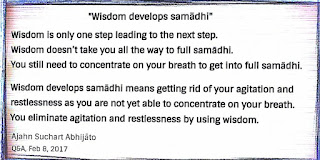
"Wisdom develops samādhi.”


QuestionLuangta Maha Boowa mentioned that there are two general ways in meditation to achieve stillness. One being ‘samādhi develops wisdom’, and the other is ‘wisdom develops samādhi’. Will Venerable Ajahn share the key points of 'wisdom develops samādhi' – using wisdom as a means to develop concentration?

Than Ajahn: When you sit to meditate and your mind keeps thinking about work or about the problems you have and when you cannot use a mantra or use your breath to calm it down, then, you need to attack the problem that keeps your mind away from being calm.

If you’re worried about your work, then you have to look at your work whether it’s permanent or not. No matter how well you do with your work, one day you’re gonna run out of work. Why should you worry? Don’t worry. One day you are going to lose it anyway. And you cannot tell when you’re going to lose your job today or tomorrow.

If you can accept the truth that your work is impermanent and there is nothing you can do about it to make it permanent, then you just forget about it and accept it. Once you accept that one day, sooner or later, you’re going to lose the job, you have no worry about your job. Your mind can then settle down and you can concentrate on your breath.

Wisdom is only one step leading to the next step. Wisdom doesn’t take you all the way to full samādhi. You still need to concentrate on your breath to get into full samādhi. Wisdom develops samādhi means getting rid of your agitation and restlessness as you are not yet able to concentrate on your breath. So you eliminate agitation and restlessness by using wisdom. Wisdom is to see things as aniccaṁ, dukkhaṁ, anattā (impermanent, subjected to suffering, and everything doesn’t belong to you). Sooner or later, one day, you’re going to lose them.

If you can see the truth, you will not worry about anything or anybody. Right now, you think that people and things are belonged to you and you want them to stay with you. When they show signs of not staying with you, you become worried and agitated. If you can see the truth and say, ‘They’re gonna leave you one day, sooner or later, and there’s nothing you can do to stop them from leaving you. It’s either they leave you or you leave them.’, then you’ll just stop worrying. Your mind can settle down. You can sit and concentrate on your breath.


By Ajahn Suchart Abhijāto