Labels

Thursday, 8 February 2018

Difference between Mahayana and Theravada.

Difference between Mahayana and Theravada.


"The question came up yesterday about the difference between Mahayana and Theravada.
And one of the important differences is how they view samsara.

     For the Mahayana, samsara is a place. And because it’s a place, if someone does a lot of good, develops a lot of good qualities, and then leaves that place, that person is leaving everybody else in a lurch—which is why they say that the truly generous and compassionate person wants to hang around, doesn’t want to leave samsara. In fact, they define samsara as being identical with nibbana if, they say, you look at it the right way.

That way the bodhisattva gets to be in samsara and nibbana at the same time.

     But the early teachings don’t treat samsara as a place. They treat it as a process.

    Samsara literally means “the wandering-on.”
It’s an activity. A process.
And you don’t just wander.
You create the worlds that you wander into.

     They involve feeding, and that’s addictive.

     So samsara is basically a bad habit, where you have an idea: You’d like to have this kind of pleasure, but no matter what it is, it’s going to cost a certain amount of suffering both for yourself and for other people in the worlds you create around that desire.

     This is why stopping the process, stopping the addictive habit, is actually good for yourself and for those others.

     And this is why samsara and nibbana can’t be the same thing, because samsara is an addiction, and you can’t stop the addiction—the stopping is nibbana—while still indulging in it."

- Ven. Thanissaro Bhikkhu

Full article here:
https://goo.gl/Tsf9k6

Shared by Ven Dhammavuddho

Saturday, 3 February 2018

The Buddhist Teachings on Samvega & Pasada -Thanissaro Bhikkhu

The Buddhist Teachings on Samvega & Pasada
-Thanissaro Bhikkhu


Think back for a moment on the story of the young Prince Siddhartha and his first encounters with aging, illness, death, and a wandering contemplative. It's one of the most accessible chapters in the Buddhist tradition, largely because of the direct, true-to-the-heart quality of the young prince's emotions. He saw aging, illness, and death as an absolute terror, and pinned all his hopes on the contemplative forest life as his only escape.

As Asvaghosa, the great Buddhist poet, depicts the story, the young prince had no lack of friends and family members who tried to talk him out of those perceptions, and Asvaghosa was wise enough to show their life-affirming advice in a very appealing light. Still, the prince realized that if he were to give in to their advice, he would be betraying his heart. Only by remaining true to his honest emotions was he able to embark on the path that led away from the ordinary values of his society and toward an unsurpassed Awakening into the Deathless.

This is hardly a life-affirming story in the ordinary sense of the term, but it does affirm something more important than life: the truth of the heart when it aspires to a happiness absolutely pure. The power of this aspiration depends on two emotions, called in Pali samvega and pasada.

Samvega was what the young Prince Siddhartha felt on his first exposure to aging, illness, and death. It's a hard word to translate because it covers such a complex range--at least three clusters of feelings at once:
-  the oppressive sense of shock, dismay, and alienation that come with realizing the futility and meaninglessness of life as it's normally lived;
- a chastening sense of one's own complacency and foolishness in having let oneself live so blindly;
- and an anxious sense of urgency in trying to find a way out of the meaningless cycle.

But more than providing a useful term, Buddhism also offers an effective strategy for dealing with the feelings behind it--feelings that our own culture finds threatening and handles very poorly. Ours, of course, is not the only culture threatened by feelings of samvega. In the Siddhartha story, the father's reaction to the young prince's discovery stands for the way most cultures try to deal with these feelings: He tried to convince the prince that his standards for happiness were impossibly high, at the same time trying to distract him with relationships and every sensual pleasure imaginable. To put it simply, the strategy was to get the prince to lower his aims and to find satisfaction in a happiness that was less than absolute and not especially pure.

Fortunately for us, however, the prince was born in a society that did provide support and respect for its dropouts. This was what gave him the opportunity to find a solution to the problem of samvega that did justice to the truths of his heart.

The first step in that solution is symbolized in the Siddhartha story by the prince's reaction to the fourth person he saw on his travels outside of the palace: the wandering forest contemplative. The emotion he felt at this point is termed pasada, another complex set of feelings usually translated as "clarity and serene confidence." It's what keeps samvega from turning into despair.

As the early Buddhist teachings freely admit, the predicament is that the cycle of birth, aging, and death is meaningless. They don't try to deny this fact and so don't ask us to be dishonest with ourselves or to close our eyes to reality. As one teacher has put it, the Buddhist recognition of the reality of suffering--so important that suffering is honored as the first noble truth--is a gift, in that it confirms our most sensitive and direct experience of things, an experience that many other traditions try to deny.

So the Buddhist attitude toward life cultivates samvega--a clear acceptance of the meaninglessness of the cycle of birth, aging, and death--and develops it into pasada: a confident path to the Deathless. That path includes not only time-proven guidance, but also a social institution that nurtures it and keeps it alive. These are all things that our society desperately needs.
http://www.accesstoinsight.org/lib/authors/thanissaro/affirming.html


Upcoming Events MONTH OF MARCH 2018

Upcoming Events for 2018
Month of March 2018


1st Mac, 2018 (Thur) (Cancelled)

Fellowship & Dhamma sharing with Bro Dr Wong Yin Onn 

Time 8.00 to 10.00 pm


3rd Mac, 2018 (Sat)

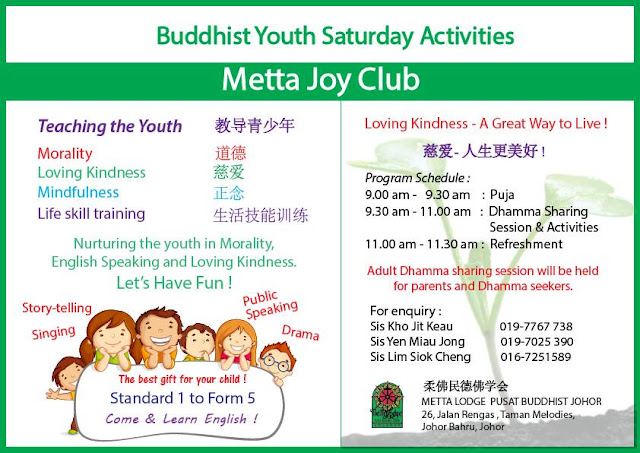
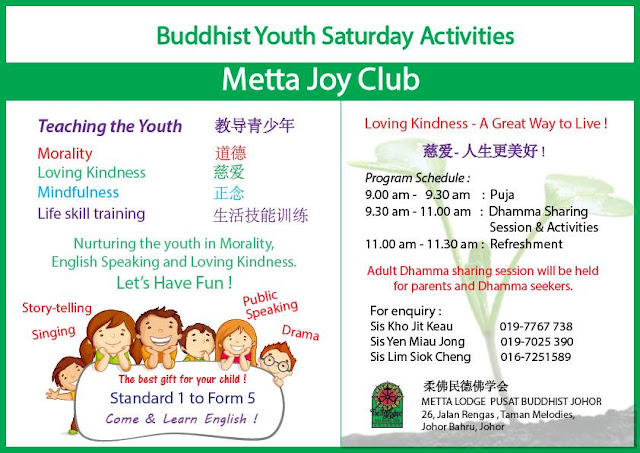
2018 Buddhist Youth Saturday Activities

Time: 9 am to 11.30 am


3rd Mac, 2018 (Sat)

Bro & sis
This CNY we cordially invite all members & devotees with their relatives & friends to join us on 3rd Mac. 2018 for a "Gong Xi Potluck gathering" at 8 pm to 10 pm for fellowship and to celebrate CNY Chap Luck Mei
Metta

https://goo.gl/UYZx8G


5th Mac, 2018 (Mon)

"Let's-Chant-Together"
with Bro Loh Piak Hong

Every 1st & 3rd Monday
Time: 8.00 to 9.30 pm

Buddhist researchers find that religious chanting reduces stress
https://goo.gl/BS6gSQ

Why Reciting Buddhist Sutras Out Loud is Important; Sutras Help Us Remain Mindful of the Teachings and Disengage the “Clinging” Conscious Mind
https://goo.gl/6KaeY2


6th Mac, 2018 (Tues)

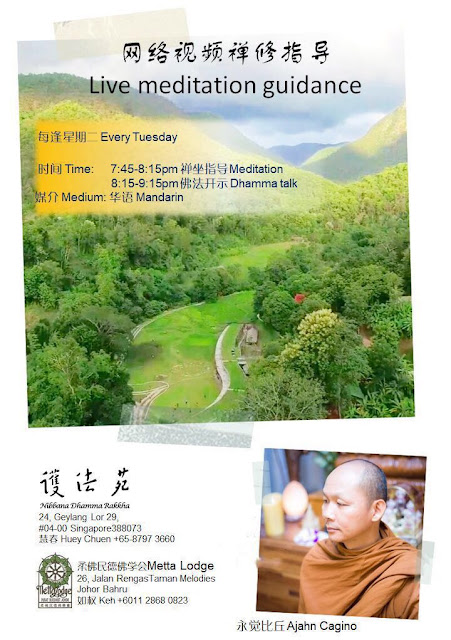
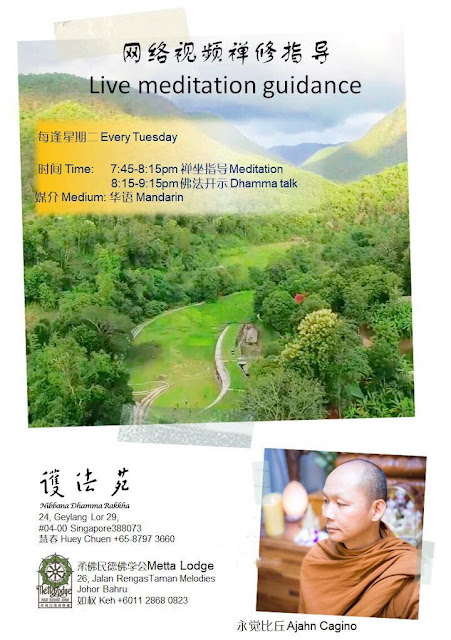
Live Streaming video Meditation Guidance

🕖 7:45 pm-9:15 pm

☸网络视频禅修指导
Ajahn Cagino 👤  永觉比丘
Mandarin 🗣华语

Enquiry 📱询问 :
如权  Bro Keh +601128680823


8th Mac, 2018 (Thur)

Fellowship & Dhamma sharing with Bro Dr Wong Yin Onn 

Time 8.00 to 10.00 pm


10th Mac, 2018 (Sat)

2018 Buddhist Youth Saturday Activities

Time: 9 am to 11.30 am


13th Mac, 2018 (Tues)

Live Streaming video Meditation Guidance

🕖 7:45 pm-9:15 pm

☸网络视频禅修指导
Ajahn Cagino 👤  永觉比丘
Mandarin 🗣华语

Enquiry 📱询问 :
如权  Bro Keh +601128680823


14th Mac, 2018 (Wed)

Pali / Buddhist Social Philosophy by Bro T C Lim

For details Bro TC Lim
Hp no: +60177455093


15th Mac, 2018 (Thur)

Fellowship & Dhamma sharing with Bro Dr Wong Yin Onn

8.00 pm to 10.00 pm


17th Mac, 2018 (Sat)

2018 Buddhist Youth Saturday Activities

Time: 9 am to 11.30 am


19th Mac, 2018 (Mon)

"Let's-Chant-Together"
with Bro Loh Piak Hong

Every 1st & 3rd Monday
Time: 8.00 to 9.30 pm

Buddhist researchers find that religious chanting reduces stress
https://goo.gl/BS6gSQ
Why Reciting Buddhist Sutras Out Loud is Important; Sutras Help Us Remain Mindful of the Teachings and Disengage the “Clinging” Conscious Mind
https://goo.gl/6KaeY2


20th Mac, 2018 (Tues)

Live Streaming video Meditation Guidance

🕖 7:45 pm-9:15 pm

☸网络视频禅修指导
Ajahn Cagino 👤  永觉比丘
Mandarin 🗣华语

Enquiry 📱询问 :
如权  Bro Keh +601128680823


21st Mac, 2018 (Wed)

Pali / Buddhist Social Philosophy by Bro T C Lim

For details Bro TC Lim
Hp no: +60177455093


22nd Mac, 2018 (Thur)

Fellowship & Dhamma sharing with Bro Dr Wong Yin Onn 

Time 8.00 to 10.00 pm


24th Mac, 2018 (Sat)

2018 Buddhist Youth Saturday Activities

Time: 9 am to 11.30 am


26th March - 2th April, 2018

Dhamma Tour by Bhante Aggacitta


27th Mac, 2018 (Tues)

Live Streaming video Meditation Guidance

🕖 7:45 pm-9:15 pm

☸网络视频禅修指导
Ajahn Cagino 👤  永觉比丘
Mandarin 🗣华语

Enquiry 📱询问 :
如权  Bro Keh +601128680823


31st Mac, 2018 (Sat)

2018 Buddhist Youth Saturday Activities

Time: 9 am to 11.30 am


Wednesday, 24 January 2018


"The Buddha never said that life is suffering. He said there is suffering in life. That was his first noble truth. And he identified what that suffering is, but he went on to say that there is a cause for suffering that you can abandon, and there is a path to the end of suffering that you can develop, so that you can reach the end of suffering, all of which can be found in life.

So life isn’t just suffering. It’s important to underline that point, because so many people misunderstand the Buddha’s attitude toward happiness and suffering. Just this last weekend, I heard someone saying that the Buddha’s basic teachings are that all things are inconstant and all things are suffering. That’s not the case, either. As the Buddha once said, if there were no pleasure in the five aggregates, we wouldn’t be attached to them. They do offer pleasure. And we need to understand the different kinds of pleasure they offer, so we can use that pleasure as a means to the highest happiness or the highest pleasure: Nibbana."

 ~ Ajahn Thanissaro.

Monday, 8 January 2018

Upcoming Event for 2018 - MONTH OF FEBRUARY

Upcoming Event for 2018
MONTH OF FEBRUARY


1st Feb, 2018 (Thur)

Fellowship & Dhamma sharing 
with Bro Dr Wong Yin Onn

Time 8.00 to 10.00 pm


3rd Feb, 2018 (Sat)

2018 Buddhist Youth Saturday Activities

Time: 9 am to 11.30 am


5th Feb, 2018 (Mon)

"Let's-Chant-Together"
with Bro Loh Piak Hong

Every 1st & 3rd Monday
Time: 8.00 to 9.30 pm

Buddhist researchers find that religious chanting reduces stress
https://goo.gl/BS6gSQ

Why Reciting Buddhist Sutras Out Loud is Important; Sutras Help Us Remain Mindful of the Teachings and Disengage the “Clinging” Conscious Mind
https://goo.gl/6KaeY2


6th Feb, 2018 (Tues)

Live Streaming video Meditation Guidance

 7:45 pm-9:15 pm
☸网络视频禅修指导

Ajahn Cagino   永觉比丘
Mandarin 华语

Enquiry 询问 :
如权  Bro Keh +601128680823


7th Feb, 2018 (Wed)

Pali / Buddhist Social Philosophy by Bro T C Lim

For details Bro TC Lim
Hp no: +60177455093


8th Feb, 2018 (Thur)

Fellowship & Dhamma sharing 
with Bro Dr Wong Yin Onn

Time 8.00 to 10.00 pm


10th Feb, 2018 (Sat)

2018 Buddhist Youth Saturday Activities  (Cancelled)

Time: 9 am to 11.30 am


13th Feb, 2018 (Tues)

Live Streaming video Meditation Guidance

 7:45 pm-9:15 pm
☸网络视频禅修指导

Ajahn Cagino   永觉比丘
Mandarin 华语

Enquiry 询问 :
如权  Bro Keh +601128680823


15th Feb, 2018 (Thur)

Fellowship & Dhamma sharing 
with Bro Dr Wong Yin Onn

Time 8.00 to 10.00 pm


16th Feb, 2018 (Fri)

"Gong Xi Fa Cai" 


17th Feb, 2018 (Sat)

2018 Buddhist Youth Saturday Activities (Cancelled)

Time: 9 am to 11.30 am


19th Feb, 2018 (Mon)

"Let's-Chant-Together"
with Bro Loh Piak Hong

Every 1st & 3rd Monday
Time: 8.00 to 9.30 pm

Buddhist researchers find that religious chanting reduces stress
https://goo.gl/BS6gSQ

Why Reciting Buddhist Sutras Out Loud is Important; Sutras Help Us Remain Mindful of the Teachings and Disengage the “Clinging” Conscious Mind
https://goo.gl/6KaeY2


20th Feb, 2018 (Tues)

Live Streaming video Meditation Guidance
 7:45 pm-9:15 pm
☸网络视频禅修指导

Ajahn Cagino   永觉比丘
Mandarin 华语

Enquiry 询问 :
如权  Bro Keh +601128680823


22nd Feb, 2018 (Thur)

Fellowship & Dhamma sharing 
with Bro Dr Wong Yin Onn

Time 8.00 to 10.00 pm


24th Feb, 2018 (Sat)

2018 Buddhist Youth Saturday Activities
Will have CNY gathering at Sis Keng Keng's house. Students, parents, teachers & volunteers are invited. 

Time: 9 am to 11.30 am


27th Feb, 2018 (Tues)

Live Streaming video Meditation Guidance
 7:45 pm-9:15 pm
☸网络视频禅修指导

Ajahn Cagino   永觉比丘
Mandarin 华语

Enquiry 询问 :
如权  Bro Keh +601128680823


28th Feb, 2018 (Wed)

Pali / Buddhist Social Philosophy by Bro T C Lim

For details Bro TC Lim
Hp no: +60177455093


Sunday, 7 January 2018

The Happiness of a Beautiful Mind - Sayalay Dīpaṅkara

The Happiness of a Beautiful Mind
喜滿禪心- 幸福來自美麗的心
燃燈禪師(Sayalay Dīpaṅkara)


Faith I (part 5)

Concentrate on the Breath

Peacefully note in-and-out breaths and relax. Slowly, slowly, you need to train to be happy. Once you don’t feel happy on the breathing, it is very difficult to get concentration.

So, don’t let go of the breath. Train slowly, day by day, every moment, every session, each and every minute.

ānāpānasati

Put the pleasant feeling on the breathing. Only then, you’ll like it. This feeling of liking it will make you concentrate. So if you feel comfortable concentrating on the object, then slowly, the mind gets happy with this object. The mind gets brighter in our mind.

The mind becomes very bright with concentration. After the mind becomes bright, you will feel a kind of bright light appearing, from the mind or outside of your body, or in front of your body, or on the face.

Actually, the bright light is not from the outside, not from an external window, etc. Don’t be confused by those things. All of the light comes from the concentrated mind, from our heart-base.

So, the happy and concentrated mind will produce the bright light. Different colours will appear.

That’s the first step of nimitta, the first sign of concentration.

So now, many meditators have this pleasant feeling. This is a very good sign. Because you feel comfortable, your concentration will improve. That’s the reason you see the light.

And then, you know the rest already. You have listened to talks about jhāna many times already about what absorption is. I’m also bored talking about this. So, you know that concentration improves because the nimitta appears in front of you.

When any colour appears, you don’t concentrate on the colour. That’s the first thing. You just concentrate continuously on the breathing. Don’t let go of the original object of the breath.

Stick continuously to the breathing. Then slowly, slowly, in the beginning, the colour will come and go. It doesn’t matter. Just keep concentrating on the breath. Sometimes, the breath can stop for a while. It doesn’t matter. Keep on concentrating on the breath.

Then slowly, slowly, the colour will change to white. When it changes to the white colour, it is the second level of nimitta.

Even when the colour changes to white, you still need to place the awareness on the breath. Don’t let go of the original object. At this time, you should not use energy on the breathing.

Sometimes, you want to make the breath clear. You are worried about losing the breath. At this time, the breath is very subtle. Because you don’t want to lose your concentration on the breath, you may use a lot of effort to breathe.

You want to make the breath very clear. Because of this, you push too hard and this can cause the movement of the breath to be very fast.

Because the breath movements become fast, the heartbeats and heart palpitations also become very fast. You can feel the connection of the movement of the breath and the beating of the heart. So easily, you will get tired, nervous and frustrated.

That’s the reason, when this happens, you need to relax and breathe. You can adjust the breathing. We purposely make it slower and breathe in and out very softly. So, when you breathe in this way, that is, when you breathe slowly, the breath will become soft and subtle again.

Pacing Heartbeat

The heartbeat can also be slowed down. And also, you’ll feel more peaceful. So we can adjust in this way. Even when the breathing is fast, make it slow. Sometimes, when the breathing is too slow, the breath will disappear. You need to breathe again. Slowly, you breathe again.

When you breathe, the subtle breath will appear again. Then concentrate again. After a while, the mind becomes peaceful. Then slowly, the nimitta becomes brighter and transparent, clearer and clearer. In the end, you need to have the clear nimitta.

The third level of nimitta is the clear nimitta, a clear light. The clear light is like a crystal ball, like a clear, bright star. If your nimitta can be like the crystal ball or like the transparent diamond, then that is the best nimitta.

If you cannot get the nimitta like the crystal ball or the transparent diamond, you need to practise until the nimitta is like a clear bright star. Only then, the nimitta will slowly come and stop. We need to concentrate on the breath until this clear light is stable. It needs to be stable for at least five or ten minutes.

Only then, the mind will slowly focus on the nimitta, the clear light. If you absorb or concentrate too early on the nimitta when it just comes and stops, it will slowly spread to the whole body.
After spreading to the whole body, you will feel comfortable in body and mind. But in the end, there is no longer an object. You don’t feel the nimitta in front of you.

That’s the reason that your absorption cannot last a long time. And that is not the true ānāpānā-jhāna. This happens because your light is spread to the whole body. You feel comfortable with the body. Your mind is so happy and peaceful with the body.

We need to remember that the body-object is not the ānāpāna object. That’s the reason why even though the body is comfortable and the mind is happy, we still need to stick to the meditation object of the nimitta. The nimitta cannot disappear or spread.

Look at the nimitta When It Is Clear

Also, don’t penetrate inside the nimitta. When you go inside the nimitta, the nimitta will also spread. Slowly, it can disappear and your mind is inside the feeling of the spreading of the nimitta. This is also not correct.

The feeling is very comfortable, very peaceful and boundless. But it is not yet the ānāpāna object.
That’s the reason why we should not go inside. The first step is to just relax and watch the nimitta. Watch slowly, like you are gazing at the full moon in the night. Your mind is so happy and so relaxed watching the moon.

It’s the same for nimitta. Relax and watch the nimitta slowly, with happiness. Then you look at it again. At the beginning, it’s a little bit unstable. It doesn’t matter. Keep on thinking about this object. Oh, this is nimitta, nimitta.

And then, continuously, the awareness for your mind is to know the object, i.e. nimitta nimitta. Then slowly, you feel happy and mind stick to the nimitta, that is called jhāna. Absorption starts! The mind becomes happy, and the body becomes lighter and lighter.

In the end, you don’t feel your hand, your body. Your body form is lost. There are only the mind, the happiness-mind and nimitta only. If you continue in this way for one or two hours, this is what we call absorption, first jhāna.

First jhāna means, vitakka (applying thought), vicāra (sustained thought), pīti (joy), sukha (happiness) and ekaggatā (one-pointedness of the mind). Five jhāna factors arise during the concentration of the mind on the nimitta.

Absorption

The arising of these jhāna factors, is what we call absorption. It can be said that during the time of the first jhāna, feeling also arises. This is what we call first jhāna.

If you can enter the first jhāna, it’s very good. After you got the experience of the first jhāna, you will know, how peaceful your concentrated mind is. At the same time, because you’re doing absorption on the wholesome object, every moment, every thought process can produce wholesome kamma, kusala kamma.

Don’t think, “Why do I have to stay with this object for one hour or two hours? I am wasting my time.” Don’t think in this way. Some people have that kind of thought.

Many people question staying with the nimitta object. Only concentrating on the nimitta, seems a waste of time. Some people feel that way.

It is not because we just want to force you to practise in this way. When you concentrate on the nimitta, you will know. The mind is so happy, so alert and it doesn’t have any akusala, unwholesome thoughts.

Unwholesome and wholesome thoughts cannot happen at the same time. So when thinking about dhamma object, this is dhamma object also. Because you are contemplating on the nimitta object and because of the concentrating and penetrating mind, you don’t have unwholesome thoughts.

Every thought process is producing wholesome kamma. In one minute, you are producing a lot of wholesome kamma. And at the same time, if you have happiness, then your kamma is higher than normal kusala kamma.

Among the mental components of consciousness, there is intention. We call this intention, cetanā. For good things, the intention must be with happiness, only then, your producing kamma becomes stronger and stronger.

So that’s the reason it is important to concentrate on the nimitta. When you are entering jhāna time, you can feel the mind is so quiet, so happy, so relaxed, without tension. At that time kusala kamma is produced.

After emerging from the absorption, you can feel the mind is so powerful. It is very alert and very bright. Whatever you want to concentrate on or penetrate into, you can easily penetrate and understand.

Sometimes before you penetrate, the insight is already there. You want to know something. After emerging from the jhāna, you concentrate. You think about that, and you directly find the answer in your mind. There is no need to use psychic power.

Automatically, in you mind, you know what you need to do. And the guidance is there. After practising jhāna many times, automatically in your mind, you will be guided and know this is wholesome or unwholesome.

That is produced by the Dhamma. So, it is very, very important for us to get concentration and wisdom for our kamma and for our way to the Nibbāna. Although you’re tired, please be patient, and put in more effort until you get jhāna. Also, don’t talk too much. When you talk, you cannot get jhāna. Remember that.


Friday, 22 December 2017

Essential Teachings By Ajahn Suchart Abhijāto


"It is useless for beginners to readily observe their minds as they're still attached to their senses: forms, sounds, odours, and flavours.”


Question:

“Should you only focus on one particular subject when meditating in order to contemplate things at all times?”

Than Ajahn:

“It's like doing your homework, which is for practising—to prepare yourself in advance. So when you're put to the test in a real situation, you'll see whether you can manage to see for what it is. For instance, when you get told off, can you just shrug it off? That is, are you able to discern that it was just a sound? To regard it as something that is bound to arise and pass away— impermanent, unsatisfactory, and not self.

There are three levels of wisdom (paññā). First is sutta-mayapaññā— a kind that arises from listening to the Dhamma just as you are at the moment. Second is cintā-maya-paññā—a kind that derives from contemplating regularly the Dhamma one has heard. For example, you might train yourself to get used to other people's criticism, so that you'll be unaffected when it actually happens.

Third is bhāvanā-maya-paññā—a kind that can be applied in real time. You can just smile and shrug it off when you get told off. You'll be able to get through it if you're keenly aware of the situation, that is, you can deal with and accept it as soon as something happens. You can readily put an end to your defilement as soon as it appears; then that is considered bhāvanā- maya-paññā.

At the level of wisdom that is derived from contemplation, cintā-maya-paññā, you'll lose it entirely when something happens. Your mind will be ruffled, forgetting entirely all of your effort and practice. So you will hit the roof when there's anger. This is a test for your level of wisdom, whether it is a kind that is derived from contemplation or practice. At the level of bhāvanā-maya-paññā, you'll be able to handle any type of situation as you'll readily discern its inherent nature of the three marks of existence. You'll know that it is something you need to let go and leave be.

You'll have to devise your own technique as to how to get to that level. For instance, you may treat it as children's mistake. You can't hold it against them; you can only let them be. You don't usually get upset by the things children do; for example, you don't mind their tantrums. Why can't you view your partner or spouse as a child? You can then leave them be if you see them in such light. You need to come up with your own way to handle these situations as you're all different.

These mental techniques, to do with the wisdom faculty, can be wide-ranging whereas concentration (samādhi) isn't. You just need to be aware of your meditation subject in order to get your mind concentrated. There are different levels of wisdom, ranging from coarse to intermediate and subtle. At a coarse level, it concerns the externals, which are forms, sounds, odours, flavours, and touch. At an intermediate level, it has to do with the five aggregates (khandhas): forms (rūpa), feelings (vedanā), memories (saññā), thoughts (saṅkhāra), and consciousness (viññāṇa). At a subtle level, it is to do with the mind.

You have to tune out all the externals before getting into the inner level. Renunciants, who are able to shut out the externals—turning away from forms, sounds, odours, flavours, and touch as well as wealth and possessions, can focus on the five khandhas. Contemplation of forms, feelings, memories, thoughts, and consciousness to the level of detachment will allow them to access their mental basis (citta) where they'll find the subtlest forms of defilements.

You won't be able to get rid of your defilements if you're a beginner. It is useless for beginners to readily observe their minds as they're still attached to their senses: forms, sounds, odours, and flavours. You'll be fooled by your own defilements to do things, such as buying drinks and going to places. Defilements are keen on this type of mind; they are still very much in control of the mind as it isn't yet calm.”

“Essential Teachings”

By Ajahn Suchart Abhijāto