Labels

Wednesday, 13 April 2022

Songkran Festival

Songkran Festival


I would like to wish all brothers and sisters in the Dhamma a happy Songkran 2022. May all of us receive the baramee of the Bodhisattas and flourish both in the Dhamma and in our worldly life, so that we are able to support the Buddha Sasana. 

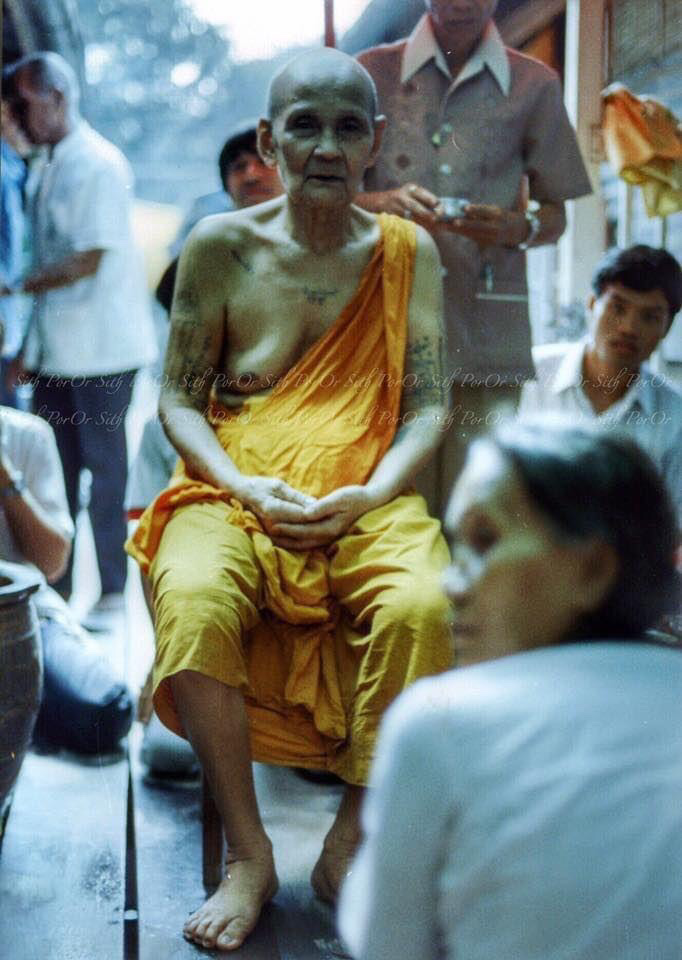
This photo is of Luang Pu’s looksits preparing to bathe him. In the earlier days, Luang Pu had metta and allowed his disciples to bathe his whole body instead of just the hands, as we customarily do for our elders today. 

Regarding the bathing of Luang Pu, when Luang Pu got up from his seat to bathe in the water, people would bring their hands to touch the water that remained on the wooden floor and then sprinkle on their head. Everyone had a lot of faith in Luang Pu. 

But all these are merely customs. To show real respect to Luang Pu, it is important for us to pawana and suat mon. 

Photo cr. Sith Poror

Songkran Festival

https://en.wikipedia.org/wiki/Songkran_(Thailand)


Tuesday, 12 April 2022

DHAMMA: LIGHT OUT OF DARKNESS by Acharya S.N. GOENKA [ANNUAL MEETING: Dhamma Thali, India January 1, 1993 OPENING ADDRESS]

DHAMMA: LIGHT OUT OF DARKNESS 
by Acharya S.N. GOENKA
[ANNUAL MEETING: Dhamma Thali, India January 1, 1993 OPENING ADDRESS]


My dear Vipassana meditators:


As every year, we have again assembled to review whatever we have done, to find whether there have been any defects, and to understand how to eradicate those defects. We review whatever has been attained, not to develop ego, but with a balanced understanding; and we see how this success can be increased. 

Last, we meet to make practical plans for the future. 

This meeting should not be like other ordinary social gatherings where people debate, pass resolutions, and forget all about it. No! The practical aspect of Dhamma is of utmost importance to us. 

That is why, before starting this annual meeting, most of you participated in a long course, and after the meeting many others of you will do so. This is a good sign. You are giving more importance to the practice, and discussions are based on this foundation. This healthy tradition should be maintained in the future; otherwise our service to suffering humanity will not be successful.

There is suffering, it cannot be denied. All around there is darkness and suffering. People are miserable, and they are groping about in the darkness, not knowing how to come out of misery. 

Throughout the world in the name of different religions there are conflicts, struggles and wars. 

Unfortunately this country, which takes pride in being the land of origin of the pure Dhamma, is also suffering from such conflicts. When the darkness is very deep, it invites light. The way to come out of misery arises from the deepest misery.

It is good that the light has come and that the way is becoming clearer. In the last years a beginning has been made. People have started examining the technique and have found that it gives results. Intelligent, wise people—intellectuals from different communities, sects, countries and traditions—have come to the Ganges of Vipassana, taken a dip and found that it is truly refreshing and fruitful.

Every step on the path has to be examined at the intellectual level: Is it rational, pragmatic and reasonable? 

And then at the actual level of practice: Is it fruitful, is it giving benefit here and now? The path leads you to the goal where you become totally liberated, an arahant. That is good, but what result does it give now? 

It is a long path to reach the final goal of becoming an arahant; is one coming out of misery now? 

Everyone who walks on the path finds it is fruitful. Of course the fruits differ from person to person according to one’s own past accumulations and according to how one works now, but the path is fruitful.

Vipassana cannot be spread by discussions, nor merely by writing articles, giving lectures or trying to prove at the intellectual level that ours is the best. No, it won’t help. It is only by the actual results. There is suffering all around, let people know that there is a way out. And you can do that only by your own way of life. If people find that there is a change for the better in you, that you have attained something which you were missing, they will be attracted. This is how Dhamma will spread.

Just as every town must have schools, colleges, hospitals and gymnasiums, similarly Vipassana will become a necessity throughout the world. There must be some place where mental training is given to control and purify the mind, and there should be no fear that attending these courses will convert people to a particular religion or sect. It would be a great danger to the spread of Dhamma if Vipassana courses converted people to a particular organized religion. It would no longer be Vipassana. Going to a school, hospital or gymnasium one is not converted from one religion to another, and so it is going to a Vipassana course. Vipassana is free from sectarianism. That must become clearer in the minds of those who want to teach it, and clear in the minds of those who want to practise it. If this is missing, then everything will be missing.

The purity of the path is to keep it universal. It has been universal and it should remain universal in the future. It is helpful to one and all. Anyone and everyone who practises is bound to benefit. This is a very important message that should reach the world. And it is possible to spread this message when you yourself show that you have not been converted from one religion to another, but the impurities that you had in the mind are being eradicated by this technique and you have started coming out of your misery. 

This will be the best example of the value of Dhamma.

Another important thing that we have started doing is making the theoretical aspect of Dhamma more widely available. Because the practice was lost in many countries, the meaning of some of the Buddha’s words was not clear and the interpretations were wrong. It is important for a meditator to understand the theoretical aspect of Dhamma in order to see whether what we are practising is correct.

The theoretical aspect of Dhamma will support the practice of Dhamma. But understand that this should not become our main aim. Out of overenthusiasm if we start giving too much importance to the theoretical aspect of Dhamma, and forget the practical part, we will miss everything. This practical aspect of Dhamma is of utmost importance. Keeping this in mind, we have to research the theoretical aspect of Dhamma.

May all of you become flag-bearers of Dhamma, torch-bearers of Dhamma. Take the message of Dhamma throughout the world to help people to come out of their misery.

Generate nothing but compassion, love and goodwill to help more and more people to come out of their misery. We have nothing to do with these organized religions. We have nothing to do with this sectarianism. The suffering, the malady, is universal, and here is a remedy which is also universal. See that it remains universal, and helps people to come out of their misery.

May more and more people come in contact with Dhamma. May more and more people start coming out of their misery. May more and more people start experiencing real peace, real harmony.


 Bhavatu sabba maṅgalaṃ


The Skillful Teachings of Thanissaro Bhikkhu.

The Skillful Teachings of Thanissaro Bhikkhu.


“The chants we do in the evening, before the meditation, are meant to put you in the right frame of mind to do the meditation, pointing out skillful ways of thinking. Whether we're contemplating the body; issues of aging, illness, death, and karma; thoughts of goodwill; reflection on the nature of the world: All of these thoughts are designed to remind you of how important it is to meditate. They also remind you of your motivation for meditation. Whether you're here to find something solid in the midst of the world, or as an expression of goodwill, it's useful to remember — each time you sit down to meditate or do walking meditation — why you're doing it, the importance of what you're doing, so that you do it with an attitude of proper respect and attention. In other words, you don't just go through the motions. You don't treat it casually.

This is important work we're doing here — a point that's easy to forget. So we keep reminding ourselves, because thinking like this is an integral part of the meditation. People often believe that we're trying to learn how not to think, or trying to get the mind away from its conditioning simply by stopping any language from going through the mind. But the Buddha's instructions on meditation involve a lot of thinking, training the mind to think in skillful ways. But unlike psychotherapy — which tries to trace your thoughts back to their origins, where they're coming from in time — he focuses on where they're going, where they lead. Do they lead you where you want to go? And he gives some recommendations on ways of thinking that really help you go in the right direction.

As you carry through with his ways of thinking, part of your mind is going to rebel. For example, when you develop thoughts of goodwill there may be a little voice in the back of the mind saying, "Well, I don't really feel goodwill for these people." Or, "I don't give a damn about where my thoughts are leading, I want to think about //this//." Don't assume that the purpose of these exercises in directed thinking is to smother up those other thoughts, or to pretend they don't exist. Actually, the purpose of the exercises is to dig the problems up, bring them out into the open. If the question of how you think about the beings in the world isn't brought up, you can sail merrily along with all sorts of mixed motives, all sorts of mixed attitudes, not really being aware of what you're doing, or of how your attitudes are coming out in your actions.

Or if you have that apathetic feeling, "It doesn't really matter what I do, so I might as well just do what I like" — it's good to know that it's there. Then you can deal with it." 


~ Thanissaro Bhikkhu "Resistance", Meditations3, 


https://www.dhammatalks.org/Archive/Writings/CrossIndexed/Published/Meditations3/041025%20M3%20Resistance.pdf?fbclid=IwAR05AqmXrLK1PEe_OvYA4Y4m2BlgNrSwFcBM0hEe9C0bK5qsRFbI8NZ3fhk


Sunday, 10 April 2022

The Teachings of Ajahn Suchart.

The Teachings of Ajahn Suchart.

27 October 2024

Question:  After samatha meditation, does insight arise automatically?

Tan Ajahn:  No. Samatha only gives you peace, calm, a sense of well-being, and a sense of contentment, but no insight whatsoever. You can only have insight when you point your mind towards an object that you have dukkha with, you have problems with.

A good example is having problems with your body. You have to point your mind towards the body and study the nature of the body until you clearly see the three characteristics inherent in the body; then you will be able to eliminate your desire, which is the cause of your suffering. 

This is called insight, being able to see the three characteristics of the body and to see your desire as the cause of your suffering.

Therefore, if you haven’t seen the three characteristics of your body, then you must study, you must investigate. Ask yourself: is your body permanent or not permanent? Does the body belong to you or not? 

Can you keep the body with you all the time or not? Does the body give you happiness or give you suffering? When the body gets sick, do you feel happy or do you feel sad? When the body gets old, do you feel good or do you feel bad? When your body dies, do you feel good or do you feel bad? You have to ask this. What makes you feel bad when the body dies?

Because of your desire, you want your body to last forever, you don’t want the body to leave you, but is that possible or not? So, this is what you have to contemplate, to investigate, to ask yourself, and to think about analytically. This is what we call vimaṁsā. When you find the cause, then you can eliminate that cause.

Like when a patient who comes to see a doctor is sick and wants to get well, the doctor will have to figure out the cause of the sickness. If the doctor cannot figure out the cause of the sickness, the doctor cannot cure the disease. Once the doctor finds out the cause, s/he must then find the medicine that can cure this cause. If s/he cannot find the medicine, then s/he cannot cure this disease. 

This is the way the practice of Dhamma works – insight happens after you analyse your problems. And your problem is that you don’t see the three characteristics in the things that you are attached to, in the things that make you unhappy, such as the body. 

When you can see the body as having the three characteristics, then you know that you cannot cling to your body because the body will not stay with you all the time. If you cling, it follows that when the body leaves you, you will become very sad, very unhappy. But when you let the body go and accept the truth that the body is impermanent, that it doesn’t belong to you, then when the body leaves you, you won’t feel any suffering.


“Dhamma for the Asking, Dec 9, 2014”

By Ajahn Suchart Abhijāto

www.phrasuchart.com

Latest Dhamma talks on Youtube: 

https://www.youtube.com/channel/UCi_BnRZmNgECsJGS31F495g


Funeral of Luang Pu Doo

Funeral of Luang Pu Doo


The night before the cremation of Luang Pu Doo at Wat Sakae, there was a strange white light around the portrait of Luang Pu which showed up in photos taken. Unusual phenomena took place when Luang Pu passed away as well. 

Even though he had been dead for 48 hours, the doctor who came to examine his body was surprised that his body had not become rigid yet. His wrist could still be bent easily and wasn’t stiff. There wasn’t any signs of the body turning purple or other signs of discoloration that usually happens after people die. 

Before the day of the cremation of Luang Pu a year later, a disciple couldn’t resist and went to press on Luang Pu’s calf. He felt that it was soft and not firm or hard. 

However, no matter how sacred Luang Pu Doo was, even things didn’t go according to his wishes. Luang Pu actually told his disciples to cremate him within 7 days of his death. But because everyone wanted to prepare for a dignified ceremony and also give others a chance to pay respects to his body, it was delayed for around a year. 

Therefore all things have to go according to cause and effect, even a great Bodhisatta like Luang Pu couldn’t get his wish fulfilled.


Cr. Sith Poror


The Teaching of Ajahn Suchart.

The Teaching of Ajahn Suchart.

21 December 2023

Layperson:  There is a fear of war. Many people are dying. 

Than Ajahn:  You have to look at the big picture that everybody dies sooner or later. For every birth, there is a death following. So you have to look at the big picture, then you can accept everything that is happening. What can you do? Can you stop the war? 

Let them fight. 

When they get tired, they will stop. If everybody follows the Buddha’s teachings, there will be no war. 

The Buddha says, ’mettā.’ (loving kindness).

Layperson:  There is no war in the spiritual world because spiritual beings don’t have to fight for food, for example.

Than Ajahn:  Yeah, because there is nothing to fight for in the spiritual world. No gold, no silver, no oil to fight for.

Layperson:  I cried because many people die due to the war that is happening.

Than Ajahn:  You didn’t cry when people die in the hospital in your country. Many people die every day in your country, but you never cry for them. So, if you cry because there are many people die during the war, then you should cry for everybody every day because there are many people who are dying every day. So you don’t have upekkhā. If you have upekkhā, then you don’t cry. 

Layperson:  The world is very cruel.

Than Ajahn:  Yes, look at how many million animals like cows, chickens, and pigs are being killed every day. This is what the Buddha mean when he said that birth is suffering: when there is birth, there is ageing, sickness and death. So stop birth by practising meditation.  

Layperson 2:  We are not too far away from the war. I feel very grateful for your talks because I am also scared, and when I listen to Dhamma talks, it helps me to become a little bit calmer. 

The war is about 1100km from our village and if we go to Berlin, it’s only about 700km away from the war. We expect many refugees will be arriving, and so after this meeting, I will spend some money (give dāna) for the refugees and see if we can give them what they need. 

Than Ajahn:  Good. This is the time to do dāna. 

Layperson 2:  I work as a teaching assistant in a school, and I met with a girl from Ukraine, and seeing her was just heart breaking. She still has families and relatives in Ukraine. I am glad that I can connect with some of them and help them.

Than Ajahn:  Yeah. You just have to accept the truth, right? There are things that we can’t do anything about. 

Even our own life, we can’t do anything about it. If it’s time for the body to die, we can’t stop it. 

But if you accept it, then your mind won’t have any fear or suffering. 

This is a good Dhamma, it’s a good contemplation: contemplation of death. This reminds us that eventually, we will also have to die. 

Layperson 2:  I don’t want to survive a nuclear war, I’d rather die.

Than Ajahn:  You can’t choose though. That’s the problem. 

Layperson 2:  Yes, I know.  I am also still checking on my own translation work. I’ve translated two of your books and all these works also help me to stay calm under this circumstances. 

Than Ajahn:  Yeah, try to stay calm because that’s the only thing you can do. Once you are calm, then nothing can hurt you. The body is not us. The body is our servant. And we can’t protect our body all the time. But we can protect our mind all the time with Dhamma, with mindfulness and wisdom. So try to keep being mindful and keep thinking about the three characteristics of existence. 


“Dhamma in English, Mar 01, 2022”

- - - - - - - - 

Laypeople:  A few hours ago there was a terrorists attack in Paris and such attacks are happening in many other countries as well. I would like to know from a Buddhist perspective, how we can respond in such circumstances.

Than Ajahn:  You have to look at the total picture. 

There are many other people who also died but not from terror attacks. Death from terror attack is very small. For example, three people died yesterday. But many die from natural causes: thousands or tens or hundreds of thousands every day but it never gets into the news, that’s all. 

So you have to look at the big picture. Don’t look at the news only. News only highlights some of the events and it may look terrible, but the news does not really report how many people have died in the world. How many people have died in Africa from famine and sickness? Many people die every day. 

We ourselves make it look worse. Just let it be natural. 

Two policemen died, one terrorist died. 

Just three people died. Compare this to the twenty thousand that died today. What then is the difference of another three people? We tend to react to something that is magnified, when such incident is just as normal as apple pie. 

People die every day. People die from automobile accidents more than they die from being shot down by a terrorist.

Laypeople:  I mean this violence and terror are committed freely in the name of religion.

Than Ajahn:  People die in the name of religion, country and race or are killed for various reasons. If you were to look at the big picture, people will still die anyway from natural or unnatural causes. We all die anyway. 

We try to magnify something normal to become abnormal. 

Instead of leaving it naturally, we make it worst by our reactions. For example: ‘If they kill three of us, we will bomb 300 of them.’

I do not wish to go into the causes that resulted in this current situation. There are causes that lead people into such actions. We only look on our side and not on the other side who is hurt by our actions. We choose not to see by our justification for killing them. So they also have their justifications for killing us. 

They say, “Since you kill us, we also have the right to kill you.” That is why the Buddha said that:  Hatred can never be appeased by hatred. 

Hatred can only be appeased by love and forgiveness.

So we just have to forgive them and look at it as a natural thing. People are born and die but whatever causes this doesn’t matter. We all die anyway when the time comes for us to die. 

Seeing in this way will prevent us from taking revenge or creating more bad actions.

Laypeople:  So, we have to see the big picture and must not let this incident overshadow it.

Than Ajahn:  Yes. Everybody dies. How many people are there in France? Eighty million? 

They are all going to die. How many people are there in Thailand? Seventy million? They too are all going to die. So what’s the big deal of 3 people dying yesterday or today? There are more people dying of drinking alcohol.

Laypeople:  But it is how they die that matters, right?

Than Ajahn:  That’s what I mean; you look from the wrong perspective. I see from the perspective of just death and not how they die. 

If you choose to see how they die, you can get angry. 

But if you choose to see death as the end result of life, regardless of how we die we are all going to die. So why should you do anything about it? If a person dies, let him die. 

Instead of seeing things in this way, we take revenge. If you try to kill me, I will kill your father and his son will come and kill you. Back and forth and it’s never ending. So instead of living together peacefully, you live in hatred and violence.

If you contemplate on the nature of the body, you will see that death is just part of the body’s nature. 

Regardless of how it dies, it doesn’t really matter. 

Maybe, there are more people killed by their own loved ones, such as husband and wife. I suppose if you are to look at the statistics, you are more likely to be killed by your spouse than terrorists. You make your wife angry and she can kill you! 

So, in Buddhism, it teaches us to just be ready to die. 

Just accept it. Who dies or not has no significance in Buddhism. What dies isn’t us. 

The body is like our servant, a robot. Right now, we are developing a robot to do things for us. If the robot you built ‘dies’, would you get mad or angry? Would you get sad? It’s OK! 

The body is a just biological robot and not a mechanical one. That’s all it is. It is not you or me. It’s just your robot or my robot. So why get so upset when your robot dies? You just get a new one. Reborn again, you get a new robot.

Like vines that wrap themselves round sandal trees,

People who keep company with holy ones

Become, in their turn, holy.

And like kusha grass left in a fetid marsh,

People who keep company with evil beings

Will in their turn be evil.

So keep the company of holy beings

And from bad teachers strive to keep your distance.

— Longchenpa


“Dhamma in English, April 21, 2017.”

By Ajahn Suchart Abhijāto

www.phrasuchart.com

YouTube:  Dhamma in English.

https://www.youtube.com/channel/UCi_BnRZmNgECsJGS31F495g

Saturday, 9 April 2022

ALL DHAMMAS COME DOWN TO THE HEART

 ALL DHAMMAS COME DOWN TO THE HEART


"The Dhamma, you know, can be said to be broad, but can also be said to be narrow because it all comes down to one point – the heart. The heart is what experiences both good and evil. The heart is what does good and evil, and the results – good and bad, pleasant and painful – all come down to the heart. This is why the Buddha taught,

~

mano pubbaçgama dhammã

~

“The heart comes first,” the heart is chief, the heart is the principle factor. All dhammas come down to the heart. They don’t lie anywhere else. So this is where we should straighten things out. Get so that the heart is shining and bright.

~

The body is something filled with suffering and discontent, but the heart can be filled with happiness. This is where they differ. The body is pitch dark in line with the crudeness of its elements, but the heart can be dazzlingly bright through the power of the Dhamma. This is where the heart becomes a ‘Dhamma element’, when it’s fully bright within itself because absolutely nothing is left to obscure it.

~

So. Get rid of its stains. Wash them away. It will then be fully bright in a way that blankets the cosmos. 

This one heart is the only thing with a power this great. It blankets the whole cosmos, with no sense of too near or too far. It’s always just right through its own gentleness, its own brightness. So gentle that there’s no word to describe it, so bright that it blankets the cosmos in radiance by day and by night. This is called ‘ãloko udapãdi:’ The dawning of light within the heart.

~

Everything within us, everything in the world, comes down to this one heart. The important essence lies here and nowhere else. So make an effort to free this heart, to straighten it out in line with your abilities – or to the utmost of your abilities. You’ll then come to possess a rewarding treasure within the heart – the great, extremely rewarding treasure of the heart’s own purity."


❀❀❀

A Life of Inner Quality

Ajaan Mahã Boowa Ñãõasampanno

Translated by Thãnissaro Bhikkhu

~

http://www.forestdhamma.org/ebooks/english/pdf/A_Life_of_Inner_Quality.pdf